NREL's New Robots Scrutinize Solar Cells
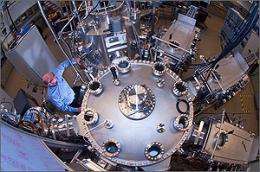
(PhysOrg.com) -- The race to build a better solar cell is looping through the National Renewable Energy Laboratory where new robots are fabricating thin-film cells and analyzing glitches faster and with more precision than ever before.
How much faster? The robot working with silicon can build a semi-conductor on a six-inch-square plate of glass, plastic or flexible metal in about 35 minutes. It pivots and dishes like a point guard, sifts like a master chef, analyzes like a forensics expert and does it all while maintaining a vacuum seal on the entire process.
Simultaneously, it can analyze glitches and measure light absorption, while preparing the next half-dozen plates.
"It used to require us to go to, let's see, one … two … three … four … five labs to do the same thing," NREL scientist Ingrid Repins said.
And the silicon robot is one of just six such robots in six bays in NREL's Process Development and Integration Laboratory (PDIL), the place where industry is starting to turn to test their newest cells.
The bay that uses silicon as the semiconductor for solar cells was the first to begin operating and holds all the speed and performance records so far.
Next to go on line were bays devoted to stand-alone characterization, integrated characterization and atmospheric processing.
The latest bay to start operating is the one that uses Copper Indium Gallium diSelenide (CIGS) as the semi-conductor in solar cells. Still being installed is the final bay, which will work with cadmium-telluride cells.
In each bay, the central transfer robot is the hub, operating like a jukebox, delivering the plate to chambers that can deposit micron-thin layers of chemicals to build the semi-conductors, or test and measure the growth of the crystals that make the cells.
Solar Companies Can Test Samples, Use Their Own Tools
Solar companies will be able to hook their own tools to the central robot and discover how their newest formulas compare. A vacuum transport tool can take the sample plates to the different, yet compatible, bays to see how an unusual process might bolster the power of a cell.
Solar companies know how to make solar cells in a dozen different ways — as shingles, as windows, as fanny packs, as attachments to space vehicles — but they constantly are searching for ways to lower costs and gain efficiency.
"The whole goal is dollars per watt," Repins said.
President Obama has set a goal that solar energy become cost-competitive with coal and other fossil fuels by 2015.
"The gap is closing," Repins said. "We're getting closer. Already, First Solar is saying that for a large installation in southern California where electricity prices are relatively high, they are at parity now."
NREL scientists are hoping their PDIL facility will help industry close that gap sooner by bringing lab-like precision to industrial-type processes.
R&D Agreement with Climax Molybdenum
For example, NREL last month signed a cooperative agreement with Climax Molybdenum of Empire, Colorado, which wants the lab to help test a new process of building sodium into the molybdenum layer of solar cells and then sputtering that sodium onto the CIGS layer.
Traditionally, the sodium leaches into the solar cell from the glass plate, but that's not really a good way to do it because there is little quality-control in the glass-making procedure, Repins said.
For Climax Molybdenum, NREL will measure how well the company uses its tools to sputter the sodium from the molybdenum into the semiconductor, and how precisely it gets there.
"The assumption is that there will be more control getting sodium from the molybdenum than from the glass," she said.
If it's perfected, that's another step toward lowering the cost of solar energy.
Solar cells are like mini-batteries, with three layers of thin films representing the two terminals and the current in between. The three layers together are about one-seventh the thickness of a human hair.
The middle layer, which absorbs the sun's rays and acts as the current, is where the action is.
Some companies are sure CIGS will emerge as the best semi-conductor; others pin their hopes on cadmium telluride or the venerable silicon.
World Record; Now, How to Transfer It to Industry?
NREL two years ago set a world record for the efficiency of a thin-film solar cell, when its CIGS cell was able to convert to electricity 20 percent of the energy it absorbed from the sun. The record for a cadmium-telluride cell is 16.8 percent.
Today's roof-top solar panels typically are able to convert about 10 or 11 percent of the sun's energy, although there is a large range of between 8 percent and 20 percent efficiency.
Now, the challenge is to be able to layer a film of CIGS on commercial-sized solar panels without dropping down much from that 20 percent pinnacle.
Repins envisions that with the 20-percent formula as the template, in a few years companies can roll out kilometer-long sheets of solar cells and still achieve 16 percent efficiency — even as they strive to use the least expensive materials and put an emphasis on speed.
The difference between 11 percent and 16 percent is huge, because the cost savings multiply on each other, she said.
It means solar panels can be smaller and generate the same amount of energy, and that means lower materials costs, lower factory costs and lower installation costs.
Getting there — to reach a 16 percent efficiency level while making miles of thin-film cells a day — is the goal of the one-of-a-kind testing facility at NREL.
Sensors Can Read How Cells Are Growing
In the brightly lit PDIL on NREL's campus in Golden, Colorado, scientists simulate the processes industry will use. The goal is to answer previously unanswerable research questions, while controlling and characterizing the surfaces of the cells, developing new techniques and devising new structures.
"The old way we used to do things, each layer required a different machine," Repins said. "We would take out the substrate and put it into another machine." Each time the plate was removed, humidity could weaken the cell and there were issues of cleanliness and contamination.
Now, the goal is a process that is seamless, spotless and transparent.
In each bay, lasers shine light on the cells and sensors can read how the cells are growing.
PDIL's ultra-high-vacuum environment lets researchers study the role of impurities and defects, said NREL senior scientist Miguel Contreras. "We can do basic R&D at the material level. We can also develop analytical tools on site to test new plates and to test for quality."
What combination of heat, metals, chemicals and time can grow the crystals to form the perfect cell? At one step excess copper is needed; at another, just enough sodium needs to leach into the middle layer.
The goal of all the depositing, analyzing and measuring is to be able to tell industrial partners why the cell isn't growing as well as it should and what can be done about it.
"We do a post-mortem," Repins said. For example, "'We got 14 percent efficiency with these materials, why are you only getting 12 percent?'"
Companies want to know how they can turn the knobs to get the ultimate performance out of the cells. "This helps take that step toward telling them what to do in the process," she said. "We can tell them, 'this is what the sodium content should look like,' for example. It's one more clue."
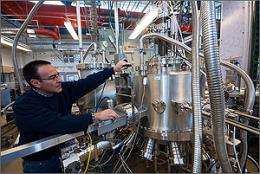
Bill Nemeth, a scientist in NREL's PDIL facility, says he doesn't have to wear a lab coat at work "because everything revolves around maintaining a vacuum," and the researchers never come into direct contact with semi-conductors.
"We have the capability that no other place can duplicate," Nemeth added. "This encourages cooperation."
Goal: Fewer Impurities, Better Efficiency, Better Yield
The CIGS PDIL tool also was designed to do basic research and development on materials. The ultra-high vacuum environment allows scientists to study the role of impurities and defects, as well as what happens when the metals are deposited at the fast rate demanded by industry. That knowledge will help researchers develop analytical tools for quality control and to test for new plate materials.
"The system was designed to allow us to do things we could not do before, such as get a better look at impurities and the quality of materials, the different layers that compose the CIGS cell," Contreras said. "It's helping us understand better what is limiting our efficiencies, as well as learning how to improve industrial productivity.
"This gives us more insight into the physics and materials science of CIGS-based solar cells," Contreras added. The fundamental research will "lead to better solar cell efficiency, process control, improved uniformity and improved yield."
Provided by National Renewable Energy Laboratory


