Four preventable risk factors reduce life expectancy in US and lead to health disparities
March 23, 2010
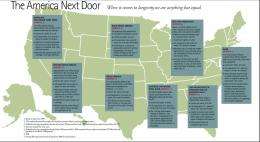
Harvard Public Health Review chart that summarizes the Eight Americas.
A new study led by researchers from the Harvard School of Public Health (HSPH) in collaboration with researchers from the Institute for Health Metrics and Evaluation at the University of Washington estimates that smoking, high blood pressure, elevated blood glucose and overweight and obesity currently reduce life expectancy in the U.S. by 4.9 years in men and 4.1 years in women. It is the first study to look at the effects of those four preventable risk factors on life expectancy in the whole nation.
The researchers also estimated the effects of these risk factors on eight subgroups of the U.S. population, called the "Eight Americas." The Eight Americas are defined by race, county location and the socioeconomic features of each county. They found that these four risk factors account for a substantial proportion of differentials in life expectancy among these groups. Southern rural blacks had the largest reduction in life expectancy due to these risk factors (6.7 years for men and 5.7 years for women) and Asians the smallest (4.1 years for men and 3.6 years for women).
The study appears in the March 23, 2010 issue of the open-access journal PLoS Medicine.
"This study demonstrates the potential of disease prevention to not only improve health outcomes in the entire nation but also to reduce the enormous disparities in life expectancy that we see in the U.S.," said Majid Ezzati, associate professor of international health at HSPH and senior author of the study.
Smoking, high blood pressure, elevated blood glucose and obesity are responsible for hundreds of thousands of deaths from chronic diseases such as cardiovascular diseases, cancers and diabetes, in the U.S. each year. By studying how these risk factors affect mortality and life expectancy, public health officials can better address how to improve the nation's health and to reduce health disparities.
For their study, the researchers used 2005 data from the National Center for Health Statistics, the National Health and Nutrition Examination Survey, the Behavioral Risk Factor Surveillance System, and an extensive review of epidemiologic studies on the effects of these factors. They estimated the number of deaths that would have been prevented in 2005 if exposure to the four risk factors had been reduced to their optimal levels or commonly used guidelines. They also assessed the benefits for life expectancy, a measure of longevity.
The Eight Americas were defined by the authors in an earlier study as Asians; Northland low-income rural whites; middle America; low-income whites in Appalachia and Mississippi Valley; Western Native Americans; Black middle America; high-risk urban blacks and Southern low-income rural blacks.
The researchers found that a person's ethnicity and where they live is a predictor of life expectancy and how healthy a person is. Some of the findings include:
- Asian American men and women had the lowest body mass index (BMI), blood glucose levels and prevalence of smoking
- Blacks, especially those in the rural South, had the highest blood pressure
- Whites had the lowest blood pressure
- Western Native American men and Southern low-income rural black women had the highest BMI
- Western Native American and low-income whites in the Appalachia and Mississippi Valley had the highest prevalence of smoking
Below is the number of years that would be gained in life expectancy in the U.S. if each individual risk factor was reduced to its optimal level:
- Blood pressure: 1.5 years (men), 1.6 years (women)
- Obesity (measured by body mass index): 1.3 years (men), 1.3 years (women)
- Blood glucose: 0.5 years (men), 0.3 years (women)
- Smoking: 2.5 years (men), 1.8 years (women)
More information: Danaei G, Rimm EB, Oza S, Kulkarni SC, Murray CJL, et al. (2010) The Promise of Prevention: The Effects of Four Preventable Risk Factors on National Life Expectancy and Life Expectancy Disparities by Race and County in the United States. PLoS Med 7(3): e1000248. doi:10.1371/journal.pmed.1000248
-
Men-women life expectancy gap narrows
May 01, 2006 |
not rated yet |
0
-
Smoking, high blood pressure, being overweight -- top 3 preventable causes of death in the US
Apr 28, 2009 |
not rated yet |
0
-
Study quantifies racial disparities in cancer mortality rates between blacks and whites
Mar 20, 2009 |
not rated yet |
0
-
Degree of obesity raises risk of stroke, regardless of gender, race
Jan 21, 2010 |
not rated yet |
0
-
IQ among strongest predictors of cardiovascular disease -- second only to cigarette smoking
Feb 10, 2010 |
not rated yet |
0
-
Engineers build first sub-10-nm carbon nanotube transistor
Feb 01, 2012 |
4.9 / 5 (31) |
30
-
Something old, something new: Evolution and the structural divergence of duplicate genes
Jan 31, 2012 |
4.6 / 5 (7) |
1
-
The hidden nanoworld of ice crystals: Revealing the dynamic behavior of quasi-liquid layers
Jan 30, 2012 |
5 / 5 (3) |
1
-
Stock market network reveals investor clustering
Jan 27, 2012 |
3.9 / 5 (23) |
8
-
Of microchemistry and molecules: Electronic microfluidic device synthesizes biocompatible probes
Jan 26, 2012 |
5 / 5 (1) |
0
-
Classical and Quantum Mechanics via Lie algebras
Apr 15, 2011
- More from Physics Forums - Independent Research
More news stories
Complex wiring of the nervous system may rely on a just a handful of genes and proteins
Researchers at the Salk Institute have discovered a startling feature of early brain development that helps to explain how complex neuron wiring patterns are programmed using just a handful of critical genes. ...
4 hours ago |
5 / 5 (7) |
0
|
Both maternal and paternal age linked to autism
Older maternal and paternal age are jointly associated with having a child with autism, according to a recently published study led by researchers at The University of Texas Health Science Center at Houston (UTHealth).
Medicine & Health / Psychology & Psychiatry
8 hours ago |
5 / 5 (1) |
0
|
New understanding of DNA repair could eventually lead to cancer therapy
A research group in the Faculty of Medicine & Dentistry at the University of Alberta is hoping its latest discovery could one day be used to develop new therapies that target certain types of cancers.
8 hours ago |
4.8 / 5 (4) |
0
|
Curry spice component may help slow prostate tumor growth
Curcumin, an active component of the Indian curry spice turmeric, may help slow down tumor growth in castration-resistant prostate cancer patients on androgen deprivation therapy (ADT), a study from researchers ...
9 hours ago |
4.6 / 5 (5) |
0
|
Human cognitive performance suffers following natural disasters, researchers find
Not surprisingly, victims of a natural disaster can experience stress and anxiety, but a new study indicates that it might also cause them to make more errors - some serious - in their daily lives. In their upcoming Human Fa ...
Medicine & Health / Psychology & Psychiatry
5 hours ago |
4 / 5 (1) |
0
Google users warned of threat to smartphone wallets
Users of Google smartphone wallets were being warned on Friday that there is a way to crack pass codes intended to thwart thieves from going on illicit shopping sprees.
Anonymous knocks CIA website offline (Update)
The website of the Central Intelligence Agency was inaccessible on Friday after the hacker group Anonymous claimed to have knocked it offline.
Putting the squeeze on planets outside our solar system
(PhysOrg.com) -- Using high-powered lasers, scientists at Lawrence Livermore National Laboratory and collaborators discovered that molten magnesium silicate undergoes a phase change in the liquid state, abruptly ...
NASA sees wide-eyed cyclone Jasmine
Cyclone Jasmine's eye has opened wider on NASA satellite imagery, as it moves through the Southern Pacific Ocean.
New error-correcting codes guarantee the fastest possible rate of data transmission
Error-correcting codes are one of the triumphs of the digital age. Theyre a way of encoding information so that it can be transmitted across a communication channel such as an optical fiber o ...
The power of estrogen -- male snakes attract other males
A new study has shown that boosting the estrogen levels of male garter snakes causes them to secrete the same pheromones that females use to attract suitors, and turned the males into just about the sexiest ...
Mar 23, 2010
Rank: not rated yet
Mar 23, 2010
Rank: 1 / 5 (1)
Yet the actuary tables tell another story.
Mar 23, 2010
Rank: 1 / 5 (1)