Five myths about electric cars
March 23, 2010 By Jim Motavalli
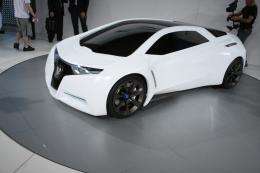
Honda FC Sport prototype EV.
Despite how many times they're told differently, some Americans persist in their belief that there were weapons of mass destruction in Iraq. Sorry, nope. And almost as enduring are the myths about the forthcoming electric vehicles. So let me use my bully pulpit here to dispel some of the more common rumors, half-truths and innuendos.
1. Electric vehicles will be slow "Ralph Nader-mobiles." Definitely wrong. I've driven every single one that will be out this year, and not one of them was a slug. Electric motors benefit from huge low-end torque, so they're actually very fast indeed off the line. That makes even some of the little econo-boxes capable of blowing off complacent Camaros and Mustangs. And some EVs, such as the Tesla Roadster and Fisker Karma, are serious high-performance cars.
2. Electric vehicles will be expensive. This is a half-truth, since the purchase price will indeed be higher than you're used to paying. Expect $35,000 to $40,000 for entry-level cars the size of a Subaru Forester. But the last time I looked, nobody was subsidizing my purchase of gas-powered cars, and there is money for EVs. Specifically, there's a $7,500 federal tax credit for the purchase of battery cars, and a second credit of up to $2,000 that will pay up to 50 percent of your home charger installation. It's even better if you live in certain states. California just launched a $5,000 "cash-for-clunkers" type rebate (much better than a tax break) to early adopters of EVs there. Other states are similarly generous. Oklahoma (who knew?) subsidizes half the purchase price of battery cars, which made it possible to buy Wheego EVs for only $2,500, and more than 100 have already been sold there.
3. Electric vehicles will be unsafe. You're not going to get shocked when you plug them in, and battery acid won't spill all over you in an accident. Automakers, working with the Society of Automotive Engineers, have standardized the ultra-safe five-pin J1772 connector. Battery packs, heavily protected from passenger compartments, will be mostly under the car. The biggest safety issue so far is whether they'll be heard by pedestrians, a challenge some carmakers are addressing by having them produce tailor-made noises (they could even be like ringtones).
This video is not supported by your browser at this time.
Here's a video look at some of the newer (and sexier) EVs, many of which will be headin' out on the highway soon.
4. Charging electric vehicles will be a hassle. Never have I seen so many great minds working to make something as simple as possible, and they've pretty much succeeded. Carmakers and charging companies are lobbying for, and will probably get, streamlined rules for home wiring, which should reduce installation times from a month to 24 hours. Your home charger (about $2,000 installed) is likely to be addressable like the cable box, which means you'll be able to program charging times from your laptop or cell phone. Utilities are very pro-EV, and will be offering lucrative time-of-day pricing to encourage customers to charge at night. But you don't have to get up in the middle of the night to plug-in _ the charger will be smart enough to start the clock ticking on its own. 5. Electric vehicles aren't really clean because they use electricity from coal plants. This one is undoubtedly true, in that battery cars are not "zero emission" on a "well to wheels" basis. Coal power is indeed dirty power. But, all things considered, EVs are still much better for our planet than gasoline cars. According to Sherry Boschert, author of the book Plug-In Hybrids: The Cars that Will Recharge America (New Society), EVs reduce carbon dioxide emissions by 11 to 100 percent (depending on the type of power plant) compared to internal-combustion cars, and 24 to 54 percent compared to hybrid cars. Even if all our plants burned coal, we'd still reduce CO2 by as much as 59 percent with people driving only EVs. Boschert's primary source was a study by the federal Argonne National Laboratories.
(c) 2010, Mother Nature Network.
Distributed by McClatchy-Tribune Information Services.
-
Electric cars rolling out
Dec 16, 2009 |
not rated yet |
0
-
Toyota to release solar charger for electric vehicles
Oct 27, 2009 |
not rated yet |
0
-
Mercedes to Produce a Fully Electric Gullwing
Aug 07, 2009 |
not rated yet |
0
-
Drag racing goes green as US electric cars shine
Sep 06, 2009 |
not rated yet |
0
-
Chicago Installs Solar Powered Charging Station for Electric Vehicles
Apr 10, 2009 |
not rated yet |
0
-
Engineers build first sub-10-nm carbon nanotube transistor
Feb 01, 2012 |
4.9 / 5 (31) |
30
-
Something old, something new: Evolution and the structural divergence of duplicate genes
Jan 31, 2012 |
4.6 / 5 (7) |
1
-
The hidden nanoworld of ice crystals: Revealing the dynamic behavior of quasi-liquid layers
Jan 30, 2012 |
5 / 5 (3) |
1
-
Stock market network reveals investor clustering
Jan 27, 2012 |
3.9 / 5 (23) |
8
-
Of microchemistry and molecules: Electronic microfluidic device synthesizes biocompatible probes
Jan 26, 2012 |
5 / 5 (1) |
0
-
Calling function with no input argument
4 hours ago
-
Force free body diagram problem on gym equipment
5 hours ago
-
Empirical data regarding shower heads and water
13 hours ago
-
feed hold button on CNC lathe
Feb 09, 2012
-
RFAC in Fortran
Feb 09, 2012
-
dynamics 2/32
Feb 08, 2012
- More from Physics Forums - General Engineering
More news stories
New error-correcting codes guarantee the fastest possible rate of data transmission
Error-correcting codes are one of the triumphs of the digital age. Theyre a way of encoding information so that it can be transmitted across a communication channel such as an optical fiber o ...
Technology / Computer Sciences
7 hours ago |
5 / 5 (3) |
4
|
Small modular reactor design could be a 'SUPERSTAR'
(PhysOrg.com) -- Though most of today's nuclear reactors are cooled by water, we've long known that there are alternatives; in fact, the world's first nuclear-powered electricity in 1951 came from a reactor ...
Technology / Energy & Green Tech
7 hours ago |
4.2 / 5 (10) |
16
|
New power source discovered
(PhysOrg.com) -- Researchers at the Massachusetts Institute of Technology (MIT) and RMIT University have made a breakthrough in energy storage and power generation.
Technology / Energy & Green Tech
6 hours ago |
5 / 5 (5) |
2
|
Advanced power-grid model finds low-cost, low-carbon future in West
(PhysOrg.com) -- The least expensive way for the Western U.S. to reduce greenhouse gas emissions enough to help prevent the worst consequences of global warming is to replace coal with renewable and other ...
Technology / Energy & Green Tech
7 hours ago |
5 / 5 (2) |
7
|
Zuckerberg's focus drives Facebook's ascent
When Mark Zuckerberg showed up to rent Judy Fusco's Los Altos, Calif., house in the fall of 2004, soon after he'd arrived in Silicon Valley, the landlord was immediately struck by his confidence.
3 hours ago |
1 / 5 (1) |
0
Human cognitive performance suffers following natural disasters, researchers find
Not surprisingly, victims of a natural disaster can experience stress and anxiety, but a new study indicates that it might also cause them to make more errors - some serious - in their daily lives. In their upcoming Human Fa ...
The power of estrogen -- male snakes attract other males
A new study has shown that boosting the estrogen levels of male garter snakes causes them to secrete the same pheromones that females use to attract suitors, and turned the males into just about the sexiest ...
Putting the squeeze on planets outside our solar system
(PhysOrg.com) -- Using high-powered lasers, scientists at Lawrence Livermore National Laboratory and collaborators discovered that molten magnesium silicate undergoes a phase change in the liquid state, abruptly ...
Both maternal and paternal age linked to autism
Older maternal and paternal age are jointly associated with having a child with autism, according to a recently published study led by researchers at The University of Texas Health Science Center at Houston (UTHealth).
Curry spice component may help slow prostate tumor growth
Curcumin, an active component of the Indian curry spice turmeric, may help slow down tumor growth in castration-resistant prostate cancer patients on androgen deprivation therapy (ADT), a study from researchers ...
Humans may have helped the decline of African rainforests 3000 years ago
(PhysOrg.com) -- Large areas of rainforests in Central Africa mysteriously disappeared over three thousand years ago, to be replaced by savannas. The prevailing theory has been that the cause was a change ...
Mar 23, 2010
Rank: 5 / 5 (1)
A good accurate article on EV's. I've driven them every day for a decade and saved large amounts of money, gas and my running costs are 25% of similar ICE's. Next yr gas will be $5/gal just as these EV's come out will make them look real good.
Mar 23, 2010
Rank: 2.3 / 5 (3)
Mar 23, 2010
Rank: 3 / 5 (3)
And most Americans - and i have not run into any that would disagree - know that there were no WMD in Iraq... that was a statement meant for the trolls.
Mar 23, 2010
Rank: 3 / 5 (4)
Mar 23, 2010
Rank: 1 / 5 (4)
my thinking...convert the wheels into a type of alternator to at least provide some charge back to the batteries during operation, along with the energy capturing shock absorbers...and maybe some small wind turbines on the front of the vehicle. Granted, it would not offset the total power taken, but I would think it would slow the rate of power loss due to the trickle charge being fed back into the vehicles batteries...
Mar 23, 2010
Rank: 5 / 5 (3)
Mar 23, 2010
Rank: 2.3 / 5 (3)
Mar 24, 2010
Rank: 3.5 / 5 (2)
Mar 24, 2010
Rank: 4.8 / 5 (4)
Mar 24, 2010
Rank: 2 / 5 (3)
Mar 24, 2010
Rank: 1.8 / 5 (5)
Mar 24, 2010
Rank: 1 / 5 (2)
Mar 25, 2010
Rank: 3.3 / 5 (3)
An advantage of EV over gasoline powered cars is: You get heat instantly - no more waiting until your engine heats up. No more 'blind driving' until everything defrosts. Sure it will reduce your range a bit. But since these types of cars will be mostly 'second cars' used by commuters you'll be very well aware of how much range you need - so buy accordingly.
Mar 27, 2010
Rank: 1 / 5 (1)
We are so accustomed to hanging out at a pump for 15 minutes every week, why is it so much more trouble to take 10 seconds whenever you get in or out of your car to plug it in? Sure that takes time, but you do realize that you don't have to wait at the gas pump anymore, right? Oh and you also don't need to wait at the oil change place either.
Mar 28, 2010
Rank: 1 / 5 (1)
Mar 28, 2010
Rank: 3 / 5 (2)
Also the system has degraded over time. In 1970 the standard delivery was 250/125V. Today the system isn't expected to delivery more than 108/215V.
Without the Electric Cars the US needs 100GW in additional capacity. What's a greenie to do?
Mar 28, 2010
Rank: 1 / 5 (1)
You wind the windows up!
You wear a jumper and a coat!
How do you think people kept warm for the first 50 years of automobile travel.
Mar 29, 2010
Rank: not rated yet
Mar 29, 2010
Rank: 5 / 5 (1)
With an electric heater.
A powerfull electric heater will use about 1 kiloWatt. That is just about 5% of what a normal car has at its disposal (The Tesla Roadster uses 21kWh to go 100 miles). I see no problem in significantly reducing range/power of your car by simply turning on a heater.
Mar 29, 2010
Rank: 3 / 5 (1)
Mar 29, 2010
Rank: 4 / 5 (1)
Because the energy density of capacitors (even ultracapacitors) is about one tenth of a battery per unit of weight. Batteries are already a weight issue for EV cars imagine how much worse that gets when you use capacitors.
Toting 10 times that weight (and probably volume) is not an option.
Using small amounts of capacitors for capturing braking energy (which is then fed back when you accelerate) is probably worth it, though.
Mar 29, 2010
Rank: 1 / 5 (1)
Mar 29, 2010
Rank: 3 / 5 (2)
its like comedy for the real intelligent...
Apr 27, 2010
Rank: not rated yet
Its sad. Rather than going for "all or nothing" and getting nothing, you folks should really learn to go for the realistic compromise, which in this case would be gas/electric hybrids. Had you argued for them instead in this forum you might have won over a few converts.
Well, maybe.
And whats with El Nose for bringing in politics to the discussion, or COCO for bringing in conspiracy theories?