Hydrokinetic proposal for Mississippi river
March 23, 2010 by Lin Edwards report
Hydrokinetic proposal for Mississippi river

Enlarge

(PhysOrg.com) -- Everyone is looking for alternative forms of energy, and one company proposes to generate electricity from the flow of the river Mississippi in the US, without using dams to control the water flow.

The company, Free Flow Power (FFP) from Gloucester in Massachusetts, has high hopes for its proposals because, unlike tidal hydroelectricity generation, the river water is fresh and will therefore be expected to produce fewer corrosion problems. According to US army data, the river water at New Orleans flows at about 6 kph (4 mph), and this flow could turn the blades of submerged turbines sufficiently to generate electricity to power thousands of homes, especially as moving water can generate 800 times more than wind.

The proposal should work in theory, but it is still unclear whether or not hydrokinetic power is feasible commercially. FFP has already carried out a six-month test of a submerged at Baton Rouge, and spokesman Jon Guidroz said they were happy with the results, although he gave few details.

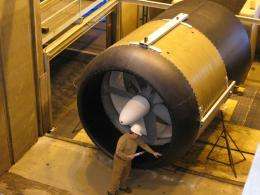
The proposal for the Mississippi is to anchor concrete pilings deep in the river, and attach turbines to them. The only thing visible from the shore would be the cables emerging at the banks. The turbines, each with seven 3 meter (10 foot) blades, would turn very slowly to reduce the hazard to fish and marine mammals, although the noise of the turbines could still affect the behavior of animals using the river.

The design also takes the aquatic environment into account, even though some efficiency was sacrificed. The turbines are lubricated only by water, so no hazardous lubricants can leak into the river if a part breaks.

The company plans to start from the river in 2013, but the project must first be approved by the Federal Energy Regulatory Commission (FERC). A FERC spokesman said there were over 100 applications on file for hydroelectric and hydrokinetic projects, including proposals for the Mississippi and Ohio , which are large enough to have the potential to make hydrokinetic energy financially viable. Two other applications for hydrokinetic permits (one by FFP and one by Morgan City) are for the Wax Lake Outlet of the Atchafalaya river that empties into the Gulf of Mexico.

More information: Free Flow Power - http://www.free-fl … hnology.html

© 2010 PhysOrg.com

4.5 /5 (12 votes)  

Filter


Move the slider to adjust rank threshold, so that you can hide some of the comments.


Display comments: newest first

finitesolutions
Mar 23, 2010

Rank: not rated yet
I thought of a similar solution some time ago. The main problem I see unsolved is the logs that the river is caring will inevitably stop the blades. Some sort of a conical deflection bars need to be placed in front of the turbine. But the bars might get clogged too by smaller branches.
ubavontuba
Mar 23, 2010

Rank: 1 / 5 (1)
I thought of a similar solution some time ago. The main problem I see unsolved is the logs that the river is caring will inevitably stop the blades. Some sort of a conical deflection bars need to be placed in front of the turbine. But the bars might get clogged too by smaller branches.

No, no, no. You POWER the blades every once in a while to turn it into a giant food processor/disposal unit! HA! HA! HA!

In-Sink-Erator would probably pay to sponsor it!
croghan27
Mar 24, 2010

Rank: not rated yet
Would the energy taken out of the river to turn the blades have any effect on the overall flow? Would it perhaps cause silt to build up near the turbine as the velocity of the water is reduced?
ubavontuba
Mar 24, 2010

Rank: not rated yet
Would the energy taken out of the river to turn the blades have any effect on the overall flow? Would it perhaps cause silt to build up near the turbine as the velocity of the water is reduced?
Interestingly, the overall flow of the river's water doesn't really slow. It just piles up a bit in front of the turbines and subsides behind. It's the pressure differential that really powers the turbines.
croghan27
Mar 25, 2010

Rank: not rated yet
Interestingly, the overall flow of the river's water doesn't really slow. It just piles up a bit in front of the turbines and subsides behind. It's the pressure differential that really powers the turbines.


I know the Mississippi is a big river .. but a string of these turbines across any channel (where the flow is quickest) it seems to me, would effect the movement of water.

I guess you are saying it would be an immediate and localized phenomena.
ubavontuba
Mar 25, 2010

Rank: 5 / 5 (1)
Interestingly, the overall flow of the river's water doesn't really slow. It just piles up a bit in front of the turbines and subsides behind. It's the pressure differential that really powers the turbines.
I know the Mississippi is a big river .. but a string of these turbines across any channel (where the flow is quickest) it seems to me, would effect the movement of water.

I guess you are saying it would be an immediate and localized phenomena.
Correct. They're obstructions, not dams. The water will actually move a little faster around them. The average flow for the system will remain the same.
croghan27
Mar 25, 2010

Rank: not rated yet
Thanks for you patience, uba ... but I still have questions about the energy taken out of the river .... is it that large that it would make no difference?
ubavontuba
Mar 25, 2010

Rank: 5 / 5 (1)
Thanks for you patience, uba ... but I still have questions about the energy taken out of the river .... is it that large that it would make no difference?
Look at it this way. When the water slows, it has to pile up (like with a dam). Dams have to release water to keep from overfilling. In this case, the water piles up in front until it overcomes the obstacles, and the flow simply resumes.

The energy isn't really coming from the river. The energy comes from the water cycle (evaporation and rain). It's really just a concentrated form of solar energy.
Caliban
Mar 28, 2010

Rank: 1 / 5 (3)
Not to forget Gravity.
ubavontuba
Mar 29, 2010

Rank: 5 / 5 (1)
Not to forget Gravity.
Gravity isn't an energy source. It's only good for energy storage. It's called, "potential energy." The potential energy is delivered to the system by some other means (in this case, solar energy).

Here's an article about it:
http://en.wikiped...l_energy
Rank 4.5 /5 (12 votes)
Relevant PhysicsForums posts

More news stories

Stanford research team cracks animated NuCaptcha

(PhysOrg.com) -- The research team from Stanford University, led by Elie Bursztein, that previously had cracked regular CAPTCHAs and then audio CAPTCHAs, now has also successfully cracked the animated version called NuCapt ...

Technology / Computer Sciences

created 18 hours ago | popularity 5 / 5 (3) | comments 6 | with audio podcast report

Tiny, implantable medical device can propel itself through bloodstream

Someday, your doctor may turn to you and say, "Take two surgeons and call me in the morning." If that day arrives, you may just have Ada Poon to thank.

Technology / Engineering

created 17 hours ago | popularity 5 / 5 (9) | comments 8 | with audio podcast

Italian engineer invents floating solar panels

Rays of the winter sun bounce off gleaming mirrors on the tiny lake of Colignola in Italy, where engineers have built a cost-effective prototype for floating, rotating solar panels.

Technology / Energy & Green Tech

created 21 hours ago | popularity 4.7 / 5 (6) | comments 5

Microsoft hits Motorola, Google with EU complaint

Microsoft on Wednesday lodged a formal complaint with the European Union's competition regulator against Motorola Mobility and its soon-to-be owner Google, saying Motorola's aggressive enforcement of patent ...

Technology / Business

created 17 hours ago | popularity 2 / 5 (1) | comments 2

Calif. pledges better mobile privacy disclosures

(AP) -- Mobile applications seeking to collect personal information will have to forewarn users as part of an agreement reached in California.

Technology / Internet

created 9 hours ago | popularity not rated yet | comments 0


Researchers build first physical 'metatronic' circuit

(PhysOrg.com) -- The technological world of the 21st century owes a tremendous amount to advances in electrical engineering, specifically, the ability to finely control the flow of electrical charges using ...

Spitzer finds solid buckyballs in space

(PhysOrg.com) -- Astronomers using data from NASA's Spitzer Space Telescope have, for the first time, discovered buckyballs in a solid form in space. Prior to this discovery, the microscopic carbon spheres ...

Faster than light neutrinos? More like faulty wiring

You can shelf your designs for a warp drive engine (for now) and put the DeLorean back in the garage; it turns out neutrinos may not have broken any cosmic speed limits after all.

Physicists surprised by disappearing and reappearing superconductivity in iron selenium chalcogenides

Superconductivity is a rare physical state in which matter is able to conduct electricity -- maintain a flow of electrons -- without any resistance. This phenomenon can only be found in certain materials at low temperatures, ...

Going up: Japan builder eyes space elevator

A Japanese construction firm claimed Wednesday it could execute an out-of-this-world plan to put tourists in space within 40 years by building an elevator that stretches a quarter of the way to the moon.

Flesh-eating bacteria inspire superglue

(PhysOrg.com) -- A bio-inspired superglue has been developed by Oxford University researchers that can’t be matched for sticking molecules together and not letting go.