Prism-patterned screen brings paradigm shift to 3D displays
March 23, 2010 By Lisa Zyga feature
Prism-patterned screen brings paradigm shift to 3D displays

Enlarge

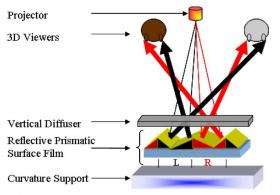
In the 3D prism-patterned display, the angular prism screen reflects different light pixels to each eye, which creates a sense of depth through parallax. Image credit: Wallen Mphepö, et al.

(PhysOrg.com) -- A team of engineers from Taiwan seems to have overcome one of the most persistent challenges of 3D display technology, which could enable them to produce a cinematic 3D display with superior quality compared to most current systems. Their proposed design combines a prism-patterned projection screen with advanced projection technology to achieve both high optical efficiency and low image crosstalk -- two properties that have been considered mutually exclusive until now.

The researchers, led by Wallen Mphepö from National Chiao Tung University in Hsinchu, Taiwan, and Chalmers University of Technology in Göteborg, Sweden, have published their proposed display design in a recent issue of IEEE's Journal of .

The new display uses a prism-patterned 3D screen, a technology which has previously been explored to varying degrees of success. In this system, the prism’s angular surfaces reflect light at two different angles, which are received by a viewer’s left and right eyes, creating a sense of depth through parallax. The prism screen can display 3D images to multiple viewers, as long as they are located within a specific distance range from the screen. The system is also autostereoscopic, meaning viewers do not need glasses to see the 3D effects.

The key to prism-based 3D displays is that the prism screen must effectively separate the left and right image pixels. To achieve this pixel separation, the researchers worked on defining the prism angles as well as the curvature of the entire screen, which is necessary in order to keep the rays within the viewing zone. To derive the curvature’s coordinates, the researchers used an iterative process, with each new point on the curved surface computed based on the previous points’ locations.

The initial results of their simulations showed a large amount of crosstalk between left and right viewing zones, meaning that the right eye could see some residue of the image intended for the left eye, and vice versa. In order to minimize the crosstalk, the researchers reconfigured the prism angles to sharpen the reflected rays’ separation. In addition, they slightly increased the inter-ocular separation (the distance between a viewer’s eyes) from 65 to 70 mm, and moved the viewing location to 1.15 m, 50 mm closer to the screen. These measures reduced the amount of overlap between left and right pixels, virtually eliminating the crosstalk.

However, as the engineers note, it’s not the 0% crosstalk that makes the 3D display innovative, but rather the fact that the display also operates at 90% optical efficiency. As Mphepö explained, previous technologies have always assumed that image crosstalk is inversely proportional to optical efficiency.

“In our design you simultaneously get both the desirable high optical efficiency and desirable low or zero crosstalk,” Mphepö told PhysOrg.com. “This bucks the trend and changes the way standard prevailing autostereoscopic 3D display design assumptions that have been in effect up to this point are to be viewed. In short, they no longer apply.”

For instance, as Mphepö explained, a typical autostereoscopic 3D display might use a parallax barrier - a layer of opaque material with slits that is placed in front of the screen, allowing each eye to see a different set of pixels. If the slits are wide, more light can pass through, which increases the optical efficiency. However, wide slits allow more image crosstalk, since each eye sees more light that is intended only for the other eye. On the other hand, making the slits narrower can reduce image crosstalk, but also blocks most of the light, reducing optical efficiency. Thus there is an inherent tradeoff between optical efficiency and crosstalk in such a design.

To overcome this problem, the new system replaces the parallax barrier with fine-tuned prisms that, as Mphepö explained, reflect light to create a “sweet spot” with high optical efficiency and virtually no crosstalk.
Prism-patterned screen brings paradigm shift to 3D displays
Enlarge

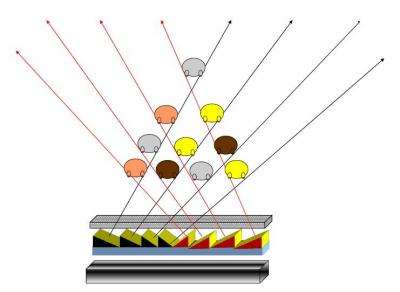
By increasing the number of prisms per pixel, the 3D prism-patterned display can accommodate many viewers simultaneously without a dramatic loss of resolution. In the version shown here, four prisms per pixel generates 10 3D viewing zones in four rows. Image credit: Wallen Mphepö.

“For our design we made sure that most of the light that comes from the projector and is incident onto our screen is reflected back to the viewers' eyes with no barrier blocking it, raising the overall optical efficiency of the system,” Mphepö explained. “By designing the prisms to reflect the incident light from the projector to specific pre-computed left and right eye locations at the viewing distances, we obtain a sweet spot where there is maximum separation of left and right pixels. At these locations the left and right pixels don't mix, thus giving us an area where there is zero crosstalk even though no barrier is actually between the viewer and the screen, in contrast to the parallax barrier autostereoscopic 3D display.”

Although the 3D viewing zone is currently somewhat small, the design has another important advantage, in that it can be configured to provide several 3D viewing zones without drastically reducing the image resolution. This ability contrasts with other autostereoscopic 3D displays, such as those that use a parallax barrier and those that are based on a lenticular lens, which is what most of the major manufacturers are using today. In both designs, the method of increasing the number of viewers involves dividing up the pixels among viewers, which decreases each viewer’s image resolution - especially for a large number of viewers.

As Mphepö explains, in the prism-based design, the resolution of each individual viewer is reduced by at most only half of the projector's original resolution, no matter how many viewers are added. Instead of dividing up the pixels, the system increases the number of prisms per pixel to accommodate more viewers. In this way, using only 11 prisms per incident projector pixel, the system can accommodate 100 simultaneous autostereoscopic 3D viewers.

“The fabrication process is orders of magnitude simpler, while the number of views that can be generated is much higher and makes cinema autostereoscopic systems more feasible,” Mphepö said. He also added that part of the inspiration for the design came from bouncing off ideas with Professor Michael Bove, Jr., at MIT Media Labs, who is the co-director of The Center for Future Storytelling.

The design still needs work in some areas, such as optimizing the system for an inter-ocular distance of 65 mm, which is considered the ideal distance for most viewers. The researchers also plan to increase the stability and size of the 3D viewing zones to allow for more head movement.

“There are plans to fabricate a prototype of this version of the system and also the second generation version of the system,” Mphepö said. “We are currently looking for companies to collaborate with in realizing some aspects of the system apart from actually manufacturing it at some point down the road.”

More information: Wallen Mphepö, Yi-Pai Huang, Per Rudquist, and Han-Ping Shieh. “An Autostereoscopic 3D Display System Based on Prism Patterned Projection System.” Journal of Display Technology, Vol. 6, No. 3, March 2010. Doi:10.1109/JDT.2009.2034759

Copyright 2010 PhysOrg.com.
All rights reserved. This material may not be published, broadcast, rewritten or redistributed in whole or part without the express written permission of PhysOrg.com.

4.6 /5 (46 votes)  

Filter


Move the slider to adjust rank threshold, so that you can hide some of the comments.


Display comments: newest first

El_Nose
Mar 23, 2010

Rank: 4.5 / 5 (4)
THis is an awesome article - just for the sheer detail and thought that went into writing it. It doesn't assume a stupid reader and answers all basic questions about design. I do not watch much tv - but i would be interested in see a demo of this.
antialias
Mar 23, 2010

Rank: 4.6 / 5 (5)
Screwed around with these 5 years back for augmented displays in medical contexts (overlay of 3D information during keyhole and microscope surgery).

The problem is that the prism structure is 2D. it allows for a shift of the head on the X-axis and will give a good '3D feel'.

But shifting on the y-Axis does nothing - and therein lies the problem. When you watch 3D stuff you want to move your head in all directions unconsciously - and the lack of 3D effect in y-direction which will break the immersion.

In the above situation you might even fall out of one viewing zone into another which would give you a very uncomfortable feeling of suddenly 'jumping to the left' with your last fractional head movement to the right.

Nice toy, no doubt, but limited applications.
dev2000
Mar 23, 2010

Rank: 3.7 / 5 (3)
What are those colorful little creatures sitting in front of the TVs? Furbies?
SincerelyTwo
Mar 23, 2010

Rank: 3 / 5 (1)
antialias,

they could try to create an interlaced pattern of these prisms, alternating between up/down and left/right orientation, i wonder if that'd solve the problem.
antialias
Mar 23, 2010

Rank: 5 / 5 (1)
You'd need prisms in all psooible viewing directions and for all possible viewing positions. I don't think that would work too well.
pubwvj
Mar 23, 2010

Rank: 1 / 5 (3)
This is almost like a screen technology I designed 24 years ago but they're missing one crucial detail that makes it a lot better.
poof
Mar 23, 2010

Rank: 2 / 5 (2)
This is almost like a screen technology I designed 24 years ago but they're missing one crucial detail that makes it a lot better.


that being....? Or if this is some super-secret idea, you should probably present it to them.
Sonhouse
Mar 23, 2010

Rank: 4 / 5 (1)
If it happened 24 years ago, looks like it wasn't so great an idea. Maybe big brother suppressed it till now when the inventor can now be a billionaire.
hudres
Mar 23, 2010

Rank: 3.5 / 5 (2)
I have been aware of this technology for over 20 years too. There is such a thing as being too early with technology. That is a far more likely explanation of why it didn't take off two decades ago. I have also seen autostereoscopic devices based on a fresnel lens with a conventional lens inset. Made no sense, but I built one and it worked.
@pubwvj: you should do somnething with this.
ubavontuba
Mar 24, 2010

Rank: 5 / 5 (2)
Hmm. This reminds me of my old 3-D baseball trading cards from the 70's. Anyone want to trade for a Willy Mays?
tkjtkj
Mar 24, 2010

Rank: 4 / 5 (1)
This technology is already on the market: it was demo'd by one of the major screen makers weeks ago .. I forget the maker, but the screen didnt need glasses for 3D .. It's hard for me to feel that the viewing experience is worth it .. I imagine that viewing angles/head position would have to be restricted .. but then, i wasn't there.
lengould100
Mar 25, 2010

Rank: 5 / 5 (1)
Big projectors / screens for large audiences is a dead-end technology. We're not too far from a standardized means to project images directly onto everyone's eyeglasses (or retinae), making stereoscopic capability inherint.
Nartoon
Mar 27, 2010

Rank: not rated yet
Exactly! What ever happened to the LCD glasses, in which left and right would have no problem being controlled for 3D effect. The glasses were said to give the effect of watching a giant screen TV.
Bob_Kob
Mar 28, 2010

Rank: not rated yet
Well this would probably work quite well for computer monitors where you really don't change orientation much.
CSharpner
Mar 29, 2010

Rank: not rated yet
I too came up with something similar (3D without glasses) back in 1988 or '87... I remember designing a graphic presentation for the design on my Apple ][GS at the time. It provided for multiple viewing angles, including both in the X and Y direction... in essence, you can "look around" objects on the screen, but at a cost of resolution... not that that's a big barrier to overcome these days. It would also work for cameras (which, you'd kind of need :) I guess I should get around to trying to patent it if it hasn't already been done (man, that'd really yank my chains!!)
SincerelyTwo
Apr 02, 2010

Rank: not rated yet
Oh yea, well... I just discovered how to travel from here to mars in 10 seconds, but I am not going to tell you how it works or give any convincing evidence, but I am going to think about patenting it because telling you that legitimizes the claim.

/sigh.
Rank 4.6 /5 (46 votes)
Related Stories
Relevant PhysicsForums posts
  • Empirical data regarding shower heads and water
    created1 hour ago
  • feed hold button on CNC lathe
    created20 hours ago
  • Mechanics of Solids ( Final exam question) please help!
    created22 hours ago
  • RFAC in Fortran
    createdFeb 09, 2012
  • dynamics 2/32
    createdFeb 08, 2012
  • dynamics
    createdFeb 08, 2012
  • More from Physics Forums - General Engineering

More news stories

Soraa LED light may dim 50-watt halogen rivals

(PhysOrg.com) -- Soraa, a Fremont, California company founded in 2008, this week launched its first product, a light that uses LEDS (light emitting diodes). The "Soraa LED MR16 lamp" is the "perfect" replacement ...

Technology / Semiconductors

created 21 hours ago | popularity 4.3 / 5 (17) | comments 18 | with audio podcast report

Samsung can continue selling Galaxy tabs in Germany: court

South Korea's Samsung Electronics can continue to sell its Galaxy Tab 10.1N tablet computer in Germany, a German court ruled Thursday, rejecting a bid by arch-rival Apple to have them banned.

Technology / Business

created 19 hours ago | popularity 3.7 / 5 (3) | comments 3

Digital photos could put kids at risk

A study published in the International Journal of Electronic Security and Digital Forensics this month suggests that parents and carers could be putting children at risk if they upload digital photos that are automatically "geota ...

Technology / Internet

created 15 hours ago | popularity 5 / 5 (1) | comments 3

Google launches Chrome browser for Android smartphones

With more and more people connecting to the Internet through a phone or a tablet instead of a PC, Google Inc. is bringing its fast-growing browser, Chrome, to the newest Android-powered mobile devices.

Technology / Software

created 18 hours ago | popularity 5 / 5 (4) | comments 0

Model analyzes shape-memory alloys for use in earthquake-resistant structures

Recent earthquake damage has exposed the vulnerability of existing structures to strong ground movement. At the Georgia Institute of Technology, researchers are analyzing shape-memory alloys for their potential ...

Technology / Engineering

created 16 hours ago | popularity 5 / 5 (1) | comments 0 | with audio podcast


'Dark plasmons' transmit energy

Microscopic channels of gold nanoparticles have the ability to transmit electromagnetic energy that starts as light and propagates via "dark plasmons," according to researchers at Rice University.

FDA-approved drug rapidly clears amyloid from the brain, reverses Alzheimer's symptoms in mice

Neuroscientists at Case Western Reserve University School of Medicine have made a dramatic breakthrough in their efforts to find a cure for Alzheimer's disease. The researchers' findings, published in the journal Science, show t ...

Hydrogen from acidic water: Researchers develop potential low cost alternative to platinum for splitting water

A technique for creating a new molecule that structurally and chemically replicates the active part of the widely used industrial catalyst molybdenite has been developed by researchers with the Lawrence Berkeley ...

Ultraviolet protection molecule in plants yields its secrets

Lying around in the sun all day is hazardous not just for humans but also for plants, which have no means of escape. Ultraviolet (UV) radiation from the sun can damage proteins and DNA inside cells, leading ...

Anyone can learn to be more inventive, cognitive researcher says

There will always be a wild and unpredictable quality to creativity and invention, says Anthony McCaffrey, a cognitive psychology researcher at the University of Massachusetts Amherst, because an "Aha moment" is rare and ...

Flexible paper robots

(PhysOrg.com) -- These inexpensive robots can stretch, bend and twist under control, and lift objects up to 120 times their own weight. Being soft, they can apply gentle and even pressure, and adapt to varied ...