NASA Mars Rover Getting Smarter as it Gets Older
March 23, 2010
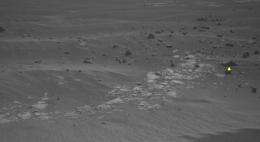
The more-than-50 rocks in this image are near a young crater called "Concepcion" and might have been thrown outward by the impact that excavated the crater. Image Credit: NASA/JPL-Caltech
(PhysOrg.com) -- NASA's Mars Exploration Rover Opportunity, now in its seventh year on Mars, has a new capability to make its own choices about whether to make additional observations of rocks that it spots on arrival at a new location.
Software uploaded this winter is the latest example of NASA taking advantage of the twin Mars rovers' unanticipated longevity for real Martian test drives of advances made in robotic autonomy for future missions.
Now, Opportunity's computer can examine images that the rover takes with its wide-angle navigation camera after a drive, and recognize rocks that meet specified criteria, such as rounded shape or light color. It can then center its narrower-angle panoramic camera on the chosen target and take multiple images through color filters.
"It's a way to get some bonus science," said Tara Estlin of NASA's Jet Propulsion Laboratory, Pasadena, Calif. She is a rover driver, a senior member of JPL's Artificial Intelligence Group and leader of development for this new software system.
The new system is called Autonomous Exploration for Gathering Increased Science, or AEGIS. Without it, follow-up observations depend on first transmitting the post-drive navigation camera images to Earth for ground operators to check for targets of interest to examine on a later day. Because of time and data-volume constraints, the rover team may opt to drive the rover again before potential targets are identified or before examining targets that aren't highest priority.
The first images taken by a Mars rover choosing its own target show a rock about the size of a football, tan in color and layered in texture. It appears to be one of the rocks tossed outward onto the surface when an impact dug a nearby crater. Opportunity pointed its panoramic camera at this unnamed rock after analyzing a wider-angle photo taken by the rover's navigation camera at the end of a drive on March 4. Opportunity decided that this particular rock, out of more than 50 in the navigation camera photo, best met the criteria that researchers had set for a target of interest: large and dark.
"It found exactly the target we would want it to find," Estlin said. "This checkout went just as we had planned, thanks to many people's work, but it's still amazing to see Opportunity performing a new autonomous activity after more than six years on Mars."
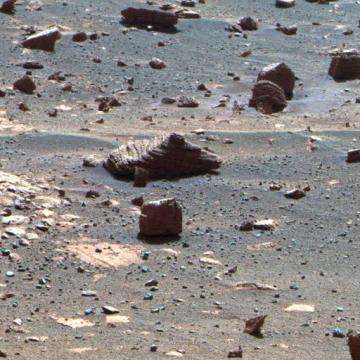
This view results from the first observation of a target selected autonomously by a spacecraft on Mars. Image credit: NASA/JPL-Caltech/Cornell University
Opportunity can use the new software at stopping points along a single day's drive or at the end of the day's drive. This enables it to identify and examine targets of interest that might otherwise be missed."We spent years developing this capability on research rovers in the Mars Yard here at JPL," said Estlin. "Six years ago, we never expected that we would get a chance to use it on Opportunity."
The developers anticipate that the software will be useful for narrower field-of-view instruments on future rovers.
Other upgrades to software on Opportunity and its twin, Spirit, since the rovers' first year on Mars have improved other capabilities. These include choosing a route around obstacles and calculating how far to reach out a rover's arm to touch a rock. In 2007, both rovers gained the know-how to examine sets of sky images to determine which ones show clouds or dust devils, and then to transmit only the selected images. The newest software upload takes that a step further, enabling Opportunity to make decisions about acquiring new observations.
The AEGIS software lets scientists change the criteria it used for choosing potential targets. In some environments, rocks that are dark and angular could be higher-priority targets than rocks that are light and rounded, for example.
-
NASA Rover Opportunity Takes First Peek Into Victoria Crater
Sep 20, 2006 |
not rated yet |
0
-
Mars Rover and Orbiter Team Examines Victoria Crater
Oct 06, 2006 |
not rated yet |
0
-
Mars rover Opportunity sets out on its greatest journey yet
Sep 25, 2008 |
not rated yet |
0
-
Opportunity Presses On Toward Victoria
May 18, 2006 |
not rated yet |
0
-
Mars Rover Opportunity To Head Toward Bigger Crater
Sep 22, 2008 |
not rated yet |
0
-
Engineers build first sub-10-nm carbon nanotube transistor
Feb 01, 2012 |
4.9 / 5 (31) |
30
-
Something old, something new: Evolution and the structural divergence of duplicate genes
Jan 31, 2012 |
4.6 / 5 (7) |
1
-
The hidden nanoworld of ice crystals: Revealing the dynamic behavior of quasi-liquid layers
Jan 30, 2012 |
5 / 5 (3) |
1
-
Stock market network reveals investor clustering
Jan 27, 2012 |
3.9 / 5 (23) |
8
-
Of microchemistry and molecules: Electronic microfluidic device synthesizes biocompatible probes
Jan 26, 2012 |
5 / 5 (1) |
0
-
Titan's lack of impact craters
Feb 09, 2012
-
Real pictures of black hole eating a star?
Feb 08, 2012
-
Hypothetical way to travel faster than light, but not technically exceed lightspeed
Feb 06, 2012
-
How do scientists monitor the Sun's activity?
Feb 05, 2012
-
Search patterns in observational studies
Feb 05, 2012
-
Derivation of Pogson's law
Feb 03, 2012
- More from Physics Forums - General Astronomy
More news stories
Humans may have helped the decline of African rainforests 3000 years ago
(PhysOrg.com) -- Large areas of rainforests in Central Africa mysteriously disappeared over three thousand years ago, to be replaced by savannas. The prevailing theory has been that the cause was a change ...
Could Venus be shifting gear?
(PhysOrg.com) -- ESAs Venus Express spacecraft has discovered that our cloud-covered neighbour spins a little slower than previously measured. Peering through the dense atmosphere in the infrared, the ...
Space & Earth / Space Exploration
6 hours ago |
5 / 5 (5) |
7
|
Mars Science Laboratory computer issue resolved
(PhysOrg.com) -- Engineers have found the root cause of a computer reset that occurred two months ago on NASA's Mars Science Laboratory and have determined how to correct it.
Space & Earth / Space Exploration
7 hours ago |
5 / 5 (5) |
3
|
Clam fields found at deep, low-temperature Mariana vents
(PhysOrg.com) -- Scientists have marveled at the unusual life forms thriving at high temperature hydrothermal vents of the deep ocean.
Space & Earth / Earth Sciences
6 hours ago |
not rated yet |
0
|
Two new moons for Jupiter
Advances in technology have lead to the discovery of new planets outside of our Solar System, and now even new moons in our own backyard.
Space & Earth / Space Exploration
6 hours ago |
not rated yet |
3
Human cognitive performance suffers following natural disasters, researchers find
Not surprisingly, victims of a natural disaster can experience stress and anxiety, but a new study indicates that it might also cause them to make more errors - some serious - in their daily lives. In their upcoming Human Fa ...
The power of estrogen -- male snakes attract other males
A new study has shown that boosting the estrogen levels of male garter snakes causes them to secrete the same pheromones that females use to attract suitors, and turned the males into just about the sexiest ...
New error-correcting codes guarantee the fastest possible rate of data transmission
Error-correcting codes are one of the triumphs of the digital age. Theyre a way of encoding information so that it can be transmitted across a communication channel such as an optical fiber o ...
Putting the squeeze on planets outside our solar system
(PhysOrg.com) -- Using high-powered lasers, scientists at Lawrence Livermore National Laboratory and collaborators discovered that molten magnesium silicate undergoes a phase change in the liquid state, abruptly ...
Both maternal and paternal age linked to autism
Older maternal and paternal age are jointly associated with having a child with autism, according to a recently published study led by researchers at The University of Texas Health Science Center at Houston (UTHealth).
Curry spice component may help slow prostate tumor growth
Curcumin, an active component of the Indian curry spice turmeric, may help slow down tumor growth in castration-resistant prostate cancer patients on androgen deprivation therapy (ADT), a study from researchers ...
