Pulling power points the way to the world's strongest insect
March 23, 2010
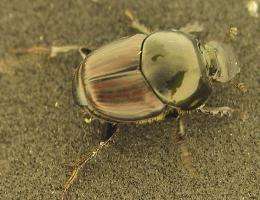
Onthophagus taurus. Credit: Bugguide
Following months of gruelling tests and trials, scientists now reveal the World's strongest insect to be a species of dung beetle called Onthophagus taurus.
In an experiment to find out why animals vary so much in strength and endurance, Dr Rob Knell from Queen Mary, University of London and Professor Leigh Simmons from the University of Western Australia found the strongest beetle could pull an astonishing 1,141 times its own body weight - the equivalent of a 70kg person lifting 80 tonnes (the same as six full double-decker buses).
Writing in the journal Proceedings of the Royal Society B, the scientists also found these insect athletes need to pay just as much attention to their diet as human athletes. Even the strongest beetles were reduced to feeble weaklings when put on a poor diet for a few days.
"Insects are well known for being able to perform amazing feats of strength," explained Dr Knell from Queen Mary's School of Biological and Chemical Sciences, "and it's all on account of their curious sex lives. Female beetles of this species dig tunnels under a dung pat, where males mate with them. If a male enters a tunnel that is already occupied by a rival, they fight by locking horns and try to push each other out." Knell and Simmons tested the beetles' ability to resist a rival by measuring how much weight was needed to pull him out of his hole.
"Interestingly, some male dung beetles don't fight over females," said Dr Knell. "They are smaller, weaker and don't have horns like the larger males. Even when we fed them up they didn't grow stronger, so we know it's not because they have a poorer diet.
"They did, however, develop substantially bigger testicles for their body size. This suggests they sneak behind the back of the other male, waiting until he's looking the other way for a chance to mate with the female. Instead of growing super strength to fight for a female, they grow lots more sperm to increase their chances of fertilising her eggs and fathering the next generation."
-
Female dung beetles use horns to fight over manure
Mar 04, 2010 |
not rated yet |
0
-
Armed beetles find a mate, whatever their size
Mar 27, 2008 |
not rated yet |
0
-
Sex is thirst-quenching for female beetles
Aug 28, 2007 |
not rated yet |
0
-
Lustful beetles desire water, not sex
Mar 05, 2009 |
not rated yet |
0
-
Why do males and females of some species look so different?
Dec 04, 2006 |
not rated yet |
0
-
Engineers build first sub-10-nm carbon nanotube transistor
Feb 01, 2012 |
4.9 / 5 (31) |
30
-
Something old, something new: Evolution and the structural divergence of duplicate genes
Jan 31, 2012 |
4.6 / 5 (7) |
1
-
The hidden nanoworld of ice crystals: Revealing the dynamic behavior of quasi-liquid layers
Jan 30, 2012 |
5 / 5 (3) |
1
-
Stock market network reveals investor clustering
Jan 27, 2012 |
3.9 / 5 (23) |
8
-
Of microchemistry and molecules: Electronic microfluidic device synthesizes biocompatible probes
Jan 26, 2012 |
5 / 5 (1) |
0
-
Protease cleavage
7 hours ago
-
Pertubance in a model
13 hours ago
-
Cancer drugs and Alzheimer's, Oh my!
21 hours ago
-
Squishing cells
22 hours ago
-
Any books/articles for evolutionary stable strategy models in humans?
Feb 09, 2012
-
Science behind the bore feeling?
Feb 09, 2012
- More from Physics Forums - Biology
More news stories
The power of estrogen -- male snakes attract other males
A new study has shown that boosting the estrogen levels of male garter snakes causes them to secrete the same pheromones that females use to attract suitors, and turned the males into just about the sexiest ...
11 hours ago |
4.8 / 5 (5) |
0
|
Grass to gas: Researchers' genome map speeds biofuel development
Researchers at the University of Georgia have taken a major step in the ongoing effort to find sources of cleaner, renewable energy by mapping the genomes of two originator cells of Miscanthus x giganteus, a large perenn ...
8 hours ago |
3.8 / 5 (5) |
0
|
Experts reveal how plants don't get sunburn
(PhysOrg.com) -- Experts at the University of Glasgow have discovered how plants survive the harmful rays of the sun.
11 hours ago |
5 / 5 (2) |
0
|
Miami battling invasion of giant African snails
No one knows how they got there. But an invasion of African giant snails has southern Florida in a panic over potential crop damage, disease and general yuckiness surrounding the slimy gastropods.
15 hours ago |
4 / 5 (1) |
4
Protein libraries in a snap
(PhysOrg.com) -- A Rice University undergraduate will depart with not only a degree but also a possible patent for his invention of an efficient way to create protein libraries, an important component of biomolecular ...
15 hours ago |
5 / 5 (3) |
0
|
Google users warned of threat to smartphone wallets
Users of Google smartphone wallets were being warned on Friday that there is a way to crack pass codes intended to thwart thieves from going on illicit shopping sprees.
Anonymous knocks CIA website offline (Update)
The website of the Central Intelligence Agency was inaccessible on Friday after the hacker group Anonymous claimed to have knocked it offline.
Complex wiring of the nervous system may rely on a just a handful of genes and proteins
Researchers at the Salk Institute have discovered a startling feature of early brain development that helps to explain how complex neuron wiring patterns are programmed using just a handful of critical genes. ...
New error-correcting codes guarantee the fastest possible rate of data transmission
Error-correcting codes are one of the triumphs of the digital age. Theyre a way of encoding information so that it can be transmitted across a communication channel such as an optical fiber o ...
Putting the squeeze on planets outside our solar system
(PhysOrg.com) -- Using high-powered lasers, scientists at Lawrence Livermore National Laboratory and collaborators discovered that molten magnesium silicate undergoes a phase change in the liquid state, abruptly ...
Humans may have helped the decline of African rainforests 3000 years ago
(PhysOrg.com) -- Large areas of rainforests in Central Africa mysteriously disappeared over three thousand years ago, to be replaced by savannas. The prevailing theory has been that the cause was a change ...