New ancestor? Scientists ponder DNA from Siberia
March 24, 2010
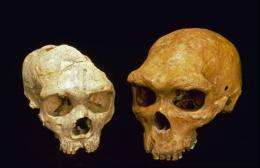
The DNA of an ancient unidentified Siberian has been revealed. The Denisova human shared a common ancestor with modern humans and Neanderthals (cranium shown on the left) about 1 million years ago. The Denisova human could be an off-shoot of Homo heidelbergensis (shown on the right).
(PhysOrg.com) -- An international team of scientists from the Max Planck Institute for Evolutionary Anthropology in Leipzig has sequenced ancient mitochondrial DNA from a finger bone found in southern Siberia. The bone is from a previously unknown form of human that lived in the Altai Mountains of Central Asia around 48,000 to 30,000 years ago. This mitochondrial genetic material, passed down through the descendants in the maternal line, is a sign of a new wave of migration out of Africa, one that is distinct from that of Homo erectus, the ancestors of Neanderthals and Homo sapiens (Nature, 24 March 2010).
The first group of hominins to leave Africa some 1.9 million years ago was Homo erectus. Archaeological finds and genetic data indicate that at least two other groups left Africa at a later date: first, around 500,000 to 300,000 years ago, the ancestors of the Neanderthals migrated. Then, about 50,000 years ago, it was the turn of the forefathers of anatomically modern humans. Direct descendants of Homo erectus may have survived in Indonesia until less than 100,000 years ago. Older representatives of Homo erectus and Homo heidelbergensis also lived in more northerly climes, for instance in the Altai Mountains in southern Siberia more than 125,000 years ago. Neanderthals also lived in Siberia at that time.
Johannes Krause, Svante Pääbo and their colleagues from the Max Planck Institute for Evolutionary Anthropology in Leipzig have now sequenced mitochondrial DNA from a tiny fragment of a finger bone. The bone was found in the Denisova Cave in the Altai Mountains in southern Siberia in 2008. The scientists compared the ancient DNA from the mitochondria, the "powerhouses of the cell", with the mitochondrial DNA of Neanderthals and of humans alive today. They found that the mitochondrial DNA of this hominin from southern Siberia differed markedly from all other known hominins.
A detailed analysis of the mitochondrial genetic material showed that this hominin shared a descendant with modern humans and with Neanderthals about 1.0 million years ago. This common descendant is about twice as old as the shared descendant of anatomically modern humans and Neanderthals, as determined on the basis of their mitochondrial DNA. Furthermore, the age of the fossil indicates that this unknown form of human could have co-existed with Neanderthals and modern humans in southern Siberia.
More information: Johannes Krause, Qiaomei Fu, Jeffrey M. Good, Bence Viola, Michael V. Shunkov, Anatoli P. Derevianko & Svante Pääbo, The complete mitochondrial DNA genome of an unknown hominin from southern Siberia. Nature, 24 March 2010, DOI: 10.1038/nature08976
Provided by Max Planck Society
-
Using modern sequencing techniques to study ancient modern humans
Dec 31, 2009 |
not rated yet |
0
-
Researchers Probe Links Between Modern Humans and Neanderthals
Sep 19, 2009 |
not rated yet |
0
-
Humans were once an endangered species
Jan 21, 2010 |
not rated yet |
0
-
Humans spread out of Africa later
Sep 04, 2009 |
not rated yet |
0
-
Could Neanderthals live again?
Feb 11, 2010 |
not rated yet |
0
-
Engineers build first sub-10-nm carbon nanotube transistor
Feb 01, 2012 |
4.9 / 5 (31) |
30
-
Something old, something new: Evolution and the structural divergence of duplicate genes
Jan 31, 2012 |
4.6 / 5 (7) |
1
-
The hidden nanoworld of ice crystals: Revealing the dynamic behavior of quasi-liquid layers
Jan 30, 2012 |
5 / 5 (3) |
1
-
Stock market network reveals investor clustering
Jan 27, 2012 |
3.9 / 5 (23) |
8
-
Of microchemistry and molecules: Electronic microfluidic device synthesizes biocompatible probes
Jan 26, 2012 |
5 / 5 (1) |
0
-
Protease cleavage
4 hours ago
-
Pertubance in a model
10 hours ago
-
Cancer drugs and Alzheimer's, Oh my!
18 hours ago
-
Squishing cells
19 hours ago
-
Any books/articles for evolutionary stable strategy models in humans?
Feb 09, 2012
-
Science behind the bore feeling?
Feb 09, 2012
- More from Physics Forums - Biology
More news stories
Employers feel no love for unscrupulous practice of 'service sweethearting'
A new study led by two Florida State University marketing professors finds that some frontline service employees who are rewarded for hikes in customer loyalty and satisfaction also may engage in "service ...
Other Sciences / Economics & Business
4 hours ago |
4 / 5 (1) |
4
A frank discussion of the power law and linking correlation to causation
(PhysOrg.com) -- Michael Stumpf a mathematics professor at Imperial College in London, and Mason Porter a lecturer at Oxford have teamed together to write and publish a perspective piece in Science regarding the in ...
Sonic Cradle lands spot in TED exhibition
A Simon Fraser University graduate student project that melds music, meditation and modern technology has landed a rare spot as an exhibit at TEDActive 2012 in Palm Springs, California this month.
6 hours ago |
not rated yet |
0
The question of life in the ancient world
Theres a general feeling that we dont get the Greeks ancient or modern. Many, including heads of state like Angela Merkel, visibly shake their head in exasperation, rightly or wrongly, at ...
Other Sciences / Archaeology & Fossils
10 hours ago |
1 / 5 (1) |
4
Chilean miners' rescue capsule on show in London
The capsule used to rescue Chilean miners trapped underground for two months goes on display Saturday at the Science Museum in London -- the first time it has been seen in Europe.
9 hours ago |
not rated yet |
0
Google users warned of threat to smartphone wallets
Users of Google smartphone wallets were being warned on Friday that there is a way to crack pass codes intended to thwart thieves from going on illicit shopping sprees.
CIA website offline, Anonymous takes credit
The website of the Central Intelligence Agency was unresponsive on Friday after the hacker group Anonymous claimed to have knocked it offline.
NASA sees wide-eyed cyclone Jasmine
Cyclone Jasmine's eye has opened wider on NASA satellite imagery, as it moves through the Southern Pacific Ocean.
Complex wiring of the nervous system may rely on a just a handful of genes and proteins
Researchers at the Salk Institute have discovered a startling feature of early brain development that helps to explain how complex neuron wiring patterns are programmed using just a handful of critical genes. ...
NASA sees Giovanna reach cyclone strength, threaten Madagascar
Tropical Storm 12S built up steam and became a cyclone on February 10, 2012 as NASA's Terra satellite passed overhead. Residents of east-central Madagascar should prepare for this cyclone to make landfall ...
Putting the squeeze on planets outside our solar system
(PhysOrg.com) -- Using high-powered lasers, scientists at Lawrence Livermore National Laboratory and collaborators discovered that molten magnesium silicate undergoes a phase change in the liquid state, abruptly ...