HP Demos Rollup Flexible Displays (w/ Video)

March 25, 2010 by John Messina weblog
HP Demos Rollup Flexible Displays (w/ Video)

Enlarge

Current flexible displays use a batch cookie cutter process for manufacturing. A new production method called Self-Aligned Imprint Lithography (SAIL) will streamline production and reduce cost.

(PhysOrg.com) -- The Flexible Display Center, at Arizona State University, hopes to have flexible displays ready for test trials in approximately three years. The possibilities of using flexible displays are endless and one day will be used in many portable devices such as e-readers, cell phones, and tablets.

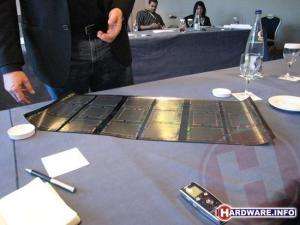
The people at hardware.info recently saw one of HP’s flexible screens rolled up and placed into a poster tube. HP’s CTO, Phil McKinney states that the is not designed to be rolled up. The display would only survive being rolled up about six times before it would start to malfunction. The screens are printed on flexible plastic sheets of Mylar material and could be easily rolled during the manufacturing process.

This video is not supported by your browser at this time.

First demo of HP's new flexible display technology demo by Phil McKinney (HP’s CTO)

The displays can be mass produced by using a production method called Self-Aligned Imprint (SAIL). By manufacturing the displays in the form of rolls instead of sheets makes the production method more cost effective.
HP Demos Rollup Flexible Displays (w/ Video)
Enlarge

The flexible display is not intended to be a roll up screen but a lighter and more compact display.

HP’s manufacturing process, for the prototype, allows for the fabrication of arrays on a flexible plastic material. The displays would then be created using a roll-to-roll manufacturing process in a similar way like a newspaper is printed in the press. This compares to the current method used today as a batch process where displays are cookie cut.

Carl Taussig director of Information Surfaces at HP Labs stated, “In addition to providing a lower-cost process, SAIL technology represents a more sustainable, environmentally sensitive approach to producing electronic displays. We want to lower the costs of traditional flat panel displays and increase their functionality.”

HP Demos Rollup Flexible Displays (w/ Video)
Enlarge

Here the fabrication of thin film transistor arrays can be seen on a flexible plastic material.

HP is hoping to use this technology to offer lighter and more compact devices such as e-readers and tablets. The head of HP technology is expecting, in about two years, to have the first products on the market and in about three years to have mass production.

More information: http://flexdisplay.asu.edu/
via HardwareInfo

© 2010 PhysOrg.com

3.6 /5 (14 votes)  

Filter


Move the slider to adjust rank threshold, so that you can hide some of the comments.


Display comments: newest first

DaffyDuck
Mar 25, 2010

Rank: not rated yet
Sorry but why even mention that it rolls if it's not supposed to be rolled?
fourthrocker
Mar 25, 2010

Rank: not rated yet
Because it can be rolled at manufacture and then shipped rolled, it just can't be re-rolled. Since it's a prototype, improvements will most likely allow them to be rolled many times eventually.
gennoveus
Mar 25, 2010

Rank: not rated yet
I thought that the whole point of flexible displays was that they could be rolled up to be very small? I understand the value in lightweight displays, but they'll need to make them roll up like a scroll for them to be a truly revolutionary technology.
Royale
Mar 26, 2010

Rank: not rated yet
Absolutely agreed. The title, as per the usual, is a misnomer. 'You can roll them people, just don't pass 6 times or you're screwed'. And to think the title got me all excited. Ah well, it's a step in the right direction. Plus, I bet it'll get here before sustainable hot fusion.
dutchman
Mar 31, 2010

Rank: not rated yet

Think of the possibilities: Mass produced Torahs. I'm getting totally verklemmt
Rank 3.6 /5 (14 votes)
Relevant PhysicsForums posts
  • Calling function with no input argument
    created16 hours ago
  • Force free body diagram problem on gym equipment
    created17 hours ago
  • Empirical data regarding shower heads and water
    createdFeb 10, 2012
  • feed hold button on CNC lathe
    createdFeb 09, 2012
  • RFAC in Fortran
    createdFeb 09, 2012
  • dynamics 2/32
    createdFeb 08, 2012
  • More from Physics Forums - General Engineering

More news stories

Anonymous knocks CIA website offline (Update)

The website of the Central Intelligence Agency was inaccessible on Friday after the hacker group Anonymous claimed to have knocked it offline.

Technology / Internet

created 11 hours ago | popularity 5 / 5 (10) | comments 16

New error-correcting codes guarantee the fastest possible rate of data transmission

Error-correcting codes are one of the triumphs of the digital age. They’re a way of encoding information so that it can be transmitted across a communication channel — such as an optical fiber o ...

Technology / Computer Sciences

created 19 hours ago | popularity 4.9 / 5 (8) | comments 6 | with audio podcast

Google users warned of threat to smartphone wallets

Users of Google smartphone wallets were being warned on Friday that there is a way to crack pass codes intended to thwart thieves from going on illicit shopping sprees.

Technology / Internet

created 9 hours ago | popularity 5 / 5 (2) | comments 0

New power source discovered

(PhysOrg.com) -- Researchers at the Massachusetts Institute of Technology (MIT) and RMIT University have made a breakthrough in energy storage and power generation.

Technology / Energy & Green Tech

created 18 hours ago | popularity 4.7 / 5 (31) | comments 8 | with audio podcast

Small modular reactor design could be a 'SUPERSTAR'

(PhysOrg.com) -- Though most of today's nuclear reactors are cooled by water, we've long known that there are alternatives; in fact, the world's first nuclear-powered electricity in 1951 came from a reactor ...

Technology / Energy & Green Tech

created 19 hours ago | popularity 4.4 / 5 (13) | comments 25 | with audio podcast


Humans may have helped the decline of African rainforests 3000 years ago

(PhysOrg.com) -- Large areas of rainforests in Central Africa mysteriously disappeared over three thousand years ago, to be replaced by savannas. The prevailing theory has been that the cause was a change ...

The power of estrogen -- male snakes attract other males

A new study has shown that boosting the estrogen levels of male garter snakes causes them to secrete the same pheromones that females use to attract suitors, and turned the males into just about the sexiest ...

Advanced power-grid model finds low-cost, low-carbon future in West

(PhysOrg.com) -- The least expensive way for the Western U.S. to reduce greenhouse gas emissions enough to help prevent the worst consequences of global warming is to replace coal with renewable and other ...

Could Venus be shifting gear?

(PhysOrg.com) -- ESA’s Venus Express spacecraft has discovered that our cloud-covered neighbour spins a little slower than previously measured. Peering through the dense atmosphere in the infrared, the ...

Complex wiring of the nervous system may rely on a just a handful of genes and proteins

Researchers at the Salk Institute have discovered a startling feature of early brain development that helps to explain how complex neuron wiring patterns are programmed using just a handful of critical genes. ...

Japan scientist makes 'Avatar' robot

A Japanese-developed robot that mimics the movements of its human controller is bringing the Hollywood blockbuster "Avatar" one step closer to reality.