Blueprint for 'artificial leaf' mimics Mother Nature
March 25, 2010
Blueprint for 'artificial leaf' mimics Mother Nature

Enlarge

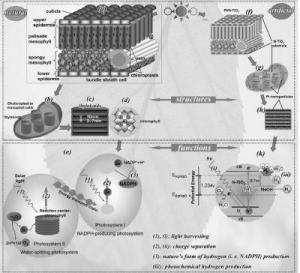
This is part of the recipe for an artificial leaf, which draws on Mother Nature's secrets, and could use sunlight and water to produce fuel. Credit: Tongxiang Fan, Ph.D.

Scientists today presented a design strategy to produce the long-sought artificial leaf, which could harness Mother Nature's ability to produce energy from sunlight and water in the process called photosynthesis. The new recipe, based on the chemistry and biology of natural leaves, could lead to working prototypes of an artificial leaf that capture solar energy and use it efficiently to change water into hydrogen fuel, they stated.

Their report was scheduled for the 239th National Meeting of the American Chemical Society (ACS), being held here this week. It was among more than 12,000 scientific reports scheduled for presentation at the meeting, one of the largest scientific gatherings of 2010.

"This concept may provide a new vista for the design of artificial photosynthetic systems based on biological paradigms and build a working prototype to exploit sustainable energy resources," Tongxiang Fan, Ph.D. and colleagues Di Zhang, Ph.D. and Han Zhou, Ph.D., reported, They are with the State Key Lab of Matrix Composites at Shanghai Jiaotong University, Shanghai, China.

Fan pointed out that using sunlight to split water into its components, hydrogen and oxygen, is one of the most promising and sustainable tactics to escape current dependence on coal, oil, and other traditional fuels. When burned, those fuels release carbon dioxide, the main . Combustion of hydrogen, in contrast, forms just water vapor. That appeal is central to the much-discussed "," and some auto companies, such as Toyota, have developed hydrogen-fueled cars. Lacking, however, is a cost-effective sustainable way to produce hydrogen.

With that in mind, Fan and co-workers decided to take a closer look at the leaf, nature's photosynthetic system, with plans to use its structure as a blueprint for their next generation of artificial systems. Not too surprisingly, the structure of green leaves provides them an extremely high light-harvesting efficiency. Within their architecture are structures responsible focusing and guiding of solar energy into the light-harvesting sections of the leaf, and other functions.

The scientists decided to mimic that natural design in the development of a blueprint for artificial leaf-like structures. It led them to report their recipe for the "Artificial Inorganic Leaf" (AIL), based on the natural leaf and titanium dioxide (TiO2) — a chemical already recognized as a photocatalyst for hydrogen production.

The scientists first infiltrated the leaves of Anemone vitifolia - a plant native to China - with titanium dioxide in a two-step process. Using advanced spectroscopic techniques, the scientists were then able to confirm that the structural features in the leaf favorable for light harvesting were replicated in the new TiO2 structure. Excitingly, the AIL are eight times more active for hydrogen production than TiO2 that has not been "biotemplated" in that fashion. AILs also are more than three times as active as commercial photo-catalysts. Next, the scientists embedded nanoparticles of platinum into the leaf surface. Platinum, along with the nitrogen found naturally in the leaf, helps increase the activity of the artificial leaves by an additional factor of ten.

In his ACS presentation, Fan reported on various aspects of Artificial Inorganic Leaf production, their spectroscopic work to better understand the macro- and microstructure of the photocatalysts, and their comparison to previously reported systems. The activity of these new "leaves", are significantly higher than those prepared with classic routes. Fan attributes these results to the hierarchical structures derived from natural leaves:

"Our results may represent an important first step towards the design of novel artificial solar energy transduction systems based on natural paradigms, particularly based on exploring and mimicking the structural design. Nature still has much to teach us, and human ingenuity can modify the principles of natural systems for enhanced utility."

Provided by American Chemical Society (news : web)

4.9 /5 (15 votes)  

Filter


Move the slider to adjust rank threshold, so that you can hide some of the comments.


Display comments: newest first

TheWalrus
Mar 25, 2010

Rank: not rated yet
Minor correction (unless I'm wrong): Tongxiang is (probably) the surname. Chinese names put the surname first. So, the reference to "Fan" is like referring to "John" when you mean "Dr. Smith."
hedagi
Mar 26, 2010

Rank: not rated yet
So far so good! The big hurdle Tongxiang & Co. will face is to keep their leaves alive after so many chemical aggressions (titanium, nano-particles) to them. For if their leaves died, would they be able to collect any hydrogen bubbles? Finally I wonder whether Tongxiang & Co. are aware that there is a chap – Nocera by name – that has been on this at the MIT during the last 25 years; he's even founded a start-up!
Quantum_Conundrum
Mar 26, 2010

Rank: not rated yet
...are they seriously considering making solor power using platinum? Anyone checked the PRICE of platinum lately?

$1609.00 per ounce today...

Or an average of:

$1595.28 over the past month.

If they averaged 1/10th of an ounce of platinum per meter of the artificial leaf, then that would be $159 per square meter in platinum raw material costs alone.
pikey
May 08, 2010

Rank: not rated yet
Costs, always costs.We cannot eat nor drink profitability.
Rank 4.9 /5 (15 votes)
Relevant PhysicsForums posts
  • Cis-trans Selectivity in Wittig Reactions
    created4 hours ago
  • Chemical Kinetics
    created4 hours ago
  • heat-driven chemical reaction and thermodynamics
    created11 hours ago
  • phenol to benzene
    created15 hours ago
  • TQM, QA and QC
    created16 hours ago
  • oxidising power
    created22 hours ago
  • More from Physics Forums - Chemistry

More news stories

Flesh-eating bacteria inspire superglue

(PhysOrg.com) -- A bio-inspired superglue has been developed by Oxford University researchers that can’t be matched for sticking molecules together and not letting go.

Chemistry / Biochemistry

created 21 hours ago | popularity 5 / 5 (8) | comments 3 | with audio podcast

Scientists create potent molecules aimed at treating muscular dystrophy

While RNA is an appealing drug target, small molecules that can actually affect its function have rarely been found. But now scientists from the Florida campus of The Scripps Research Institute have for the first time designed ...

Chemistry / Biochemistry

created 10 hours ago | popularity 5 / 5 (4) | comments 0 | with audio podcast

Researchers discover what cancer cells need to travel

(PhysOrg.com) -- Cancer cells must prepare for travel before invading new tissues, but new Cornell research has found a possible way to stop these cells from ever hitting the road.

Chemistry / Biochemistry

created 20 hours ago | popularity 4.9 / 5 (12) | comments 0 | with audio podcast

New microfluidic device could be used to diagnose and monitor cancer and other diseases

Separating complex mixtures of cells, such as those found in a blood sample, can offer valuable information for diagnosing and treating disease. However, it may be necessary to search through billions of other ...

Chemistry / Analytical Chemistry

created 20 hours ago | popularity 5 / 5 (2) | comments 0 | with audio podcast

New way to tap largest remaining treasure trove of potential new antibiotics

Scientists are reporting use of a new technology for sifting through the world's largest remaining pool of potential antibiotics to discover two new antibiotics that work against deadly resistant microbes, ...

Chemistry / Biochemistry

created 13 hours ago | popularity 5 / 5 (4) | comments 0


Researchers build first physical 'metatronic' circuit

(PhysOrg.com) -- The technological world of the 21st century owes a tremendous amount to advances in electrical engineering, specifically, the ability to finely control the flow of electrical charges using ...

Spitzer finds solid buckyballs in space

(PhysOrg.com) -- Astronomers using data from NASA's Spitzer Space Telescope have, for the first time, discovered buckyballs in a solid form in space. Prior to this discovery, the microscopic carbon spheres ...

Faster than light neutrinos? More like faulty wiring

You can shelf your designs for a warp drive engine (for now) and put the DeLorean back in the garage; it turns out neutrinos may not have broken any cosmic speed limits after all.

Physicists surprised by disappearing and reappearing superconductivity in iron selenium chalcogenides

Superconductivity is a rare physical state in which matter is able to conduct electricity -- maintain a flow of electrons -- without any resistance. This phenomenon can only be found in certain materials at low temperatures, ...

Stanford research team cracks animated NuCaptcha

(PhysOrg.com) -- The research team from Stanford University, led by Elie Bursztein, that previously had cracked regular CAPTCHAs and then audio CAPTCHAs, now has also successfully cracked the animated version called NuCapt ...

Going up: Japan builder eyes space elevator

A Japanese construction firm claimed Wednesday it could execute an out-of-this-world plan to put tourists in space within 40 years by building an elevator that stretches a quarter of the way to the moon.