Safer nuclear reactors could result from new research
March 25, 2010
Safer nuclear reactors could result from new research

Enlarge

(PhysOrg.com) -- Self-repairing materials within nuclear reactors may one day become a reality as a result of research by Los Alamos National Laboratory scientists.

In a paper appearing today in the journal Science, Los Alamos researchers report a surprising mechanism that allows nanocrystalline materials to heal themselves after suffering radiation-induced damage. Nanocrystalline materials are those created from nanosized particles, in this case copper particles. A single nanosized particle—called a grain—is the size of a virus or even smaller. Nanocrystalline materials consist of a mixture of grains and the interface between those grains, called grain boundaries.

When designing nuclear reactors or the materials that go into them, one of the key challenges is finding materials that can withstand an outrageously . In addition to constant bombardment by radiation, reactor materials may be subjected to extremes in temperature, physical stress, and corrosive conditions. Exposure to high radiation alone produces significant damage at the nanoscale.

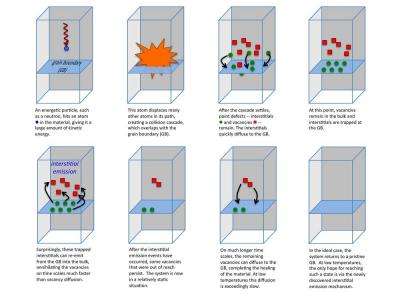
Radiation can cause individual atoms or groups of atoms to be jarred out of place. Each vagrant atom becomes known as an interstitial. The empty space left behind by the displaced atom is known as a vacancy. Consequently, every interstitial created also creates one vacancy. As these defects—the interstitials and vacancies—build up over time in a material, effects such as swelling, hardening or embrittlement can manifest in the material and lead to catastrophic failure.

Therefore, designing materials that can withstand radiation-induced damage is very important for improving the reliability, safety and lifespan of nuclear energy systems.

Because nanocrystalline materials contain a large fraction of grain boundaries—which are thought to act as sinks that absorb and remove defects—scientists have expected that these materials should be more radiation tolerant than their larger-grain counterparts. Nevertheless, the ability to predict the performance of nanocrystalline materials in extreme environments has been severely lacking because specific details of what occurs within solids are very complex and difficult to visualize.

Recent computer simulations by the Los Alamos researchers help explain some of those details.

In the Science paper, the researchers describe the never-before-observed phenomenon of a "loading-unloading" effect at grain boundaries in nanocrystalline materials. This loading-unloading effect allows for effective self-healing of radiation-induced defects. Using three different computer simulation methods, the researchers looked at the interaction between defects and grain boundaries on time scales ranging from picoseconds to microseconds (one-trillionth of a second to one-millionth of a second).

On the shorter timescales, radiation-damaged materials underwent a "loading" process at the grain boundaries, in which interstitial atoms became trapped—or loaded—into the grain boundary. Under these conditions, the subsequent number of accumulated vacancies in the bulk material occurred in amounts much greater than would have occurred in bulk materials in which a boundary didn't exist. After trapping interstitials, the grain boundary later "unloaded" interstitials back into vacancies near the grain boundary. In so doing, the process annihilates both types of defects—healing the material.

This unloading process was totally unexpected because grain boundaries traditionally have been regarded as places that accumulate interstitials, but not as places that release them. Although researchers found that some energy is required for this newly-discovered recombination method to operate, the amount of energy was much lower than the energies required to operate conventional mechanisms—providing an explanation and mechanism for enhanced self-healing of radiation-induced damage.

Modeling of the "loading-unloading" role of grain boundaries helps explain previously observed counterintuitive behavior of irradiated nanocrystalline materials compared to their larger-grained counterparts. The insight provided by this work provides new avenues for further examination of the role of and engineered material interfaces in self-healing of radiation-induced defects. Such efforts could eventually assist or accelerate the design of highly radiation-tolerant materials for the next generation of nuclear energy applications.

Provided by Los Alamos National Laboratory (news : web)

4.5 /5 (16 votes)  

Filter


Move the slider to adjust rank threshold, so that you can hide some of the comments.


Display comments: newest first

zevkirsh
Mar 25, 2010

Rank: 4 / 5 (4)
bill gates will be taking note of this. small self contained, modular, and low/no maintanance nuclear reactors are going to be a huge export market to africa , south america and aother parts of the power-hungry developing world. if russia and china dominate this export market , the u.s. would do well to team up with the germans and the french to compete.
Slotin
Mar 25, 2010

Rank: not rated yet
One practical application of the above finding is the usage of layered materials similar to damascus steels, where the number of grain boundaries with healing effects is artificially increased.

http://www.physor...237.html
Slotin
Mar 25, 2010

Rank: 1 / 5 (1)
..never-before-observed phenomenon of a "loading-unloading" effect ..
Something like this was observed already and it was explained by surface tension forces at phase boundaries similar to those, which affect the cleaning of fluids during foam flotation.
baudrunner
Mar 26, 2010

Rank: not rated yet
Crystalline formation is a natural phenomenon, so it is not surprising that self-reconstruction of damaged crystalline materials is observed.
Rank 4.5 /5 (16 votes)
Related Stories
Relevant PhysicsForums posts
  • Doubts about surface plasmons
    created1 hour ago
  • excited U-236 decay time in the U235 fission chain
    createdFeb 09, 2012
  • Polar catastrophe?
    createdFeb 09, 2012
  • Large scale field sonication
    createdFeb 09, 2012
  • states and energy of paired electrons in BCS
    createdFeb 08, 2012
  • difference between longitudinal and transverse refractive indices
    createdFeb 08, 2012
  • More from Physics Forums - Atomic, Solid State, Comp. Physics

More news stories

Putting the squeeze on planets outside our solar system

(PhysOrg.com) -- Using high-powered lasers, scientists at Lawrence Livermore National Laboratory and collaborators discovered that molten magnesium silicate undergoes a phase change in the liquid state, abruptly ...

Physics / Condensed Matter

created 15 hours ago | popularity 4.3 / 5 (7) | comments 0 | with audio podcast

Hovering not hard if you're top-heavy, researchers find

Top-heavy structures are more likely to maintain their balance while hovering in the air than are those that bear a lower center of gravity, researchers at New York University's Courant Institute of Mathematical Sciences ...

Physics / General Physics

created 16 hours ago | popularity 5 / 5 (2) | comments 1 | with audio podcast

SLAC, Stanford team focuses on high-energy electrons to treat cancer

Accelerator physicists at SLAC and cancer specialists from Stanford are working on a new technology that could dramatically reduce the time needed for cancer radiation treatments. The team ran an initial experiment ...

Physics / General Physics

created 19 hours ago | popularity 5 / 5 (2) | comments 0

Measurements from high-energy collisions lead to better understanding of why meson particles disappear

For several years, physicists at the Relativistic Heavy Ion Collider (RHIC) at Brookhaven National Laboratory (BNL), USA, have studied an unusual state of matter called the quark–gluon plasma, which they ...

Physics / General Physics

created 20 hours ago | popularity 4.5 / 5 (4) | comments 0

Explained: Sigma

It's a question that arises with virtually every major new finding in science or medicine: What makes a result reliable enough to be taken seriously? The answer has to do with statistical significance -- but ...

Physics / General Physics

created Feb 09, 2012 | popularity 5 / 5 (16) | comments 53


Anonymous knocks CIA website offline (Update)

The website of the Central Intelligence Agency was inaccessible on Friday after the hacker group Anonymous claimed to have knocked it offline.

New error-correcting codes guarantee the fastest possible rate of data transmission

Error-correcting codes are one of the triumphs of the digital age. They’re a way of encoding information so that it can be transmitted across a communication channel — such as an optical fiber o ...

Humans may have helped the decline of African rainforests 3000 years ago

(PhysOrg.com) -- Large areas of rainforests in Central Africa mysteriously disappeared over three thousand years ago, to be replaced by savannas. The prevailing theory has been that the cause was a change ...

Small modular reactor design could be a 'SUPERSTAR'

(PhysOrg.com) -- Though most of today's nuclear reactors are cooled by water, we've long known that there are alternatives; in fact, the world's first nuclear-powered electricity in 1951 came from a reactor ...

New power source discovered

(PhysOrg.com) -- Researchers at the Massachusetts Institute of Technology (MIT) and RMIT University have made a breakthrough in energy storage and power generation.

The power of estrogen -- male snakes attract other males

A new study has shown that boosting the estrogen levels of male garter snakes causes them to secrete the same pheromones that females use to attract suitors, and turned the males into just about the sexiest ...