Death of coral reefs could devastate nations
March 25, 2010 By BRIAN SKOLOFF , Associated Press Writer
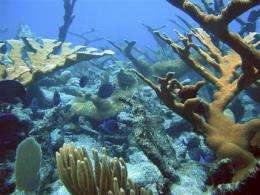
In this undated photo provided by the U.S. National Oceanic and Atmospheric Administration (NOAA), a healthy coral reef in St. Croix, US Virgin Islands is shown. According to the NOAA, some 27 percent of the world's reefs are already gone. If current trends continue, the agency predicts another two-thirds will disappear by 2032. That's nearly 70 percent of the world's reefs gone in just the next 20 years. (AP Photo/U.S. National Oceanic and Atmospheric Administration, HO)
(AP) -- Coral reefs are dying, and scientists and governments around the world are contemplating what will happen if they disappear altogether.
The idea positively scares them.
Coral reefs are part of the foundation of the ocean food chain. Nearly half the fish the world eats make their homes around them. Hundreds of millions of people worldwide - by some estimates, 1 billion across Asia alone - depend on them for their food and their livelihoods.
If the reefs vanished, experts say, hunger, poverty and political instability could ensue.
"Whole nations will be threatened in terms of their existence," said Carl Gustaf Lundin of the International Union for the Conservation of Nature.
Numerous studies predict coral reefs are headed for extinction worldwide, largely because of global warming, pollution and coastal development, but also because of damage from bottom-dragging fishing boats and the international trade in jewelry and souvenirs made of coral.
At least 19 percent of the world's coral reefs are already gone, including some 50 percent of those in the Caribbean. An additional 15 percent could be dead within 20 years, according to the National Oceanic and Atmospheric Administration. Old Dominion University professor Kent Carpenter, director of a worldwide census of marine species, warned that if global warming continues unchecked, all corals could be extinct within 100 years.
"You could argue that a complete collapse of the marine ecosystem would be one of the consequences of losing corals," Carpenter said. "You're going to have a tremendous cascade effect for all life in the oceans."
Exotic and colorful, coral reefs aren't lifeless rocks; they are made up of living creatures that excrete a hard calcium carbonate exoskeleton. Once the animals die, the rocky structures erode, depriving fish of vital spawning and feeding grounds.
Experts say cutting back on carbon emissions to arrest rising sea temperatures and acidification of the water, declaring some reefs off limits to fishing and diving, and controlling coastal development and pollution could help reverse, or at least stall, the tide.
Florida, for instance, has the largest unbroken "no-take" zone in the continental U.S. - about 140 square miles off limits to fishing in and around Dry Tortugas National Park, a cluster of islands and reefs teeming with marine life about 70 miles off Key West.
Many fishermen oppose such restrictions. And other environmental measures have run into resistance at the state, local, national and international level. On Sunday, during a gathering of the Convention on the International Trade in Endangered Species of Wild Fauna and Flora, restrictions proposed by the U.S. and Sweden on the trade of some coral species were rejected.
If reefs were to disappear, commonly consumed species of grouper and snapper could become just memories. Oysters, clams and other creatures that are vital to many people's diets would also suffer. And experts say commercial fisheries would fail miserably at meeting demand for seafood.
"Fish will become a luxury good," said Cassandra deYoung of the U.N. Food and Agriculture Organization. "You already have a billion people who are facing hunger, and this is just going to aggravate the situation," she added. "We will not be able to maintain food security around the world."
The economic damage could be enormous. Ocean fisheries provide direct employment to at least 38 million people worldwide, with an additional 162 million people indirectly involved in the industry, according to the U.N.
Coral reefs draw scuba divers, snorkelers and other tourists to seaside resorts in Florida, Hawaii, Southeast Asia and the Caribbean and help maintain some of the world's finest sandy beaches by absorbing energy from waves. Without the reefs, hotels, restaurants and other businesses that cater to tourists could suffer financially.
Many Caribbean countries get nearly half their gross national product from visitors seeking tropical underwater experiences.
People all over the world could pay the price if reefs were to disappear, since some types of coral and marine species that rely on reefs are being used by the pharmaceutical industry to develop possible cures for cancer, arthritis and viruses.
"A world without coral reefs is unimaginable," said Jane Lubchenco, a marine biologist who heads NOAA. "Reefs are precious sources of food, medicine and livelihoods for hundreds of thousands around the world. They are also special places of renewal and recreation for thousands more. Their exotic beauty and diverse bounty are global treasures."
©2010 The Associated Press. All rights reserved. This material may not be published, broadcast, rewritten or redistributed.
-
Scientists call for coral reef regulations
Aug 04, 2006 |
not rated yet |
0
-
Tsunami reef damage recovering
Dec 27, 2005 |
not rated yet |
0
-
Coral can recover from climate change damage
Jan 09, 2010 |
not rated yet |
0
-
Twenty of world's 162 grouper species threatened with extinction
Mar 21, 2007 |
not rated yet |
0
-
Coral Triangle could die by century's end: WWF
May 13, 2009 |
not rated yet |
0
-
Engineers build first sub-10-nm carbon nanotube transistor
Feb 01, 2012 |
4.9 / 5 (30) |
30
-
Something old, something new: Evolution and the structural divergence of duplicate genes
Jan 31, 2012 |
4.6 / 5 (7) |
1
-
The hidden nanoworld of ice crystals: Revealing the dynamic behavior of quasi-liquid layers
Jan 30, 2012 |
5 / 5 (3) |
1
-
Stock market network reveals investor clustering
Jan 27, 2012 |
3.9 / 5 (23) |
8
-
Of microchemistry and molecules: Electronic microfluidic device synthesizes biocompatible probes
Jan 26, 2012 |
5 / 5 (1) |
0
-
Discrepancy between oxygen and carbon-dioxide levels
14 hours ago
-
where gems are found in the world
17 hours ago
-
Wind Waves in Reservoir ~ Wind run-up and Wind set-up
Feb 08, 2012
-
Balance of oxygen in the atmosphere
Feb 01, 2012
-
The case for a methanol-based economy
Jan 30, 2012
-
Weather in a rotating cylinder
Jan 25, 2012
- More from Physics Forums - Earth
More news stories
Could Venus be shifting gear?
(PhysOrg.com) -- ESAs Venus Express spacecraft has discovered that our cloud-covered neighbour spins a little slower than previously measured. Peering through the dense atmosphere in the infrared, the ...
Space & Earth / Space Exploration
2 hours ago |
5 / 5 (3) |
4
|
Clam fields found at deep, low-temperature Mariana vents
(PhysOrg.com) -- Scientists have marveled at the unusual life forms thriving at high temperature hydrothermal vents of the deep ocean.
Space & Earth / Earth Sciences
3 hours ago |
not rated yet |
0
|
Mars Science Laboratory computer issue resolved
(PhysOrg.com) -- Engineers have found the root cause of a computer reset that occurred two months ago on NASA's Mars Science Laboratory and have determined how to correct it.
Space & Earth / Space Exploration
3 hours ago |
5 / 5 (4) |
2
|
Humans may have helped the decline of African rainforests 3000 years ago
(PhysOrg.com) -- Large areas of rainforests in Central Africa mysteriously disappeared over three thousand years ago, to be replaced by savannas. The prevailing theory has been that the cause was a change ...
Two new moons for Jupiter
Advances in technology have lead to the discovery of new planets outside of our Solar System, and now even new moons in our own backyard.
Space & Earth / Space Exploration
2 hours ago |
not rated yet |
2
Zuckerberg's focus drives Facebook's ascent
When Mark Zuckerberg showed up to rent Judy Fusco's Los Altos, Calif., house in the fall of 2004, soon after he'd arrived in Silicon Valley, the landlord was immediately struck by his confidence.
Antidepressants and pregnancy: Women must consider the impact of drugs on baby, and of depression on baby, themselves
Upon learning they are pregnant, most women dutifully nix the alcohol, sushi and caffeine. But what about antidepressants?
Both maternal and paternal age linked to autism
Older maternal and paternal age are jointly associated with having a child with autism, according to a recently published study led by researchers at The University of Texas Health Science Center at Houston (UTHealth).
Curry spice component may help slow prostate tumor growth
Curcumin, an active component of the Indian curry spice turmeric, may help slow down tumor growth in castration-resistant prostate cancer patients on androgen deprivation therapy (ADT), a study from researchers ...
The power of estrogen -- male snakes attract other males
A new study has shown that boosting the estrogen levels of male garter snakes causes them to secrete the same pheromones that females use to attract suitors, and turned the males into just about the sexiest ...
Netflix light on flicks as viewers soak up TV shows
Like most fresh faces that arrive in Hollywood, Netflix wanted to be a movie star. But now it's learning what many in Tinseltown have known for decades: Movies are sexy, but the real money is in television.
Mar 26, 2010
Rank: 3 / 5 (2)
Mar 26, 2010
Rank: 3 / 5 (2)
2) Many human food sources originate from coral reefs via the food chains in the ocean.
3) As goes shallow coral, so too will go deeper corals.
4) Tourism is based on shallow tropical reefs, which are the ones most under threat, although all coral is in danger.
Mar 28, 2010
Rank: 1 / 5 (1)
As to CO2, that is nothing much we should be worrying about. Corals came about through evolution in anoxic seas as well as in seas with many times higher levels of CO2 than currently exist. The genes are still there.
When it is time these ancient genes will switch on and the corals will survive as they did world-wide mass extinctions. But, true pollutants are another matter.
If we do not spend more time working on cleaning up those messes, and preventing others of like kind, instead of focusing on a bogeyman, we will lose the corals and there will be nothing we can do about it.