Dynamo theory: How small planets can have self-sustaining magnetic fields
March 25, 2010 by Morgan Bettex
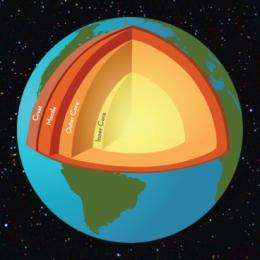
Earth’s magnetic field is generated from liquid iron located within the planet’s outer core that constantly moves as the planet cools. The outer core is located nearly 3,000 kilometers beneath Earth’s surface. Graphic: Christine Daniloff
The Earth's global magnetic field is generated in its metallic core, located nearly 3,000 kilometers beneath the planet’s surface. The field has existed on Earth for at least 3.5 billion years and offers clues about how other planets, stars and celestial bodies may have formed.
As scientists refine their understanding of how this field works in their ongoing probe of planetary history, one idea they use to explain this process is dynamo theory — the idea that a large dynamo, or magnetic field generator, exists within Earth’s outer core, where liquid iron constantly moves as the planet cools. This continuous motion creates electric currents as electrons move through the liquid. Through this process, the energy of the moving fluid is converted into a magnetic field that can be sustained for billions of years.
Knowing that planetary bodies like Earth, the Moon, Mars, and even asteroids have, or once had, a magnetic field is crucial for understanding their history and internal structure. This is because the presence of a magnetic field inside a body reveals that it also likely formed a metallic core that generated that field, according to Benjamin Weiss, an associate professor in the Department of Earth, Atmospheric and Planetary Sciences. Such a field is one of the few ways to remotely sense a metallic core buried so deep beneath a body’s surface.
If a fragment or rock from a planetary body is magnetized, this suggests that the body experienced large-scale melting in which heavier material sunk to the interior to form a metallic core and lighter material floated to the surface to create a rocky crust. This process gives a planet its history. “Otherwise, it would be a pile of space dust,” Weiss said.
Determining whether a planet generated a magnetic field in the past is not only important for inferring the presence of a core, but also may be important for learning about the origin of the planetary body and even the history of climate change for that body.
For example, although Mars does not have a magnetic field generated by a core dynamo today, Weiss and his colleagues have identified magnetization in Martian rocks, which indicates that Mars did have a strong global field billions of years ago. It appears that the disappearance of this early dynamo roughly coincided with the loss of Mars’ early thick atmosphere and the transition from an early warm, wet climate to the planet’s current cold and inhospitable conditions.
But scientists’ understanding of dynamo theory has been complicated by recent discoveries of magnetized rocks from the moon and ancient meteorites, as well as an active dynamo field on Mercury — places that were thought to have perhaps cooled too quickly or be too small to generate a self-sustaining magnetic field. It had been thought that smaller bodies couldn’t have dynamos because they cool more rapidly and are therefore more likely to have metallic cores that do not stay in liquid form for very long.
In 2008, an MIT-led group that included Weiss discovered magnetic traces within chunks from small, rocky objects called planetesimals that are believed to have slammed together to form the rocky planets 4.5 billion years ago. Planetesimals had previously been thought to be too small to have formed core dynamos. According to Weiss, the finding suggests that sustaining a magnetic field like the one on Earth might not require a large, cooling core that constantly moves liquid and creates currents, but could also be somehow generated by the cores of smaller bodies like planetesimals — some of which are only 160 kilometers wide.
Scientists will soon have a chance to explore the relationship between a body’s size and its ability to have a dynamo thanks to NASA’s Dawn spacecraft, which was launched in September 2007 to study Ceres and Vesta, the two largest asteroids in the asteroid belt located between Mars and Jupiter. Dawn is slated to go in orbit around Vesta in 2011, and one of the main goals of the mission is to test whether Vesta, which has a mean diameter of 530 kilometers, has a core. A group of magnetized meteorites known as the HED meteorites are thought to be from Vesta and could be evidence of an early core dynamo on the asteroid.
Provided by Massachusetts Institute of Technology (news : web)
-
Ancient rock's magnetic field shows that moon once had a dynamo in its core
Jan 15, 2009 |
not rated yet |
0
-
With stimulus aid, scientists hope to mimic nature's dynamos
Oct 09, 2009 |
not rated yet |
0
-
Jupiter's rocky core bigger and icier, according to new simulation
Nov 25, 2008 |
not rated yet |
0
-
Creation of a magnetic field in a turbulent fluid
Mar 10, 2007 |
not rated yet |
0
-
Hubble Images of Asteroids Help Astronomers Prepare for Spacecraft Visit
Jun 20, 2007 |
not rated yet |
0
-
Engineers build first sub-10-nm carbon nanotube transistor
Feb 01, 2012 |
4.9 / 5 (31) |
30
-
Something old, something new: Evolution and the structural divergence of duplicate genes
Jan 31, 2012 |
4.6 / 5 (7) |
1
-
The hidden nanoworld of ice crystals: Revealing the dynamic behavior of quasi-liquid layers
Jan 30, 2012 |
5 / 5 (3) |
1
-
Stock market network reveals investor clustering
Jan 27, 2012 |
3.9 / 5 (23) |
8
-
Of microchemistry and molecules: Electronic microfluidic device synthesizes biocompatible probes
Jan 26, 2012 |
5 / 5 (1) |
0
-
Scale of the Universe
8 hours ago
-
Titan's lack of impact craters
Feb 09, 2012
-
Real pictures of black hole eating a star?
Feb 08, 2012
-
Hypothetical way to travel faster than light, but not technically exceed lightspeed
Feb 06, 2012
-
How do scientists monitor the Sun's activity?
Feb 05, 2012
-
Search patterns in observational studies
Feb 05, 2012
- More from Physics Forums - General Astronomy
More news stories
Humans may have helped the decline of African rainforests 3000 years ago
(PhysOrg.com) -- Large areas of rainforests in Central Africa mysteriously disappeared over three thousand years ago, to be replaced by savannas. The prevailing theory has been that the cause was a change ...
Could Venus be shifting gear?
(PhysOrg.com) -- ESAs Venus Express spacecraft has discovered that our cloud-covered neighbour spins a little slower than previously measured. Peering through the dense atmosphere in the infrared, the ...
Space & Earth / Space Exploration
15 hours ago |
5 / 5 (7) |
7
|
NASA budget will axe Mars deal with Europe: scientists
US President Barack Obama's budget proposal to be submitted next week for 2013 will cut NASA's budget by 20 percent and eliminate a major partnership with Europe on Mars exploration, scientists said Thursday.
Space & Earth / Space Exploration
18 hours ago |
5 / 5 (2) |
18
Mars Science Laboratory computer issue resolved
(PhysOrg.com) -- Engineers have found the root cause of a computer reset that occurred two months ago on NASA's Mars Science Laboratory and have determined how to correct it.
Space & Earth / Space Exploration
16 hours ago |
4.7 / 5 (6) |
3
|
Two new moons for Jupiter
Advances in technology have lead to the discovery of new planets outside of our Solar System, and now even new moons in our own backyard.
Space & Earth / Space Exploration
15 hours ago |
4 / 5 (1) |
7
Google users warned of threat to smartphone wallets
Users of Google smartphone wallets were being warned on Friday that there is a way to crack pass codes intended to thwart thieves from going on illicit shopping sprees.
Anonymous knocks CIA website offline (Update)
The website of the Central Intelligence Agency was inaccessible on Friday after the hacker group Anonymous claimed to have knocked it offline.
New error-correcting codes guarantee the fastest possible rate of data transmission
Error-correcting codes are one of the triumphs of the digital age. Theyre a way of encoding information so that it can be transmitted across a communication channel such as an optical fiber o ...
New power source discovered
(PhysOrg.com) -- Researchers at the Massachusetts Institute of Technology (MIT) and RMIT University have made a breakthrough in energy storage and power generation.
Complex wiring of the nervous system may rely on a just a handful of genes and proteins
Researchers at the Salk Institute have discovered a startling feature of early brain development that helps to explain how complex neuron wiring patterns are programmed using just a handful of critical genes. ...
The power of estrogen -- male snakes attract other males
A new study has shown that boosting the estrogen levels of male garter snakes causes them to secrete the same pheromones that females use to attract suitors, and turned the males into just about the sexiest ...
Mar 26, 2010
Rank: not rated yet
Mar 26, 2010
Rank: 5 / 5 (1)
http://en.wikiped..._paradox
Mar 26, 2010
Rank: not rated yet
Mar 27, 2010
Rank: not rated yet