Measuring a Monstrous Supernova
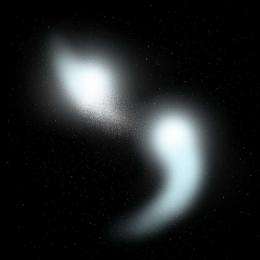
A rare Type Ia supernova whose progenitor star had a mass some two and a half times that of our sun - much more mass than a Type Ia progenitor should be able to accumulate before it explodes - has led members of the Nearby Supernova Factory based at Berkeley Lab to model a collision of two white dwarfs. They have the evidence to back up the model.
The international Nearby Supernova Factory (SNfactory) based at Berkeley Lab has measured, for the first time, the mass of a kind of Type Ia supernova astronomers once thought would be so exceedingly rare they might never be found.
Richard Scalzo of Yale University, leading a team of his SNfactory colleagues, found that the progenitor star (or stars) of the extra-bright supernova 2007if had almost two and a half times the mass of our sun - a so-called super-Chandrasekhar-mass supernova.
With the wealth of data they collected, the team was able to compare SN2007if with a handful of other unusually bright Type Ia supernovae. The remarkable similarities allowed the team to identify SN2007if as belonging to a new and rare subclass of supernovae, most likely resulting from the merger of two “degenerate” white dwarf stars. The result has implications for one of the best methods used to measure fundamental cosmological parameters.
Type Ia supernovae, standard and not-so-standard
Most Type Ia supernova are thought to explode when a single white dwarf, made mostly of carbon and oxygen, has accumulated enough extra mass from an ordinary companion star to approach the Chandrasekhar limit, about 1.4 times the mass of our sun. The white dwarf becomes so dense and hot that carbon and oxygen fuse into heavier elements, up to nickel, as the dwarf star ignites in a gigantic thermonuclear blast.
The great majority of Type Ia supernovae are so bright and so similar in their brightness that they have become famous as the “standard candles” used to measure the expansion of the universe. The realization that expansion is accelerating resulted in the discovery of dark energy. The near uniformity of Type Ia’s is thought to derive from their near-identical Chandrasekhar mass at the moment of explosion.
Scalzo, who was a postdoctoral fellow at Berkeley Lab before heading to Yale, says, “I’m particularly interested in the physics of Type Ia supernovae - not just in the core sample, as in ‘how do we standardize these for cosmology?’ but in the unusual examples out on the wings. When you think about the physics, you start asking yourself what else we should be finding out there.”
SNfactory members Peter Nugent and Rollin Thomas, both with the Computational Cosmology Center that Nugent leads in Berkeley Lab’s Computational Research Division, recall the first time they glimpsed the spectrum of the object that would later be named SN2007if. Thomas says what happened next was “convoluted,” and Nugent calls it “an embarrassing story.”
“We found it on August 25 with the Oschin telescope and Palomar-QUEST camera system, and within 48 hours we had a spectrum,” Thomas says. “It was very blue and had no sharp features. It didn’t look like anything we were familiar with.”
Says Nugent, “Robert Quimby of the Texas Supernova Search had seen the object on August 16 and asked us if we had any information. I sent him our spectra and said, ‘I don’t know what it is.’”
Greg Aldering of Berkeley Lab’s Physics Division, who heads the Nearby Supernova Factory, says, “It didn’t show the usual signs of a Type Ia,” explaining that because the SNfactory’s focus has been the physics of Type Ia’s, Berkeley Lab and Caltech’s Astronomy Department have an agreement to divide the work on what the SNfactory finds. “The Lab handles the Type Ia’s and Caltech all the other types.”
Nugent laughs when he recalls the Caltech response. “Caltech got right back to us with their opinions, all expert and all different: ‘It’s a variable star’; ‘It’s an active galaxy’; ‘It’s a core-collapse supernova’; ‘It’s a funky nova outburst.’”
But later Avishay Gal-Yam at Caltech (now with Israel’s Weizmann Institute of Science) obtained spectra from Palomar after classical supernova features had emerged. He told Nugent he thought it was a Type Ia after all. “And we’re supposed to be the Ia experts,” says Nugent.
“The delay unfortunately resulted in a gap in our data, although in the long run it didn’t affect the outcome because we were able to incorporate the images originally used to discover the supernova,” says Thomas. “In our defense, it was a very weird-looking object, with no spectral features to give us a handle.”
Scalzo, who had been following these exchanges via the SNfactory collaboration’s email list, immediately became interested in this “supernova from the wings” and volunteered to pursue an analysis.
A sharper focus
The SNfactory’s unique Supernova Integral Field Spectrograph (SNIFS), conceived at Berkeley Lab and built by the SNfactory’s French collaborators, is mounted on the University of Hawaii’s 2.2-meter telescope on Mauna Kea. It was immediately redirected to do detailed spectroscopy of SN2007if.
Meanwhile Scalzo worked with the Small and Moderate Aperture Research Telescope (SMARTS) consortium to do follow-up photometry (measurements of the supernova’s brightness at various frequencies over time) on the 1.3-meter telescope at the Cerro Tololo Inter-American Observatory in Chile. An abundance of data emerged from these studies, but key questions remained unanswered.
“SNIFS saw slow, sharp silicon lines in the spectra, but without knowing the redshift of SN2007if’s host galaxy, it was impossible to tell exactly how much the lines had shifted and what was their exact velocity,” Aldering explains.
Redshift is an indication of how fast an object is receding from the observer but may be offset by the blueshift of ejected material moving toward the observer. Knowing the redshift is also essential for calculating the supernova’s intrinsic brightness. “The problem was, we hadn’t been able to see a host galaxy,” says Aldering.
In one sense the lack of a host was a plus, Nugent says. “It was very easy to analyze the SNIFS data because there was no interference from a background galaxy!”
It wasn’t until two years after SN2007if’s discovery that Michael Childress of Berkeley Lab’s Physics Division was able to use the mighty Keck I 10-meter telescope on Mauna Kea to go looking for a galaxy where the supernova had appeared. “Using Mike’s special set-up it took the Keck about half an hour to get a spectrum of the extremely small, faint host galaxy,” Aldering says. “Once we knew its redshift, it confirmed our suspicion that the silicon lines we’d seen in the spectra were moving very slowly.”
The spectral data revealed another intriguing feature about the velocity of the ejecta: a “plateau” spanning some three weeks, indicating that something had put the brakes on the supernova’s normal expansion.
From the complementary spectral and photometric observations, it emerged that SN2007if was - except for the richness of its datasets - not quite unique. In fact it was remarkably similar to a supernova found by the Supernova Legacy Search (SNLS) in 2003, known as SNLS-03D3bb (SN2003fg), another extrabright Type Ia with slowly moving ejecta. SNLS-03D3bb was the first Type Ia supernova interpreted as having super-Chandrasekhar mass.
Two other Type Ia supernovae also seemed similar, having excess luminosity, low velocity ejecta, and other features such as evidence of unburned carbon. These clues pointed Scalzo to what he calls a “semi-analytical model,” an approximate but consistent and logical picture of what might account for these features.
The model
“We have two main things to work with,” Scalzo says, “the excess luminosity and the low velocity. Extra brightness means there is more nickel, but if there’s more nickel and everything else is the same, the velocity would be higher too.”
Some theorists have explained low velocity ejecta on the grounds that extra mass slows it down. On the contrary, says Nugent, “if all the mass goes to make nickel, the ejecta velocities would be screamingly high.”
Says Scalzo, “Extra brightness plus low velocity means there’s more total mass, but that’s not all.” His analysis pointed to an alternate idea: if the exploding white dwarf is already surrounded by an envelope of matter - say, the leftover material from a disrupted companion - then the ejecta will run into it and abruptly form a shell of mixed material that slowly plows its way through the envelope.
Abrupt slowing-down of the ejecta would also explain the plateau in SN2007if’s velocity. Thus the most persuasive arguments all pointed to a “double-degenerate” scenario - the merger of two white dwarfs with a combined mass almost two and a half times the mass of our sun.
“The last time I remember anybody trying to blow up a system like that I was in graduate school, and nobody believed it,” Nugent says, referring to modeling such a merger. “Back then, everybody thought it would take more than the age of the universe for two orbiting white dwarfs to get close enough together. We know better now.”
A subclass of Type Ia supernovae that explode with greater than Chandrasekhar mass immediately raises questions about how standard Type Ia standard candles are. While superbright Type Ia’s are automatically excluded from cosmological surveys, and while brighter-than-assumed candles don’t argue against the accelerating expansion of the universe (although they could lead to underestimates of acceleration), uncertainty could interfere with important calculations concerning the nature of dark energy.
“As weird as this supernova is, in my view it’s good news,” says Aldering. “Our measurements are already remarkably dependable, but if we’ve been mixing two progenitor channels in our data set, identifying one of the channels and getting rid of it is great. It clarifies the characteristics of the guys we’re really after.”
Nugent, however, says that while “too-bright Type Ia’s are easy to exclude from the data, what about events that are a lot closer to what we think of as standard? However it happens, it could mean that these events are extrasensitive to their environments.”
Aldering says the key may be the quality of the spectroscopic data. “We now know the spectroscopic signature of these objects under several different sets of conditions, so sufficiently good spectra can be used to eliminate them from cosmological analyses.”
Says Scalzo, “If we are successful in differentiating between the subclasses of Type Ia’s, and can find spectral and physical features that will allow us to tag even less-obvious examples in a clear-cut way, that’s progress. If not, it could cause trouble. Whatever is not known should make people nervous - but excited!”
More information: “Nearby Supernova Factory observations of SN 2007if: First total mass measurement of a super-Chandrasekhar-mass progenitor,” by Richard Scalzo, et al. To appear in Astrophysical Journal. arxiv.org/abs/1003.2217
Provided by Lawrence Berkeley National Laboratory


