Scientists stumped as bee population declines further
March 29, 2010 by Jean-Louis Santini
The best thing to help bees survive, say scientists is to try to limit habitat destruction

Enlarge

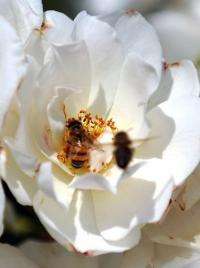
Bees gather pollen in a rose in Los Angeles, California, in 2009. The decline in the US bee population, first observed in 2006, is continuing, a phenomenon that still baffles researchers and beekeepers.

The decline in the US bee population, first observed in 2006, is continuing, a phenomenon that still baffles researchers and beekeepers.

Data from the US Department of Agriculture show a 29 percent drop in beehives in 2009, following a 36 percent decline in 2008 and a 32 percent fall in 2007.

This affects not only honey production but around 15 billion dollars worth of crops that depend on bees for pollination.

Scientists call the phenomenon "" that has led to the disappearance of millions of adult bees and beehives and occurred elsewhere in the world including in Europe.

Researchers have looked at viruses, parasites, insecticides, malnutrition and other but have been unable to pinpoint a specific cause for the .

The rough winter in many parts of the United States will likely accentuate the problem, says Jeff Pettis, lead researcher at Department of Agriculture's Bee Research Laboratory in Beltsville, Maryland.

Winter figures will be published in April. But preliminary estimates already indicate losses of 30 to 50 percent, said David Mendes, president of the American Beekeeping Federation.

"There are a lot of beekeepers who are in trouble" he said.

"Under normal condition you have 10 percent winter losses.. this year there are 30, 40 to 50 percent losses."

He said the phenomenon probably results from a combination of factors but that the increased use of pesticides appears to be a major cause.

"I don't put my bees in Florida because the last couple of years there has been tremendous increase in pesticide use in the orange crop to fight a disease," he said.

"It's a and the only way to control this disease is to use pesticide... a few years ago they did not use any pesticide at all."

He said that pesticide use "has changed dramatically" and has made beekeeping "more challenging."

Research conducted in 23 US states and Canada and published in the Public Library of Science journal found 121 different pesticides in 887 samples of bees, wax, pollen and other elements of hives, lending credence to the notion of pesticides as a key problem.

Pettis said the finding of pesticide residue is "troubling."

"It might not be the only factor but it's a contributing factor," he said.

The best thing to help bees, he said its "to try to limit habitat destruction," leaving more natural areas in agriculture and in cities such so honey can have "a diverse natural environment."

Ironically, he said the problem stems from expansion of agriculture to feed the world. But in destroying bee populations, that can hurt crop production.

"The world population growth is in a sense the reason for pollinators' decline," he said.

"Because we need to produce more and more food to feed the world and we grow crops in larger fields. A growing world means growing more food and to do that we need pollinators. And the fact that the world is continuing to grow is the driving force behind the habitat destruction."

(c) 2010 AFP

4.9 /5 (17 votes)  

Filter


Move the slider to adjust rank threshold, so that you can hide some of the comments.


Display comments: newest first

antialias
Mar 29, 2010

Rank: 4 / 5 (4)
Maybe take a look at a correlation with the use of gene-altered crops?

If you augment the amount of pest resistance that those crops exhibit then don't be surprised if the poisons mount up in those insects that feed on them.
bluehigh
Mar 29, 2010

Rank: 1.7 / 5 (7)
Simply a natural reaction to over population. Too many bees. Too many humans. Too many minke whales. Too many cars. Too many everything.

As the Holocene ends, the natural die off will enable the earth to adjust, once again.
JerryPark
Mar 29, 2010

Rank: 4 / 5 (4)
antialias,

I would think that gene altered crops would be a part of the problem -- particularly crops like bt corn which contain a pesticide in every cell, including the pollen.
lengould100
Mar 29, 2010

Rank: 5 / 5 (1)
JerryParks: Is there not a chance that you oversimplify? eg. the fact that every liver cell in your body contain the genetic pattern for bone formation doesn't mean the liver actually creates bone. Skin cells and teeth. etc etc.
LariAnn
Mar 29, 2010

Rank: 4.8 / 5 (4)
Actually, in order for the GMO to be toxic to the target pest, it has to have the actual toxin in each cell, not just the gene for it. It is not the gene that is toxic; it is the compound that the gene causes to be produced by the cell that is toxic. Without the actual toxin, wouldn't there be no pest control?

IMHO, this is the most plausible explanation for the bee population decline, as bees collect pollen of all kinds and feed it to their young. If the pollen is toxic, the bee larvae will die. I'm sure Monsanto could care less, however.
Skeptic_Heretic
Mar 29, 2010

Rank: 5 / 5 (2)
antialias,

I would think that gene altered crops would be a part of the problem -- particularly crops like bt corn which contain a pesticide in every cell, including the pollen.

Don't confuse pesticides with tannin based resistance mechanisms.

SincerelyTwo
Mar 29, 2010

Rank: not rated yet
Observe colony of bees in a natural environment and those in 'questionable' environments; Do they decline in one or the other or both?

Also, get BBC to do a bee documentary, in the process they could develop methods of monitoring bees in detail, then implemented by some research group. I'm sure direct monitoring into the minute details of bees will produce clearer evidence, it'd also be kinda neat. :)

We already tag animals in the wild with GPS collars, etc, let's figure something out for the little guys so we can get more evidence and stop guessing.

Some controlled studies on bee environments and their population should give some very clear and overall direction, and if bees are naturally dieing off then we can get the pros in there studying the colonies more in depth. This seems like the most obvious idea and direction to take, is there a good reason why I'm wrong? I'm confused as to why half the problems we have exist as problems at all.
Bitflux
Mar 29, 2010

Rank: 3.3 / 5 (4)
It will be fun to see what happens when bees are gone - but not even that will cause humans to think that theyre the only problem.
forte
Mar 29, 2010

Rank: 4.8 / 5 (6)
I was talking with a buddy of mine and happened upon this bee topic. He said "you should see the amount of dead and dieing bees I see all day long". Then it clicked, he works as a dish/tower operator and installs networks across America. He continued on describing countless times he's seen healthy bees flock to these dishes and by the end of the day where dead or half way there. He said they can't resist the signal from these dishes. I have seen articles and heard research on the effects of frequencies on bees and it made complete sense to me.
courtesy, ats FORMe2p00p0n
Caliban
Mar 29, 2010

Rank: 2.3 / 5 (3)
A highly ominous development. There were already massive declines in US honeybee populations, and, if nothing else, it appears likely that this year's harsh winter in the midwest and east exacerbated the problem.

It appears that the most likely culprit is a multiple cause scenario- varroa mite, virus, bacteria, and pesticide overload.
Another big factor is that honeybees are like most other organisms- they require a varied diet to meet nutritional requirements. In the wild, they feed on many different blossoms.
The main difference with these commercially employed colonies is that they a released into huge monoculture farms, thousands upon thousands of acres of almond, corn, soybean,orange, et c. They only get part of their dietary requirements, and so suffer from the bee equivalent of scurvy, ricketts, beri-beri, et c.
gwargh
Mar 29, 2010

Rank: 5 / 5 (1)
antialias,

I would think that gene altered crops would be a part of the problem -- particularly crops like bt corn which contain a pesticide in every cell, including the pollen.

Corn pollen is wind dispersed.
joefarah
Mar 29, 2010

Rank: 2.3 / 5 (8)
"The world population growth is in a sense the reason for pollinators' decline,"
This takes away all credibility from this article.
Caliban
Mar 29, 2010

Rank: 3 / 5 (2)
joef-

Nice try, but you definitely don't get to light the stogie.

You deliberately misread. What was meant is simply that a burgeoning human population creates pressure to produce greater and greater amounts of food, which has lead to the proliferation of massive monoculture farming, which in turn leads to most, if not all, of the factors contributing to the recent decline in honeybee population.

Do you fancy yourself as being some kind of agent provocateur, or are you just dim?
seneca
Mar 29, 2010

Rank: 1 / 5 (1)
IMO CCD is linked to the bat "white nose syndrome" (WNS), which is probably manifestation of food allergy (long term rhinitis) as well. Many bat species are significant pollinators like bees) and they have disappeared recently as well.

The introduction of GMO into Great Britain in 1998 has caused a statistically significant step in generally increasing rate of food allergy, because GMO import was enabled in food market stepwise in legal act, i.e. not gradually in this particular case.

http://www.bmj.co...9.f1.gif

The Cry1A / Cry1Ab proteins are always produced in mixtures in GMO, some of active proteins (Cry1B, Cry3Bb1, Cry9c, EPSPS) in GMO strands aren't completely specific to Lepidopthera and other higher organisms as well and a various neglected toxicity synergies can exist here.
seneca
Mar 29, 2010

Rank: 1 / 5 (1)
With respect to GMO induced allergies, the active proteins Cry1A / Cry1Ab in GMO food are very similar to bacterial toxins, against which the immune systems of living organisms (including human and bees) are programmed.

The correct function of immune system is based on correct distinction between healthy and pathogenic proteins. The higher number of foreign proteins is forced to distinguish for example in food, the higher risk of allergic response could be expected.

The Bacillus thuringiensis is very close to anthrax pathogens (Bacillus anthracis) - so high risk of coincidence in immune reactions (i.e. allergies) exists here.
seneca
Mar 29, 2010

Rank: 3 / 5 (2)
The low but permanent allergen concentration in food (GMO contaminated pollens at the case of bees) has a sensitization effect, because the correct function of adaptive immune system depends on temporary decrease of allergen concentration in reaction with specific antigen.

If such decrease doesn't occur (because the organism remains in permanent contact with GMO contaminated food every day), its immune system continues in production of various another antigens, until their number and concentration in organism isn't so high, they initiate an accidental violent allergic reaction even in contact with proteins and various pollutants, which were harmless so far.

After then the positive feedback will be established under development of permanent allergic reaction with nonspecific symptoms. In this way, bees could be gradually allergized by presence of GMO toxins in pollens even in minute concentrations.
JayK
Mar 29, 2010

Rank: 1 / 5 (1)
So, seneca, are you guilty of plagiarism?
seneca
Mar 29, 2010

Rank: 1 / 5 (2)
If I would insert the link to this blog, whole my post would be deleted by thread moderators. Anyway, I appreciate, you know (& remember) the original source....;-) It's really important to maintain intellectual property of original sources - but it violates policy of comments on this server.
seneca
Mar 29, 2010

Rank: 1 / 5 (2)
Have anything original?
Original ideas are deleted from there due the lack of referenced source, instead... Original thinking is definitely not, what is preferred & supported in contemporary society from various reasons.
JayK
Mar 30, 2010

Rank: 3 / 5 (2)
Yet I linked to it, and pointed out that you're plagiarizing a source. Are you claiming persecution for your ideas?
Skeptic_Heretic
Mar 30, 2010

Rank: 5 / 5 (1)
Yet I linked to it, and pointed out that you're plagiarizing a source. Are you claiming persecution for your ideas?

No, he doesn't understand what "pseudoscience" means and as such when his posts are removed he assumes it's because he included a link to his AWT fanboy site.
pres68y
Apr 04, 2010

Rank: 5 / 5 (1)
It's insane to think that any corporation (Monsanto) can produce a toxin (for example, Roundup) that eliminates beetles, grasshoppers, fungus, etc. yet miraculously does not effect bees!
Au-Pu
Apr 04, 2010

Rank: not rated yet
Adverse weather always has and will continue to have an effect upon bee populations.
Broad acre farming has been around for some time and it could be a contributing factor. Such a factor may take many generations before its influence became noticeable.
Genetically Modified crops could follow a similar path and take many generations before the effect became clearly noticeable.
Therefore it could be a combination of a number of "things", disease agents included.
Identifying the cause could be a difficult and protracted exercise.
Shootist
Apr 04, 2010

Rank: not rated yet
I'm sure Monsanto could care less, however.


Don't be a fool. The amount of Ludditism in this community is astounding! You would be better put to believe, rightly, that Monsanto scientists are trying to determine the cause of this situation and find a solution.
LariAnn
Apr 05, 2010

Rank: not rated yet
Not a case of Ludditism, but a case of recognizing that corporate profits trump any other consideration, including the rights of small farmers, the right of consumers to know what is in their food, etc. Shootist should do some research on what Monsanto has been doing to small farmers who refuse to use their GMO seeds, yet have the unfortunate luck of growing regular crops near the big GMO corporate ones, and see if they are really looking for solutions. The fool is the one who blindly accepts the pollyannish idea that Monsanto has all our best interests at heart. Monsanto scientists are not being paid to be environmentally friendly, they are being paid to produce something that will make more profits for their company, period. This way they can afford to lobby for the government to look the other way and allow them to experiment freely on the world's biosphere.

IMHO, if Monsanto is "looking for a solution" it is to avoid a lawsuit, not to save bees.
Rank 4.9 /5 (17 votes)
Related Stories
Relevant PhysicsForums posts
  • Mitosis
    created8 hours ago
  • Stem cell question.
    created9 hours ago
  • Protease cleavage
    created16 hours ago
  • Pertubance in a model
    created22 hours ago
  • Cancer drugs and Alzheimer's, Oh my!
    createdFeb 09, 2012
  • Squishing cells
    createdFeb 09, 2012
  • More from Physics Forums - Biology

More news stories

The power of estrogen -- male snakes attract other males

A new study has shown that boosting the estrogen levels of male garter snakes causes them to secrete the same pheromones that females use to attract suitors, and turned the males into just about the sexiest ...

Biology / Plants & Animals

created 20 hours ago | popularity 4.8 / 5 (6) | comments 2 | with audio podcast

Grass to gas: Researchers' genome map speeds biofuel development

Researchers at the University of Georgia have taken a major step in the ongoing effort to find sources of cleaner, renewable energy by mapping the genomes of two originator cells of Miscanthus x giganteus, a large perenn ...

Biology / Biotechnology

created 17 hours ago | popularity 3.8 / 5 (5) | comments 0 | with audio podcast

Experts reveal how plants don't get sunburn

(PhysOrg.com) -- Experts at the University of Glasgow have discovered how plants survive the harmful rays of the sun.

Biology / Cell & Microbiology

created 20 hours ago | popularity 4.8 / 5 (5) | comments 0 | with audio podcast

Entire genome of extinct human decoded from fossil

(PhysOrg.com) -- In 2010, Svante Pääbo and his colleagues presented a draft version of the genome from a small fragment of a human finger bone discovered in Denisova Cave in southern Siberia. The ...

Biology / Biotechnology

created Feb 07, 2012 | popularity 4.7 / 5 (56) | comments 42 | with audio podcast

Why are there so few fish in the Earth's oceans?

(PhysOrg.com) -- A Stony Brook University researcher has found that, contrary to popular belief, there are not plenty of fish in the sea.

Biology / Plants & Animals

created Feb 08, 2012 | popularity 4.3 / 5 (14) | comments 25 | with audio podcast


Anonymous knocks CIA website offline (Update)

The website of the Central Intelligence Agency was inaccessible on Friday after the hacker group Anonymous claimed to have knocked it offline.

New error-correcting codes guarantee the fastest possible rate of data transmission

Error-correcting codes are one of the triumphs of the digital age. They’re a way of encoding information so that it can be transmitted across a communication channel — such as an optical fiber o ...

Small modular reactor design could be a 'SUPERSTAR'

(PhysOrg.com) -- Though most of today's nuclear reactors are cooled by water, we've long known that there are alternatives; in fact, the world's first nuclear-powered electricity in 1951 came from a reactor ...

New power source discovered

(PhysOrg.com) -- Researchers at the Massachusetts Institute of Technology (MIT) and RMIT University have made a breakthrough in energy storage and power generation.

Advanced power-grid model finds low-cost, low-carbon future in West

(PhysOrg.com) -- The least expensive way for the Western U.S. to reduce greenhouse gas emissions enough to help prevent the worst consequences of global warming is to replace coal with renewable and other ...

Fool's gold may prove an unlikely alternative to overexploited catalytic materials

Catalytic materials, which lower the energy barriers for chemical reactions, are used in everything from the commercial production of chemicals to catalytic converters in car engines. However, with current catalytic materials ...