Few Drive Well While Yakking on Phone, Yet 1 in 40 'Supertaskers' Who Can Do Both
March 29, 2010
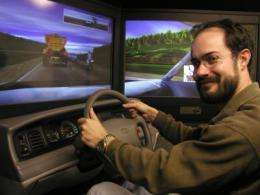
Jason Watson, a University of Utah psychologist, negotiates cybertraffic in a driving simulator used to study driver distractions such as cell phones and testing. While many people think they can safely drive and talk on a cell phone at the same time, Watson's new study shows only one in 40 is a "supertasker" who can perform both tasks at once without impairment of abilities measured in the study. Credit: Valoree Dowell, University of Utah
A new study from University of Utah psychologists found a small group of people with an extraordinary ability to multitask: Unlike 97.5 percent of those studied, they can safely drive while chatting on a cell phone.
These individuals - described by the researchers as "supertaskers" - constitute only 2.5 percent of the population. They are so named for their ability to successfully do two things at once: in this case, talk on a cell phone while operating a driving simulator without noticeable impairment.
The study, conducted by psychologists Jason Watson and David Strayer, is now in press for publication later this year in the journal Psychonomic Bulletin and Review.
This finding is important not because it shows people can drive well while on the phone - the study confirms that the vast majority cannot - but because it challenges current theories of multitasking. Further research may lead eventually to new understanding of regions of the brain that are responsible for supertaskers' extraordinary performance.
"According to cognitive theory, these individuals ought not to exist," says Watson. "Yet, clearly they do, so we use the supertasker term as a convenient way to describe their exceptional multitasking ability. Given the number of individuals who routinely talk on the phone while driving, one would have hoped that there would be a greater percentage of supertaskers. And while we'd probably all like to think we are the exception to the rule, the odds are overwhelmingly against it. In fact, the odds of being a supertasker are about as good as your chances of flipping a coin and getting five heads in a row."
The researchers assessed the performance of 200 participants over a single task (simulated freeway driving), and again with a second demanding activity added (a cell phone conversation that involved memorizing words and solving math problems). Performance was then measured in four areas—braking reaction time, following distance, memory, and math execution.
As expected, results showed that for the group, performance suffered across the board while driving and talking on a hands-free cell phone.
For those who were not supertaskers and who talked on a cell phone while driving the simulators, it took 20 percent longer to hit the brakes when needed and following distances increased 30 percent as the drivers failed to keep pace with simulated traffic while driving. Memory performance declined 11 percent, and the ability to do math problems fell 3 percent.
However, when supertaskers talked while driving, they displayed no change in their normal braking times, following distances or math ability, and their memory abilities actually improved 3 percent.
The results are in line with Strayer's prior studies showing that driving performance routinely declines under "dual-task conditions" - namely talking on a cell phone while driving - and is comparable to the impairment seen in drunken drivers.
Yet contrary to current understanding in this area, the small number of supertaskers showed no impairment on the measurements of either driving or cell conversation when in combination. Further, researchers found that these individuals' performance even on the single tasks was markedly better than the control group.
"There is clearly something special about the supertaskers," says Strayer. "Why can they do something that most of us cannot? Psychologists may need to rethink what they know about multitasking in light of this new evidence. We may learn from these very rare individuals that the multitasking regions of the brain are different and that there may be a genetic basis for this difference. That is very exciting. Stay tuned."
Watson and Strayer are now studying expert fighter pilots under the assumption that those who can pilot a jet aircraft are also likely to have extraordinary multitasking ability.
The current value society puts on multitasking is relatively new, note the authors. As technology expands throughout our environment and daily lives, it may be that everyone - perhaps even supertaskers - eventually will reach the limits of their ability to divide attention across several tasks.
"As technology spreads, it will be very useful to better understand the brain's processing capabilities, and perhaps to isolate potential markers that predict extraordinary ability, especially for high-performance professions," Watson concludes.
More information: The study is available online by clicking here: http://www.psych.u … rtaskers.pdf
-
Attention Demands May Explain Why Texting While Driving Is So Dangerous
Dec 21, 2009 |
not rated yet |
0
-
Drivers make more errors when talking on cell phone than to a passenger
Dec 01, 2008 |
not rated yet |
0
-
Cell phone users drive like old folks
Feb 06, 2005 |
not rated yet |
0
-
Driven to distraction: New study shows driving hinders talking
Jan 22, 2010 |
not rated yet |
0
-
Research Urges Drivers to Put Down the Cell Phone
Dec 02, 2005 |
not rated yet |
0
-
Engineers build first sub-10-nm carbon nanotube transistor
Feb 01, 2012 |
4.9 / 5 (31) |
30
-
Something old, something new: Evolution and the structural divergence of duplicate genes
Jan 31, 2012 |
4.6 / 5 (7) |
1
-
The hidden nanoworld of ice crystals: Revealing the dynamic behavior of quasi-liquid layers
Jan 30, 2012 |
5 / 5 (3) |
1
-
Stock market network reveals investor clustering
Jan 27, 2012 |
3.9 / 5 (23) |
8
-
Of microchemistry and molecules: Electronic microfluidic device synthesizes biocompatible probes
Jan 26, 2012 |
5 / 5 (1) |
0
-
Is Everyday Technology Killing Us?
Feb 08, 2012
-
Exercise and weight loss
Feb 08, 2012
-
Why do we have head aches? Our brains can't feel anything.
Feb 07, 2012
-
"The end of diseases" by David Agus, interview from Daily Show with Jon Stewart
Feb 04, 2012
-
Oncolytic adenovirus
Feb 04, 2012
-
Nutrition label stuffs and diets
Feb 02, 2012
- More from Physics Forums - Medical Sciences
More news stories
Complex wiring of the nervous system may rely on a just a handful of genes and proteins
Researchers at the Salk Institute have discovered a startling feature of early brain development that helps to explain how complex neuron wiring patterns are programmed using just a handful of critical genes. ...
8 hours ago |
4.9 / 5 (9) |
0
|
Both maternal and paternal age linked to autism
Older maternal and paternal age are jointly associated with having a child with autism, according to a recently published study led by researchers at The University of Texas Health Science Center at Houston (UTHealth).
Medicine & Health / Psychology & Psychiatry
12 hours ago |
4.3 / 5 (3) |
0
|
New understanding of DNA repair could eventually lead to cancer therapy
A research group in the Faculty of Medicine & Dentistry at the University of Alberta is hoping its latest discovery could one day be used to develop new therapies that target certain types of cancers.
12 hours ago |
4.8 / 5 (5) |
0
|
Curry spice component may help slow prostate tumor growth
Curcumin, an active component of the Indian curry spice turmeric, may help slow down tumor growth in castration-resistant prostate cancer patients on androgen deprivation therapy (ADT), a study from researchers ...
13 hours ago |
4.4 / 5 (8) |
0
|
Team isolates nerve cells involved in storing long term memory and gene proteins associated with them
(Medical Xpress) -- A research team in Taiwan has succeeded in isolating two nerve cells in fruit fly brains that are believed to be the major players in allowing for the formation of long term memories. Furthermore, ...
Google users warned of threat to smartphone wallets
Users of Google smartphone wallets were being warned on Friday that there is a way to crack pass codes intended to thwart thieves from going on illicit shopping sprees.
Anonymous knocks CIA website offline (Update)
The website of the Central Intelligence Agency was inaccessible on Friday after the hacker group Anonymous claimed to have knocked it offline.
New error-correcting codes guarantee the fastest possible rate of data transmission
Error-correcting codes are one of the triumphs of the digital age. Theyre a way of encoding information so that it can be transmitted across a communication channel such as an optical fiber o ...
Humans may have helped the decline of African rainforests 3000 years ago
(PhysOrg.com) -- Large areas of rainforests in Central Africa mysteriously disappeared over three thousand years ago, to be replaced by savannas. The prevailing theory has been that the cause was a change ...
New power source discovered
(PhysOrg.com) -- Researchers at the Massachusetts Institute of Technology (MIT) and RMIT University have made a breakthrough in energy storage and power generation.
The power of estrogen -- male snakes attract other males
A new study has shown that boosting the estrogen levels of male garter snakes causes them to secrete the same pheromones that females use to attract suitors, and turned the males into just about the sexiest ...
Mar 29, 2010
Rank: 3 / 5 (2)
i.e. Their driving abilities are so bad, it just can't get worse :)
Mar 29, 2010
Rank: 1.5 / 5 (2)
I registered just to comment on this study. Who is memorizing words or doing math problems while driving? Another baseline should be added. Remove the phone from the study, then retest again, still having people memorize words and solve math problems.
Also, "...They are so named for their ability to successfully do two things at once: in this case, talk on a cell phone while operating a driving simulator..."
Should it not be more than 2 things? Simply talking on the phone and driving would be 2 things but adding memorizing and math solving adds additional tasks.
This isn't even my field and I can do a better job. Sadly seems like propaganda.
Mar 29, 2010
Rank: 3 / 5 (1)
Mar 29, 2010
Rank: 5 / 5 (1)
Many casual conversations require both. Time based calculation for your schedule as well as remembering names, date/time and places are all common.
L-Jouce: "and following distances increased 30 percent" Umm, that's a good thing.
This is rational compensation for the increased braking time: "it took 20 percent longer to hit the brakes". It's good that many people tend to compensate for the lack of concentration, but I'm not sure if people do that for real. I'm sure anyone of the subjects has guessed their driving abilities are being tested thus the results may be biased.
Mar 29, 2010
Rank: 1 / 5 (1)
Mar 29, 2010
Rank: not rated yet
In those situations where my attention to my driving needs to increase (more traffic, stop lights, urban driving, etc.), I just let all the impairment fall on my ability to carry on a phone conversation, the lower priority task. I don't really care if I can do both equally well, I just need to be able to drive equally well.
Mar 29, 2010
Rank: 1 / 5 (1)
I've been in situations where, for instance, I had to reference a co-workers entries into the database while they were interacting with someone over the phone, and the results were rarely pretty.
Likewise, I've double-checked my own work under similar conditions, and found plenty of errors.
And, of course, we've all had the misfortune of a near collision, or witnessed the same by some idiot talking or texting while driving their "Mobile Office" on the freeway.
This whole notion of mutlitasking flies in the face of reality, and has always, at least to me, smacked of an urealistic demand to increase productivity. I blame MTV.
Mar 30, 2010
Rank: not rated yet
However, there's a big difference between exchanging pleasantries (or asking for backup - semi-retired rent-a-cop) than sharing a recipe. The "trick" is to drop your speed and drive very defensively. And don't do it much :D ....
The biggest problem with the current phones v.s. the hardware I used to work with is the quality. You FORGET you're out there on the road!
Short answer is that it's not a good idea to do it....
Apr 05, 2010
Rank: not rated yet