Researchers find a way to make drops on a surface move in just one direction
March 29, 2010 by David L. Chandler
Pushing droplets around

Enlarge

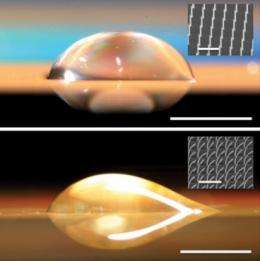
A symmetrical droplet (top) forms on a surface with straight nano-pillars, while on a surface with bent pillars (bottom) the droplet is asymmetrical, extending out only to the right. Inset images are micrographs of the surface structure. Images: Kuang-Han Chu, Rong Xiao and Evelyn N. Wang

(PhysOrg.com) -- Controlling the way liquids spread across a surface is important for a wide variety of technologies, including DNA microarrays for medical research, inkjet printers and digital lab-on-a-chip systems. But until now, the designers of such devices could only control how much the liquid would spread out over a surface, not which way it would go.

New research from mechanical engineers at MIT has revealed a new approach that, by creating specific kinds of tiny structures on a material’s , can make a droplet spread only in a single direction.

A report on the new work, by Esther and Harold E. Edgerton Assistant Professor of Mechanical Engineering Evelyn N. Wang and graduate students Kuang-Han Chu and Rong Xiao, was published on March 28 in the journal .

The system Wang and her team developed is completely passive, based on producing a textured surface with tiny shaped in specific ways to propel in one direction and restrict its movement in others. Once the surface is prepared, no mechanical or electrical controls are needed to propel the liquid in the desired direction, and a droplet placed at any point on the surface will always spread the same way.

It’s just the shapes on the surface that control how the drops spread, rather than the particular materials used, Wang says. The chips used for testing were made by etching a silicon wafer surface to produce a grid of tiny pillars, which then were selectively coated with gold on one side to make the pillars bend in one direction. To prove that the effect was caused just by the bent shapes rather than some chemical process involving the silicon and gold, the researchers, with the help of Professor Karen Gleason’s group in the Department of Chemical Engineering, then coated the surface with a thin layer of a polymer so that the water would only come in contact with a single type of material. The pillars are all curved in one direction, and cause the liquid to move in that direction.

“Nobody had really studied this kind of geometry, because it’s hard to fabricate,” Wang says.

Wang explains that while this work is still early-stage basic research, in principle such systems could be used for a wide variety of applications. For example, it could provide new ways to manipulate biological molecules on the surface of a chip, for various testing and measurement systems. It might be used in desalination systems to help direct water that condenses on a surface toward a collection system. Or it might allow more precise control of cooling liquids on a microchip, directing the coolant toward specific hotspots rather than letting them spread out over the whole surface.

“It’s a big deal to be able to cool local hotspots on a chip,” Wang says, especially as the components on a chip continue to get smaller and thermal management becomes ever more critical. The research was funded in part by the National Science Foundation, DARPA, and Northrup Grumman.

Mark Shannon, professor of mechanical science and engineering at the University of Illinois, Urbana-Champaign, agrees that this method might be further developed for a variety of applications, including biomedical lab-on-a-chip systems for the detection of specific biomolecules in blood, for example. “Droplet manipulation has been heavily developed for moving samples from station to station for different analysis steps,” he says, and this new method might provide a useful way to do that with minimal energy requirements, but to do so will require the ability to create multiple regions on a surface that propel the liquid in different directions for each stage. “This research will help enable these unit operations,” he says, in combination with related research currently being carried out in other places.

Howard Stone, professor of mechanical and aerospace engineering at Princeton University, who was not involved in this research, says researchers have taken several approaches to surface patterning and control in recent years, some inspired by nature and some by materials applications. “This research advance for one-dimensional asymmetric spreading is a nice addition to the toolbox for surface patterning to control liquid spreading,” he says.

Provided by Massachusetts Institute of Technology (news : web)

4.6 /5 (13 votes)  

Rank 4.6 /5 (13 votes)
Related Stories
Relevant PhysicsForums posts
  • excited U-236 decay time in the U235 fission chain
    created18 hours ago
  • Polar catastrophe?
    created21 hours ago
  • Large scale field sonication
    createdFeb 09, 2012
  • states and energy of paired electrons in BCS
    createdFeb 08, 2012
  • difference between longitudinal and transverse refractive indices
    createdFeb 08, 2012
  • Monte Carlo simulation
    createdFeb 07, 2012
  • More from Physics Forums - Atomic, Solid State, Comp. Physics

More news stories

Hovering not hard if you're top-heavy, researchers find

Top-heavy structures are more likely to maintain their balance while hovering in the air than are those that bear a lower center of gravity, researchers at New York University's Courant Institute of Mathematical Sciences ...

Physics / General Physics

created just added | popularity not rated yet | comments 0 | with audio podcast

SLAC, Stanford team focuses on high-energy electrons to treat cancer

Accelerator physicists at SLAC and cancer specialists from Stanford are working on a new technology that could dramatically reduce the time needed for cancer radiation treatments. The team ran an initial experiment ...

Physics / General Physics

created 3 hours ago | popularity not rated yet | comments 0

Measurements from high-energy collisions lead to better understanding of why meson particles disappear

For several years, physicists at the Relativistic Heavy Ion Collider (RHIC) at Brookhaven National Laboratory (BNL), USA, have studied an unusual state of matter called the quark–gluon plasma, which they ...

Physics / General Physics

created 3 hours ago | popularity not rated yet | comments 0

Quantum physicist explains $100K offer for proof scaled-up quantum computing is impossible

(PhysOrg.com) -- MIT researcher Scott Aaronson has certainly riled the physics community with his offer this past Friday, of $100,000 to anyone who can prove that scaled-up quantum computing is impossible. ...

Physics / Quantum Physics

created Feb 08, 2012 | popularity 4.1 / 5 (11) | comments 32 | with audio podcast weblog

Explained: Sigma

It's a question that arises with virtually every major new finding in science or medicine: What makes a result reliable enough to be taken seriously? The answer has to do with statistical significance -- but ...

Physics / General Physics

created Feb 09, 2012 | popularity 5 / 5 (14) | comments 26


New understanding of DNA repair could eventually lead to cancer therapy

A research group in the Faculty of Medicine & Dentistry at the University of Alberta is hoping its latest discovery could one day be used to develop new therapies that target certain types of cancers.

Zuckerberg's focus drives Facebook's ascent

When Mark Zuckerberg showed up to rent Judy Fusco's Los Altos, Calif., house in the fall of 2004, soon after he'd arrived in Silicon Valley, the landlord was immediately struck by his confidence.

Both maternal and paternal age linked to autism

Older maternal and paternal age are jointly associated with having a child with autism, according to a recently published study led by researchers at The University of Texas Health Science Center at Houston (UTHealth).

Night, weekend delivery OK for babies with birth defects

Weekday delivery is no better than night or weekend delivery for infants with birth defects, according to a new study presented today at The Pregnancy Meeting, the Society for Maternal-Fetal Medicine's annual conference. ...

Sonic Cradle lands spot in TED exhibition

A Simon Fraser University graduate student project that melds music, meditation and modern technology has landed a rare spot as an exhibit at TEDActive 2012 in Palm Springs, California this month.

Drug halts organ damage in inflammatory genetic disorder

A new study shows that Kineret (anakinra), a medication approved for the treatment of rheumatoid arthritis, is effective in stopping the progression of organ damage in people with neonatal-onset multisystem inflammatory disease ...