Scientists discover world's smallest superconductor
March 29, 2010
Scientists discover world's smallest superconductor

Enlarge

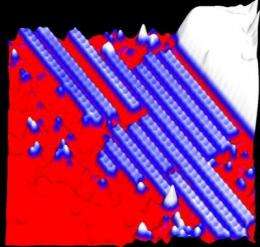
This image shows several nanoscale superconducting molecular wires on a silver substrate. Credit: Image courtesy of Saw‑Wai Hla and Kendal Clark, Ohio University.

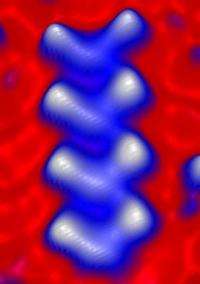
Scientists have discovered the world's smallest superconductor, a sheet of four pairs of molecules less than one nanometer wide. The Ohio University-led study, published Sunday as an advance online publication in the journal Nature Nanotechnology, provides the first evidence that nanoscale molecular superconducting wires can be fabricated, which could be used for nanoscale electronic devices and energy applications.

"Researchers have said that it's almost impossible to make nanoscale interconnects using metallic conductors because the resistance increases as the size of wire becomes smaller. The become so hot that they can melt and destruct. That issue, Joule heating, has been a major barrier for making a reality," said lead author Saw-Wai Hla, an associate professor of physics and astronomy with Ohio University's Nanoscale and Institute.

Superconducting materials have an electrical resistance of zero, and so can carry large electrical currents without power dissipation or heat generation. Superconductivity was first discovered in 1911, and until recently, was considered a macroscopic phenomenon. The current finding suggests, however, that it exists at the molecular scale, which opens up a novel route for studying this phenomenon, Hla said. Superconductors currently are used in applications ranging from supercomputers to brain imaging devices.
Scientists discover world's smallest superconductor
Enlarge

This image shows the smallest superconductor, which is only .87 nanometer wide. Credit: Image courtesy of Saw‑Wai Hla and Kendal Clark, Ohio University.

In the new study, which was funded by the U.S. Department of Energy, Hla's team examined synthesized molecules of a type of organic salt, (BETS)2-GaCl4, placed on a surface of silver. Using scanning tunneling spectroscopy, the scientists observed superconductivity in molecular chains of various lengths. For chains below 50 nanometers in length, superconductivity decreased as the chains became shorter. However, the researchers were still able to observe the phenomenon in chains as small as four pairs of molecules, or 3.5 nanometers in length.

To observe at this scale, the scientists needed to cool the molecules to a temperature of 10 Kelvin. Warmer temperatures reduced the activity. In future studies, scientists can test different types of materials that might be able to form nanoscale superconducting wires at higher temperatures, Hla said.

"But we've opened up a new way to understand this phenomenon, which could lead to new materials that could be engineered to work at higher temperatures," he said.

The study also is noteworthy for providing evidence that superconducting organic salts can grow on a substrate material.

"This is also vital if one wants to fabricate nanoscale electronic circuits using organic molecules," Hla added.

Provided by Ohio University (news : web)

4.5 /5 (36 votes)  

Filter


Move the slider to adjust rank threshold, so that you can hide some of the comments.


Display comments: newest first

labtvonline
Mar 29, 2010

Rank: 2.7 / 5 (3)
It seems like every time I turn around that a new groundbreaking revelation has occurred thanks to nanotechnology! I feel that there is amazing promise in the field of nanotech because of the efficiency and endless possibilities. Scientists are just beginning to understand how the physics even work on a nano level. I just saw how the military designed a solar panel that is flexible and 10,000 times more efficient the the old standard cell. I'll post a link if you want to see it for yourself. I feel like in the next five years, nanotechnology will be the technology behind every great invention and breakthrough of the future!

http://www.ndep.u...;t=It's a Small World
jonnyboy
Mar 29, 2010

Rank: 3 / 5 (1)
I watched the webisode and just because the Lieutenant says it, doesn't make it true. Since current solar cells are around 6% efficient then 10,000 times more efficient would make them put out 600 times more power than they absorb .......... clearly false. I think that he must have been referring to an increase in efficiency in the materials that he was holding in his hands not comparing that material to current solar cells.
jimbo92107
Mar 29, 2010

Rank: 4 / 5 (1)
Maybe this is how a room temperature superconductor will be found: Between two electrodes researchers will literally nudge molecules around until the measured resistance drops to zero.
fixer
Mar 29, 2010

Rank: 3 / 5 (1)
Quite entertaining video, but seeing the "technician" using a kitchen fork to shift samples is a mite suspicious.
I agree that the 10,000 x is tripe! double the efficiency would be sensational.
Still, the idea is good.
Flexible cells of any efficiency would be cheap and light and so much more appealing to the consumer.
johanfprins
Mar 30, 2010

Rank: 1 / 5 (2)
Maybe this is how a room temperature superconductor will be found: Between two electrodes researchers will literally nudge molecules around until the measured resistance drops to zero.

It has already been done by myself; but is blocked from being published by the mainstream "experts" on superconduction since it proves that superconduction has NOTHING to do with electrons forming pairs.
This is an astonishing story about the demise of physics which will soon be exposed in my upcoming book "The Physics Delusion". Suffice to note that all the models for which Nobel Prizes have been awarded are plain claptrap. So are the Nobel Prizes for quantum field theory based on the same concepts like Nambu's "spontaneous symmetry breaking".
Jayman
Mar 30, 2010

Rank: 3 / 5 (1)
I have been following superconductivity for over 30 years now and the promise of room-temperature superconductivity is just that - a promise. I tend to get very skeptical at the mere mention of the world. After cold fusion, that is.
FastEddy
Mar 30, 2010

Rank: not rated yet
Back to the subject article:

" ... For chains below 50 nanometers in length, superconductivity decreased as the chains became shorter. ..." !! ?? !!

Some interesting phenomena going on here, for sure. Still a long way from "room temp", but as an indicator of a future tech ...

" ... "This is also vital if one wants to fabricate nanoscale electronic circuits using organic molecules," Hla added."

Meaning I would guess, some sort of complex carbon (graphene or Buckey type?) as substrate? Maybe some Silver/Carbon/Other complex?

I say, keep the faith and keep looking forward past this possible milestone marker.

(My opinion is that there isn't enough Bismuth on the planet for that path to be of much use as a macro scale SC. Maybe Boron coatings on Carbon complex and/or Silver?)
FastEddy
Mar 30, 2010

Rank: not rated yet
Jayman: " ... the promise of room-temperature superconductivity is just that - a promise. ..."

Well, yes, right now you are correct. I'm sure you have seen what's going on with Carbon (Graphene, et al) ... Getting closer to room temp "super" conducting = very short pathways of Graphene indicate very, very good conduction, very, very low resistance ... Which if it can be scaled up, will do nicely until genuine "super conducting" comes along. Considering that practical, operational power "wire" resistances dropping 20% below that of pure Silver would save 100, mile long, coal trains per year on the secondary 600-2400 volt grid. "Super" might be too much to ask ... Almost "perfect" or very, very good may be enough to green up the grid quite a bit.
johanfprins
Mar 30, 2010

Rank: not rated yet
I have been following superconductivity for over 30 years now and the promise of room-temperature superconductivity is just that - a promise. I tend to get very skeptical at the mere mention of the world. After cold fusion, that is.

You might have followed it but have not been able to understand the fact that the London bros., Bardeen, Cooper, Schrieffer, Landau, Ginsberg, Abrikosov, Josephson, Pippard etc. did not know Atha from Matha. Once you understand the simple fact that a superconductor must cancel an applied electric field by polarisation, it is easy to obtain superconduction at room temperature as I have already done nearly 10 years ago.
taka
Mar 31, 2010

Rank: not rated yet
To cancel an applied electric field by polarization is necessary, but it seems that it is not enough. Then there are no more free electrons that can scatter from impacting atoms and generate heat and resistance this way, but even tunnelling between stationary allocations will shake atoms and so generate heat and this mean also resistance. This shaking must also be suppressed, and it seems that it is suppressed by quantifying atoms movements (phonons) so that they cannot get more energy from electrons.
(johanfprins successful experiment work with electrons that were forced out from substrate, so shaking was not a problem there)
johanfprins
Apr 01, 2010

Rank: not rated yet
To cancel an applied electric field by polarization is necessary, but it seems that it is not enough. Then there are no more free electrons that can scatter .... but even tunnelling between stationary allocations will shake atoms and so generate heat and this mean also resistance.

Not when tunnelling is driven by quantum fluctuations: A carrier can then borrow energy (del)E for a time (del)t to jump from one site to the next: This is made possible by Heisenberg's uncertainty relationship. Before jumping there is no energy to dissipate and after jumping there is alo no energy to dissipate. This also satisfies the second law of thermodynamics according to which non-ending movement can only occur when energy is used to do work and this energy is then returned en-toto to again being used.
Coper pairs cannot do the latter and can thus not explain superconduction. Furthermore when doing the analysis in terms of quantum fluctuations it is found that the carriers are singly-charged.
taka
Apr 01, 2010

Rank: not rated yet
All tunnelling is driven by quantum fluctuations, this is the definition of it. But I am surprised that you use uncertainty for description, it should not agree with your claim that there is no uncertainty, there is only wave density/intensity that matters. I believe the same equation can be interpreted in these terms also, the uncertainty become particle size then. Like - there is not enough energy to move whole electron throw, but some part of it can be still moved, if this part is over it return the energy to the rest that can now follow.

I found interesting material that clam that this Heisenberg fundamental equation was not a probability but an actuality (http://www.wbabin...15.pdf).

Matter shaking happen not because of electrons kinetic energy, but as when electron is on one position it drags atoms and so the material deform. When it is on next position it drags atoms differently and material deform differently. The result is shaking.
johanfprins
Apr 01, 2010

Rank: not rated yet
All tunnelling is driven by quantum fluctuations, this is the definition of it...

Just like "uncertainty" the term "tunnelling" should be banned. An electron-wave cannot move THROUGH an energy barrier, it can only scale an energy barrier. Heisenberg's relationship (leave the misleading term "uncertainty" out since there is no "uncertainty" involved) for energy and time allows an electron wave to borrow energy (del)E as long as it is not for longer than (del)t. This allows a charge carrier to jump OVER a barrier: Such a loan of energy actually defines a quantum fluctuation; not the probabilistic movement of a particle as is propagated in the literature based on te Copenhagen BS. The so called "uncertainties are the average sizes of the wave-intensity in space-time and its reciprocal space-time.
In a SC, the phase is in a ground-state so that energy cannot dissipate during the jump from one site to the other: No "shaking" which can cause energy loss is at all possible.
localcooling
Apr 04, 2010

Rank: not rated yet
I wonder how "low temperature spaces" behave at nano-levels? Is it possible to thermally insulate a nano-wire with a nano-insulating sheet ??? I'm at a loss as how temperature, insulation etc. etc. works at a nano-scale. Can anyone inform me ?
Rank 4.5 /5 (36 votes)
Related Stories
Relevant PhysicsForums posts
  • Books To Inspire a Beginnig Physics Student
    created2 hours ago
  • Pith balls problem
    created2 hours ago
  • Electrostatics
    created2 hours ago
  • what is phase constant
    created2 hours ago
  • Basics In electromagnetic wave
    created2 hours ago
  • How to calculate theoretical initial velocity?
    created3 hours ago
  • More from Physics Forums - General Physics

More news stories

What lies beneath: Mapping hidden nanostructures

The ability to diagnose and predict the properties of materials is vital, particularly in the expanding field of nanotechnology. Electron and atom-probe microscopy can categorize atoms in thin sheets of material, ...

Nanotechnology / Nanophysics

created 16 hours ago | popularity 5 / 5 (3) | comments 1

New kind of solar cell could capture significantly more energy than current cells

New solar cells could increase the maximum efficiency of solar panels by over 25%, according to scientists from the University of Cambridge.

Nanotechnology / Nanophysics

created Feb 08, 2012 | popularity 4.5 / 5 (12) | comments 14 | with audio podcast

Nanoshell whispering galleries improve thin solar panels

Visitors to Statuary Hall in the U.S. Capitol Building may have experienced a curious acoustic feature that allows a person to whisper softly at one side of the cavernous, half-domed room and for another on ...

Nanotechnology / Nanomaterials

created Feb 07, 2012 | popularity 4.3 / 5 (6) | comments 6 | with audio podcast

'Dark plasmons' transmit energy

Microscopic channels of gold nanoparticles have the ability to transmit electromagnetic energy that starts as light and propagates via "dark plasmons," according to researchers at Rice University.

Nanotechnology / Nanophysics

created Feb 09, 2012 | popularity 4.8 / 5 (8) | comments 1 | with audio podcast

Revealing how a battery material works

Since its discovery 15 years ago, lithium iron phosphate (LiFePO4) has become one of the most promising materials for rechargeable batteries because of its stability, durability, safety and ability to deliver ...

Nanotechnology / Nanomaterials

created Feb 08, 2012 | popularity 5 / 5 (5) | comments 0 | with audio podcast


Anonymous knocks CIA website offline (Update)

The website of the Central Intelligence Agency was inaccessible on Friday after the hacker group Anonymous claimed to have knocked it offline.

Google users warned of threat to smartphone wallets

Users of Google smartphone wallets were being warned on Friday that there is a way to crack pass codes intended to thwart thieves from going on illicit shopping sprees.

New error-correcting codes guarantee the fastest possible rate of data transmission

Error-correcting codes are one of the triumphs of the digital age. They’re a way of encoding information so that it can be transmitted across a communication channel — such as an optical fiber o ...

Humans may have helped the decline of African rainforests 3000 years ago

(PhysOrg.com) -- Large areas of rainforests in Central Africa mysteriously disappeared over three thousand years ago, to be replaced by savannas. The prevailing theory has been that the cause was a change ...

New power source discovered

(PhysOrg.com) -- Researchers at the Massachusetts Institute of Technology (MIT) and RMIT University have made a breakthrough in energy storage and power generation.

Small modular reactor design could be a 'SUPERSTAR'

(PhysOrg.com) -- Though most of today's nuclear reactors are cooled by water, we've long known that there are alternatives; in fact, the world's first nuclear-powered electricity in 1951 came from a reactor ...