Molecular Middle Managers Make More Decisions Than Bosses
March 29, 2010
Scientists are finding that on a molecular level organisms often function like social institutions. Some employ a military-like chain of command while in others important decisions are made by genetic middle managers.
(PhysOrg.com) -- Organisms are structured at the molecular level in ways similar to social hierarchies. In some, master genetic regulators call most of the shots, and in others most of life's activities are carried out by more egalitarian collaborations.
Knowing these organizational rules will help us understand biological systems and our social interactions, argues Mark Gerstein, A L Williams professor of biomedical informatics, molecular biophysics and biochemistry, and computer science. He is the senior author of a paper on the subject published online the week of March 29 in the Proceedings of the National Academy of Sciences.
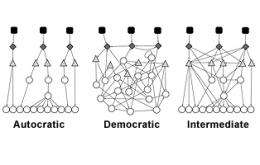
Gerstein and postdoctoral associate Nitin Bhardwaj analyzed regulatory networks of five diverse species, from E. coli to human, and rearranged those systems into hierarchies with a number of broad levels, including "master regulators," "middle managers" and "workhorses." In most organisms, master regulators control the activity of middle managers, which in turn govern suites of workhorse genes that carry out instructions for making proteins.
As a general rule, the more complex the organism, the less autocratic and more democratic the biological networks appear to be, researchers report. In both biological systems and corporate structures, interactions between middle managers are often more critical to functioning than actions by bosses. "If my department chair takes another job, the emphasis of my lab might change, but it will survive," Gerstein said. "But if my systems administrator leaves, my lab dies."
In simpler organisms such as E. coli, there tends to be a simple chain of command in which regulatory genes act like generals, and subordinate molecules "downstream" follow a single superior's instructions. Gerstein calls these systems "autocratic." But in more complex organisms, most of these subordinate genes co-regulate biological activity, in a sense sharing information and collaborating in governance. Gerstein labels these systems "democratic." If they share some qualities of both they are deemed "intermediate."
The interactions in more democratic hierarchies lead to mutually supporting partnerships between regulators than in autocratic systems, where if one gene is inactivated, the system tends to collapse. This is why Gerstein and colleagues in earlier work found that when they knocked out a master regulating gene in a complex organism, the "effects were more global, but softer" than when a key middle manager gene in a simpler life form was inactivated, which led to the death of the organism.
"Regulators in more complex species demonstrate a highly collaborative nature. We believe that these are due to the size and complexity of these genomes," Gerstein said. For example, about 250 master regulators in yeast have 6000 potential targets, a ratio of about one to 25. In humans, 20,000 targets are regulated by about 2,000 genes, a ratio of one to 10.
-
Mixing genomics and geography yields insights into life and environment
Jan 22, 2009 |
not rated yet |
0
-
Researchers Track How Biology's Army Is Mobilized
Dec 18, 2008 |
not rated yet |
0
-
Cells are like robust computational systems
Jun 16, 2009 |
not rated yet |
0
-
Putting microRNAs on the stem cell map
Aug 07, 2008 |
not rated yet |
0
-
Gene regulation in humans is closer than expected to simple organisms
Aug 29, 2007 |
not rated yet |
0
-
Engineers build first sub-10-nm carbon nanotube transistor
Feb 01, 2012 |
4.9 / 5 (31) |
30
-
Something old, something new: Evolution and the structural divergence of duplicate genes
Jan 31, 2012 |
4.6 / 5 (7) |
1
-
The hidden nanoworld of ice crystals: Revealing the dynamic behavior of quasi-liquid layers
Jan 30, 2012 |
5 / 5 (3) |
1
-
Stock market network reveals investor clustering
Jan 27, 2012 |
3.9 / 5 (23) |
8
-
Of microchemistry and molecules: Electronic microfluidic device synthesizes biocompatible probes
Jan 26, 2012 |
5 / 5 (1) |
0
-
Protease cleavage
5 hours ago
-
Pertubance in a model
12 hours ago
-
Cancer drugs and Alzheimer's, Oh my!
20 hours ago
-
Squishing cells
21 hours ago
-
Any books/articles for evolutionary stable strategy models in humans?
Feb 09, 2012
-
Science behind the bore feeling?
Feb 09, 2012
- More from Physics Forums - Biology
More news stories
The power of estrogen -- male snakes attract other males
A new study has shown that boosting the estrogen levels of male garter snakes causes them to secrete the same pheromones that females use to attract suitors, and turned the males into just about the sexiest ...
10 hours ago |
4.8 / 5 (5) |
0
|
Grass to gas: Researchers' genome map speeds biofuel development
Researchers at the University of Georgia have taken a major step in the ongoing effort to find sources of cleaner, renewable energy by mapping the genomes of two originator cells of Miscanthus x giganteus, a large perenn ...
7 hours ago |
3.7 / 5 (3) |
0
|
Experts reveal how plants don't get sunburn
(PhysOrg.com) -- Experts at the University of Glasgow have discovered how plants survive the harmful rays of the sun.
10 hours ago |
5 / 5 (2) |
0
|
Protein libraries in a snap
(PhysOrg.com) -- A Rice University undergraduate will depart with not only a degree but also a possible patent for his invention of an efficient way to create protein libraries, an important component of biomolecular ...
14 hours ago |
5 / 5 (3) |
0
|
Miami battling invasion of giant African snails
No one knows how they got there. But an invasion of African giant snails has southern Florida in a panic over potential crop damage, disease and general yuckiness surrounding the slimy gastropods.
14 hours ago |
4 / 5 (1) |
4
Google users warned of threat to smartphone wallets
Users of Google smartphone wallets were being warned on Friday that there is a way to crack pass codes intended to thwart thieves from going on illicit shopping sprees.
Anonymous knocks CIA website offline (Update)
The website of the Central Intelligence Agency was inaccessible on Friday after the hacker group Anonymous claimed to have knocked it offline.
Complex wiring of the nervous system may rely on a just a handful of genes and proteins
Researchers at the Salk Institute have discovered a startling feature of early brain development that helps to explain how complex neuron wiring patterns are programmed using just a handful of critical genes. ...
New error-correcting codes guarantee the fastest possible rate of data transmission
Error-correcting codes are one of the triumphs of the digital age. Theyre a way of encoding information so that it can be transmitted across a communication channel such as an optical fiber o ...
Putting the squeeze on planets outside our solar system
(PhysOrg.com) -- Using high-powered lasers, scientists at Lawrence Livermore National Laboratory and collaborators discovered that molten magnesium silicate undergoes a phase change in the liquid state, abruptly ...
NASA sees wide-eyed cyclone Jasmine
Cyclone Jasmine's eye has opened wider on NASA satellite imagery, as it moves through the Southern Pacific Ocean.