Microbes reprogrammed to ooze oil for renewable biofuel (w/ Video)
March 29, 2010
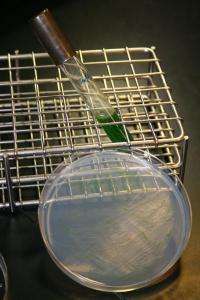
Photosynthetic microbes called cyanobacteria offer attractive advantages over the use of plants like corn or switchgrass, producing many times the energy yield with energy input from the sun and without the necessity of taking arable cropland out of production. Credit: Biodesign Institute, Arizona State University
Using genetic sleight of hand, researcher Xinyao Liu and professor Roy Curtiss at Arizona State University's Biodesign Institute have coaxed photosynthetic microbes to secrete oil—bypassing energy and cost barriers that have hampered green biofuel production. Their results appear in this week's advanced online issue of the Proceedings of the National Academy of Sciences.
The challenges of developing a renewable biofuel source that is competitive with the current scalability and low-cost of petroleum have been daunting. "The real costs involved in any biofuel production are harvesting the fuel precursors and turning them into fuel," said Roy Curtiss, director of the Biodesign Institute's Center for Infectious Diseases and Vaccinology and professor in the School of Life Sciences. "By releasing their precious cargo outside the cell, we have optimized bacterial metabolic engineering to develop a truly green route to biofuel production."
Photosynthetic microbes called cyanobacteria offer attractive advantages over the use of plants like corn or switchgrass, producing many times the energy yield with energy input from the sun and without the necessity of taking arable cropland out of production.
This video is not supported by your browser at this time.
Biodesign Institute researcher Xinyao Liu explains the advantages of genetically optimizing cyanobacteria to secrete high-energy fatty acids for renewable biofuel production. Credit: Jemal Leonard, Biodesign Institute, Arizona State University
Lead author Xinyao Liu and Curtiss, applied their expertise in the development of bacterial-based vaccines to genetically optimize cyanobacteria for biofuel production. Last year, they were able to modify these microbes, priming them to self-destruct and release their lipid contents. In the group's lastest effort however, the energy-rich fatty acids were extracted without killing the cells in the process."In China, we have a saying," Liu says. "We don't kill the hen to get the eggs." Rather than destroying the cyanobacteria, the group has ingeniously reengineered their genetics, producing mutant strains that continuously secrete fatty acids through their cell walls. The cyanobacteria essentially act like tiny biofuel production facilities.
Liu realized that if cyanobacteria could be cajoled into overproducing fatty acids, their accumulation within the cells would eventually cause these fatty acids to leak out through the cell membrane, through the process of diffusion. To accomplish this, Liu introduced a specific enzyme, known as thioesterase, into cyanobacteria.
The enzyme is able to uncouple fatty acids from complex carrier proteins, freeing them within the cell where they accumulate, until the cell secretes them. "I use genes that can steal fatty acids from the lipid synthesis pathway," Liu explains noting that thioesterase acts to efficiently clip the bonds associating the fatty acids with more complex molecules. This use of modified thioesterases to cause secretion of fatty acids was first described for Escherichia coli by John Cronan of the University of Illinois more than a decade ago.
A second series of modifications enhances the secretion process, by genetically deleting or modifying two key layers of the cellular envelope—known as the S and peptidoglycan layers—allowing fatty acids to more easily escape outside the cell, where their low water solubility causes them to precipitate out of solution, forming a whitish residue on the surface. Study results show a 3-fold increase in fatty acid yield, after genetic modification of the two membrane layers.
To improve the fatty acid production even further, the group added genes to cause overproduction of fatty acid precursors and removed some cellular pathways that were non-essential to the survival of cyanobacteria. Such modifications ensure that the microbe's resources are devoted to basic survival and lipid production.
Liu emphasizes that the current research has moved along at a lightening clip, with only about 6 months passing from the initial work, through production of the first strains—a fact he attributes to the formidable expertise in the area of microbial genetic manipulation, assembled at the Biodesign Institute. "I don't think any group would have the capacity to do this as fast," he said.
Professor Roy Curtiss agrees, noting that "the seminal advance has been to combine a number of genetic modifications and enzyme activities previously described in other bacteria and in plants in the engineered cyanobacteria strains along with the introduction of newly discovered modifications to increase production and secretion of fatty acids. The results to date are encouraging and we are confident of making further improvements to achieve enhanced productivity in strains currently under construction and development. In addition, optimizing growth conditions associated with scale-up will also improve productivity."
The team, which includes researchers Daniel Brune and Wim Vermaas, is also optimistic that significantly higher fatty acid yields will be obtainable, as research continues.
The research opens the door to practical use of this promising source of clean energy.
-
Self-destructing bacteria improve renewable biofuel production
Dec 08, 2009 |
not rated yet |
0
-
Microbes produce fuels directly from biomass
Jan 27, 2010 |
not rated yet |
0
-
African parasite makes component of fat differently from all other organisms
Aug 24, 2006 |
not rated yet |
0
-
Pregnant mothers' diet linked to baby's obesity
Apr 04, 2008 |
not rated yet |
0
-
Fatty fish protects against prostate cancer
Oct 31, 2006 |
not rated yet |
0
-
Stars containing dark matter should look different from other stars
Feb 20, 2012 |
4.5 / 5 (17) |
11
-
Physicists discover evidence of rare hypernucleus, a component of strange matter
Feb 17, 2012 |
4.7 / 5 (38) |
22
-
Fast photon control brings quantum photonic technologies closer
Feb 13, 2012 |
5 / 5 (8) |
1
-
Engineers build first sub-10-nm carbon nanotube transistor
Feb 01, 2012 |
4.9 / 5 (36) |
32
-
Something old, something new: Evolution and the structural divergence of duplicate genes
Jan 31, 2012 |
4.6 / 5 (7) |
1
-
Flowering Plant Revived After 30,000 Years in Permafrost
Feb 21, 2012
-
Toba volcano eruptions - 1.000 - 10,000 breeding pairsunb
Feb 20, 2012
-
How is a specific gene removed from DNA
Feb 20, 2012
-
Reproduction and Human evolution
Feb 19, 2012
-
Viruses: Living or Non-living organisms
Feb 19, 2012
-
Would you eat brainless animals?
Feb 16, 2012
- More from Physics Forums - Biology
More news stories
Surprising diversity at a synapse hints at complex diversity of neural circuitry
A new study reveals a dazzling degree of biological diversity in an unexpected place a single neural connection in the body wall of flies.
7 hours ago |
5 / 5 (4) |
0
|
Men might not 'become extinct' after all: Theory of the 'rotting' Y chromosome dealt a fatal blow
If you were to discover that a fundamental component of human biology has survived virtually intact for the past 25 million years, you'd be quite confident in saying that it is here to stay.
10 hours ago |
5 / 5 (6) |
1
|
Climate change affects bird migration timing in North America
Bird migration timing across North America has been affected by climate change, according to a study published Feb. 22 in the open access journal PLoS ONE.
6 hours ago |
4.5 / 5 (2) |
2
New family of legless amphibians found in India
Since before the age of dinosaurs it has burrowed unbothered beneath the monsoon-soaked soils of remote northeast India - unknown to science and mistaken by villagers as a deadly, miniature snake.
17 hours ago |
5 / 5 (8) |
3
New iridescent lizard species found in Cambodia
A new species of lizard with striking iridescent rainbow skin, a long tail and very short legs has been discovered in the rainforest in northeast Cambodia, conservationists announced Wednesday.
6 hours ago |
not rated yet |
0
Researchers build first physical 'metatronic' circuit
(PhysOrg.com) -- The technological world of the 21st century owes a tremendous amount to advances in electrical engineering, specifically, the ability to finely control the flow of electrical charges using ...
Faster than light neutrinos? More like faulty wiring
You can shelf your designs for a warp drive engine (for now) and put the DeLorean back in the garage; it turns out neutrinos may not have broken any cosmic speed limits after all.
Spitzer finds solid buckyballs in space
(PhysOrg.com) -- Astronomers using data from NASA's Spitzer Space Telescope have, for the first time, discovered buckyballs in a solid form in space. Prior to this discovery, the microscopic carbon spheres ...
Physicists surprised by disappearing and reappearing superconductivity in iron selenium chalcogenides
Superconductivity is a rare physical state in which matter is able to conduct electricity -- maintain a flow of electrons -- without any resistance. This phenomenon can only be found in certain materials at low temperatures, ...
Scientists create potent molecules aimed at treating muscular dystrophy
While RNA is an appealing drug target, small molecules that can actually affect its function have rarely been found. But now scientists from the Florida campus of The Scripps Research Institute have for the first time designed ...
Stanford research team cracks animated NuCaptcha
(PhysOrg.com) -- The research team from Stanford University, led by Elie Bursztein, that previously had cracked regular CAPTCHAs and then audio CAPTCHAs, now has also successfully cracked the animated version called NuCapt ...
Mar 29, 2010
Rank: 5 / 5 (1)
Mar 29, 2010
Rank: 2.5 / 5 (2)
I would like to see some numbers. For instance- what is yield of fatty acids per kg of cyanobacterium per 24 hours? that would be useful information.
Just the same, another stride in the right direction.
Mar 29, 2010
Rank: 4.5 / 5 (2)
Mar 29, 2010
Rank: 4.5 / 5 (2)
Mar 29, 2010
Rank: 5 / 5 (1)
Mar 29, 2010
Rank: 5 / 5 (1)
Mar 29, 2010
Rank: not rated yet
Perhaps allow small, local area "refiners"?
Or, will this just be another Exxon, Mobil, BP oil product line?
Mar 30, 2010
Rank: 1 / 5 (1)
I'm sure that they would be happy to license the technology to whoever could afford the fees.
Tech transfer to smallholder production might even be eligible for a Fed small business loan, or other program funds, given the push for green tech development currently underway.
Certainly worth checking into, if you are thinking along those lines.
Mar 30, 2010
Rank: not rated yet
Mar 30, 2010
Rank: not rated yet
Mar 30, 2010
Rank: 4 / 5 (1)
Mar 30, 2010
Rank: 5 / 5 (1)
Mar 30, 2010
Rank: 5 / 5 (3)
Generally, GMOs are less fit than their wild variants. If that weren't the case, the wild variants would already have incorporated these modifications.
Apr 03, 2010
Rank: not rated yet