1980s Video Icon Glows on Saturn Moon
March 29, 2010
1980s Video Icon Glows on Saturn Moon

Enlarge

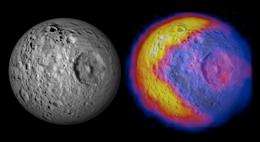
This figure illustrates the unexpected and bizarre pattern of daytime temperatures found on Saturn's small inner moon Mimas (396 kilometers, or 246 miles, in diameter). Credit: NASA/JPL/GSFC/SWRI/SSI

The highest-resolution-yet temperature map and images of Saturn's icy moon Mimas obtained by NASA's Cassini spacecraft reveal surprising patterns on the surface of the small moon, including unexpected hot regions that resemble "Pac-Man" eating a dot, and striking bands of light and dark in crater walls.

"Other moons usually grab the spotlight, but it turns out Mimas is more bizarre than we thought it was," said Linda Spilker, Cassini project scientist at NASA's Jet Propulsion Laboratory in Pasadena, Calif. "It has certainly given us some new puzzles."

Cassini collected the data on Feb. 13, during its closest flyby of the moon, which is marked by an enormous scar called Herschel Crater and resembles the Death Star from "Star Wars."

Scientists working with the composite infrared spectrometer, which mapped Mimas' temperatures, expected smoothly varying temperatures peaking in the early afternoon near the equator. Instead, the warmest region was in the morning, along one edge of the moon's disk, making a sharply defined Pac-Man shape, with temperatures around 92 Kelvin (minus 294 degrees Fahrenheit). The rest of the moon was much colder, around 77 Kelvin (minus 320 degrees Fahrenheit). A smaller warm spot - the dot in Pac-Man's mouth - showed up around Herschel, with a temperature around 84 Kelvin (minus 310 degrees Fahrenheit).

The warm spot around Herschel makes sense because tall crater walls (about 5 kilometers, or 3 miles, high) can trap heat inside the crater. But scientists were completely baffled by the sharp, V-shaped pattern.

"We suspect the temperatures are revealing differences in texture on the surface," said John Spencer, a Cassini composite infrared spectrometer team member based at Southwest Research Institute in Boulder, Colo. "It's maybe something like the difference between old, dense snow and freshly fallen powder."
1980s Video Icon Glows on Saturn Moon
Enlarge

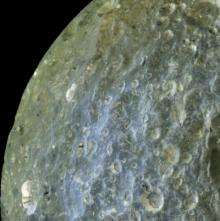
This false-color view of Saturn's moon Mimas from NASA's Cassini spacecraft accentuates terrain-dependent color differences and shows dark streaks running down the sides of some of the craters on the region of the moon that leads in its orbit around Saturn. Credit: NASA/JPL/SSI

Denser ice quickly conducts the heat of the sun away from the surface, keeping it cold during the day. Powdery ice is more insulating and traps the sun's heat at the surface, so the surface warms up.

Even if surface texture variations are to blame, scientists are still trying to figure out why there are such sharp boundaries between the regions, Spencer said. It is possible that the impact that created Herschel Crater melted surface ice and spread water across the moon. That liquid may have flash-frozen into a hard surface. But it is hard to understand why this dense top layer would remain intact when meteorites and other space debris should have pulverized it by now, Spencer said.

Icy spray from the E ring, one of Saturn's outer rings, should also keep Mimas relatively light-colored, but the new visible-light images from the flyby paint a picture of surprising contrasts. Cassini imaging team scientists didn't expect to see dark streaks trailing down the bright crater walls or a continuous, narrow pile of concentrated dark debris tracing the foot of each wall.

The pattern may appear because of the way the surface of Mimas ages, said Paul Helfenstein, a Cassini imaging team associate based at Cornell University, Ithaca, N.Y. Over time, the moon's surface appears to accumulate a thin veil of silicate minerals or carbon-rich particles, possibly because of meteor dust falling onto the moon, or impurities already embedded in surface ice.

As the sun's warming rays and the vacuum of space evaporate the brighter ice, the darker material is concentrated and left behind. Gravity pulls the dark material down the crater walls, exposing fresh ice underneath. Although similar effects are seen on other moons of Saturn, the visibility of these contrasts on a moon continually re-paved with small particles from the E ring helps scientists estimate rates of change on other satellites.

"These processes are not unique to Mimas, but the new high-definition images are like Rosetta stones for interpreting them," Helfenstein said.

Provided by Southwest Research Institute (news : web)

4.5 /5 (14 votes)  

Rank 4.5 /5 (14 votes)
Related Stories
Relevant PhysicsForums posts
  • What is this spectrum I took?
    created9 hours ago
  • Orientation of Space
    created9 hours ago
  • Geologically Active Moon Now: NASA
    created16 hours ago
  • advice on building a science fair telescope
    created22 hours ago
  • Rise of the Sun
    created22 hours ago
  • Uncertainty of planetary orbital period
    createdFeb 19, 2012
  • More from Physics Forums - General Astronomy

More news stories

Spitzer finds solid buckyballs in space

(PhysOrg.com) -- Astronomers using data from NASA's Spitzer Space Telescope have, for the first time, discovered buckyballs in a solid form in space. Prior to this discovery, the microscopic carbon spheres ...

Space & Earth / Astronomy

created 11 hours ago | popularity 4.7 / 5 (12) | comments 6 | with audio podcast

Going up: Japan builder eyes space elevator

A Japanese construction firm claimed Wednesday it could execute an out-of-this-world plan to put tourists in space within 40 years by building an elevator that stretches a quarter of the way to the moon.

Space & Earth / Space Exploration

created 18 hours ago | popularity 3.5 / 5 (13) | comments 24

ENASA satellite finds Earth's clouds are getting lower

(PhysOrg.com) -- Earth's clouds got a little lower -- about one percent on average -- during the first decade of this century, finds a new NASA-funded university study based on NASA satellite data. The results ...

Space & Earth / Earth Sciences

created 15 hours ago | popularity 5 / 5 (8) | comments 9 | with audio podcast

Fresh scandal embroils US climate science debate

A fresh scandal over climate change has erupted in the United States after leaked documents appeared to show a right-wing funded campaign to influence how climate science is taught in schools.

Space & Earth / Environment

created 7 hours ago | popularity 4.4 / 5 (7) | comments 6

World's oceans get an acid bath

Among the repercussions of global climate change, the effect of ocean acidification on marine life is one of the least-understood variables.

Space & Earth / Environment

created 14 hours ago | popularity 4.3 / 5 (6) | comments 4 | with audio podcast


Researchers build first physical 'metatronic' circuit

(PhysOrg.com) -- The technological world of the 21st century owes a tremendous amount to advances in electrical engineering, specifically, the ability to finely control the flow of electrical charges using ...

Faster than light neutrinos? More like faulty wiring

You can shelf your designs for a warp drive engine (for now) and put the DeLorean back in the garage; it turns out neutrinos may not have broken any cosmic speed limits after all.

Physicists surprised by disappearing and reappearing superconductivity in iron selenium chalcogenides

Superconductivity is a rare physical state in which matter is able to conduct electricity -- maintain a flow of electrons -- without any resistance. This phenomenon can only be found in certain materials at low temperatures, ...

Scientists create potent molecules aimed at treating muscular dystrophy

While RNA is an appealing drug target, small molecules that can actually affect its function have rarely been found. But now scientists from the Florida campus of The Scripps Research Institute have for the first time designed ...

Stanford research team cracks animated NuCaptcha

(PhysOrg.com) -- The research team from Stanford University, led by Elie Bursztein, that previously had cracked regular CAPTCHAs and then audio CAPTCHAs, now has also successfully cracked the animated version called NuCapt ...

Less is more: Study of tiny droplets could have big impact on industrial applications

(PhysOrg.com) -- Under a microscope, a tiny droplet slides between two fine hairs like a roller coaster on a set of rails until — poof — it suddenly spreads along them, a droplet no more.