An Avalanche of Asteroids
March 29, 2010 by Dauna Coulter
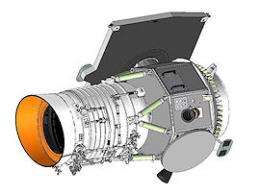
An artist's concept of NASA's Wide-field Infrared Survey Explorer (WISE).
Imagine you're a Brontosaurus with your face in a prehistoric tree top, munching on fresh leaves. Your relatives have ruled planet Earth for more than 150 million years. Huge and strong, you feel invincible.
You're not.
Fast forward about 65 million years. A creature much smaller and weaker dominates the Earth now, with brains instead of brawn. Its brain is a lot larger relative to its body size - plenty big enough to conceive a way to scan the cosmos for objects like the colossal asteroid that wrought the end of your kind.
The creature designed and built WISE, NASA's Wide-field Infrared Survey Explorer, to search for "dark" objects in space like brown dwarf stars, vast dust clouds, and Earth-approaching asteroids. WISE finds them by sensing their heat in the form of infrared light most other telescopes can't pick up.
"Our instrument is finding [dozens] of asteroids every day that were never detected before," says Ned Wright, principal investigator for WISE and a physicist at the University of California in Los Angeles. "WISE is very good at this kind of work."
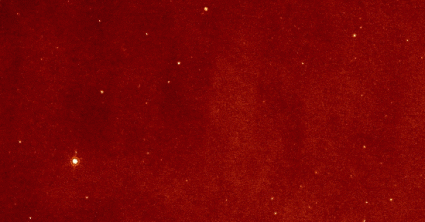
This blink comparison shows why infrared wavelengths are so good for asteroid hunting. It's a patch of sky in the constellation Taurus photographed at two different times by the infrared Spitzer Space Telescope. The two frames are correctly aligned; the objects are moving because they are asteroids. At thermal infrared wavelengths, most of the bright objects in the plane of the solar system are space rocks. (Click 'Enlarge' for animation)
Most of the asteroids WISE is finding are in the main asteroid belt between Mars and Jupiter, but a fraction of them are different—they're the kind of Earth-approaching asteroids that send shivers all the way down a Brontosaurus' spine."WISE has only been in orbit for about three months, but we've already found a handful of asteroids classified as 'potentially hazardous,' including one seen in 1996 but lost until re-observed by WISE. To be named 'potentially hazardous,' an asteroid's orbit has to pass within about 5 million miles of Earth's orbit. One of our discoveries' orbit will cross Earth's orbit less than 700,000 miles away."
WISE tracks each potentially hazardous near-Earth object (NEO) it finds every three hours for up to 30 hours and then produces a "short track" predicting where it will be for the next few weeks. The WISE team sends all of this information to the NASA-funded Minor Planet Center in Boston. They post it on a publicly available NEO confirmation page, where scientists and amateur astronomers alike can continue to track the asteroid.
The asteroid that is thought to have wiped out the dinosaurs was big--about 6 miles or 10 km in diameter. The chances of a similar hit in modern times are almost non-existent, but that doesn't mean we're out of the woods. Smaller asteroids are fairly common, and they could do damage, too, in the rare event of impacting the Earth. As recently as 1908, for instance, an asteroid some tens of meters across exploded over Tunguska, Russia, wiping out eight hundred square miles of remote forest.
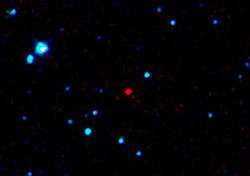
The red dot in this image is the first near-Earth asteroid discovered by WISE.
"Regional damage from a small asteroid strike can be very serious indeed," says Wright. "We need to keep surveying the skies to find these NEOs and precisely measure their orbits. If we can find the really dangerous asteroids early enough, we might have time to figure out how to deal with them."Many telescopes on Earth are already searching. Notable programs include LINEAR, the Catalina Sky Survey and others. Working together over the years they have found more than a thousand potentially hazardous asteroids.
WISE's contribution to the total will be impressive. Between now and late October, when the mission is slated to end, Wright estimates the observatory will find a hundred thousand asteroids, mostly in the main belt, and hundreds of near Earth objects.
Those are numbers even a Brontosaurus could appreciate.
Provided by Science@NASA, by Dauna Coulter
-
The First of Many Asteroid Finds for WISE
Jan 25, 2010 |
not rated yet |
0
-
WISE satellite blasts off on space-map mission
Dec 14, 2009 |
not rated yet |
0
-
NASA to launch sky-mapping spacecraft
Dec 06, 2009 |
not rated yet |
0
-
Infrared Hunt Begins: WISE Starts All-Sky Survey
Jan 14, 2010 |
not rated yet |
0
-
NASA's Wise Gets Ready to Survey the Whole Sky (w/ Video)
Nov 17, 2009 |
not rated yet |
0
-
Engineers build first sub-10-nm carbon nanotube transistor
Feb 01, 2012 |
4.9 / 5 (30) |
30
-
Something old, something new: Evolution and the structural divergence of duplicate genes
Jan 31, 2012 |
4.6 / 5 (7) |
1
-
The hidden nanoworld of ice crystals: Revealing the dynamic behavior of quasi-liquid layers
Jan 30, 2012 |
5 / 5 (3) |
1
-
Stock market network reveals investor clustering
Jan 27, 2012 |
3.9 / 5 (23) |
8
-
Of microchemistry and molecules: Electronic microfluidic device synthesizes biocompatible probes
Jan 26, 2012 |
5 / 5 (1) |
0
-
Titan's lack of impact craters
19 hours ago
-
Real pictures of black hole eating a star?
Feb 08, 2012
-
Hypothetical way to travel faster than light, but not technically exceed lightspeed
Feb 06, 2012
-
How do scientists monitor the Sun's activity?
Feb 05, 2012
-
Search patterns in observational studies
Feb 05, 2012
-
Derivation of Pogson's law
Feb 03, 2012
- More from Physics Forums - General Astronomy
More news stories
NASA budget will axe Mars deal with Europe: scientists
US President Barack Obama's budget proposal to be submitted next week for 2013 will cut NASA's budget by 20 percent and eliminate a major partnership with Europe on Mars exploration, scientists said Thursday.
Space & Earth / Space Exploration
57 minutes ago |
not rated yet |
0
Humans may have helped the decline of African rainforests 3000 years ago
(PhysOrg.com) -- Large areas of rainforests in Central Africa mysteriously disappeared over three thousand years ago, to be replaced by savannas. The prevailing theory has been that the cause was a change ...
New views show old NASA Mars landers
(PhysOrg.com) -- The High Resolution Imaging Science Experiment (HiRISE) camera on NASA's Mars Reconnaissance Orbiter recorded a scene on Jan. 29, 2012, that includes the first color image from orbit showing ...
Space & Earth / Space Exploration
23 hours ago |
4.9 / 5 (7) |
9
|
Black holes and star formation
(PhysOrg.com) -- It has long been recognized that galaxy mergers or even close interactions can play a vital role in shaping the morphology of galaxies. One way they can do so, it is thought, is by triggering ...
22 hours ago |
4.1 / 5 (7) |
5
|
Deconstructing a mystery: What caused Snowmaggedon?
In the quiet after the storms, streets and cars had all but disappeared under piles of snow. The U.S. Postal Service suspended service for the first time in 30 years. Snow plows struggled to push the evidence ...
Space & Earth / Earth Sciences
15 hours ago |
4.7 / 5 (3) |
1
|
Protein libraries in a snap
(PhysOrg.com) -- A Rice University undergraduate will depart with not only a degree but also a possible patent for his invention of an efficient way to create protein libraries, an important component of biomolecular ...
Neurologic improvement detected in rats receiving stem cell transplant
In a study to be presented today at the Society for Maternal-Fetal Medicine's annual meeting, The Pregnancy Meeting, in Dallas, Texas, researchers will report that early transplantation of human placenta-derived mesenchymal ...
Breastfeeding protects against asthma up to six years of age
(Medical Xpress) -- Research by the University of Otago in Christchurch and Wellington has shown that breastfeeding of infants has a clear protective effect against children developing asthma or wheezing up to six years of ...
Study finds stress hormones fluctuate with mood during pregnancy
(Medical Xpress) -- While pregnant, women pay particular attention to factors such as diet and exercise to ensure their babies are born healthy and develop normally. New research from the University of Calgarys Faculty ...
Clinical trial teaches binge eaters to toss away cravings
Of 190 million obese Americans, approximately 10-15 percent engage in harmful binge eating. During single sittings, these over-eaters consume large servings of high-caloric foods. Sufferers contend with weight gain and depression ...
Japan scientist makes 'Avatar' robot
A Japanese-developed robot that mimics the movements of its human controller is bringing the Hollywood blockbuster "Avatar" one step closer to reality.

Mar 29, 2010
Rank: 5 / 5 (5)
Mar 30, 2010
Rank: 5 / 5 (2)
http://www.spaceweather.com/
You will see at the bottom they keep track of the PHAs. I have been watching the count and it has gone up at the rate of about one PHA every 4.5 days over the past 3 years. I agree that these telescopes and surveys are good investments.
Mar 30, 2010
Rank: 4.3 / 5 (6)
Mar 30, 2010
Rank: 3 / 5 (2)
Mar 30, 2010
Rank: 2 / 5 (4)
Mar 30, 2010
Rank: 5 / 5 (1)
Mar 30, 2010
Rank: 3 / 5 (2)
And it matters, why? Pluto ain't a planet neither, but it is.
Mar 30, 2010
Rank: 5 / 5 (1)
As soon as I wrote that I realised what I wrote was of little consequence especially if we all die in a fiery wave :D
Mar 31, 2010
Rank: 5 / 5 (1)
Well, you at least got one out of three right. :)
As for asteroid discoveries, the newly commissioned VISTA infrared survey telescope should already be adding quite a few new asteroids to the tally. When PanSTARR-4 and LSST survey scopes come on line, the floodgates will truly be opened wrt asteroid discoveries.
Apr 03, 2010
Rank: 1 / 5 (1)
I agree. Anyway it was essentially a large cow. If you're going to go dinosaur, always lead with T-Rex.