CryoSat-2 ice mission ready for launch
March 30, 2010
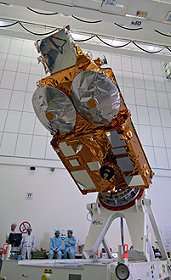
(PhysOrg.com) -- A UK-led CryoSat-2 satellite designed to monitor changes in ice cover at the poles will launch at 13:57 UK time on 8 April 2010 from the Baikonur cosmodrome in Kazakhstan.
The European Space Agency's CryoSat-2 will measure the thickness of Arctic and Antarctic ice with unprecedented accuracy and tell scientists how melting polar ice affects ocean circulation patterns, sea level and global climate.
CryoSat-2 is the third of ESA's Earth Explorer missions and follows the successful launches of the GOCE (Gravity field and steady state Ocean Circulation Explorer) and SMOS (Soil Moisture and Ocean Salinity) satellites last year. Its launch is a testament to Europe's commitment to the mission following the launch failure of CryoSat-1 in 2005.
CryoSat-2's chief scientist, Professor Duncan Wingham from the Centre for Polar Observation and Modelling - part of the National Centre for Earth Observation - at University College London first proposed the satellite in 1999. He said, "Satellites have transformed our knowledge of what is happening to these distant and uninhabited parts of the planet. CryoSat-2 will help unravel the consequences of the dramatic changes in the poles that we've seen in the past two decades."
Professor Alan O'Neill, Director of the National Centre for Earth Observation said, "Measurements from CryoSat-2 are crucially important for scientists at the National Centre for Earth Observation who are at the forefront in monitoring Earth's changing ice cover."
CryoSat-2 will use an instrument called an altimeter to measure ice thickness. This works by recording the time it takes for pulses of microwave energy fired down at the ice to return to the satellite. Scientists can use the difference between how long it takes for the echoes to return from the top of ice floes and from the water in cracks in the ice to calculate how thick the ice is.
Significant retreats in summer Arctic sea ice in recent years means there's also more potential for winds to 'spin up' the Arctic Ocean. This could change ocean circulation patterns far beyond the Arctic - as far as the North Atlantic. Changes here could affect the UK's weather. CryoSat-2 will tell scientists how winds affect the Arctic Ocean by measuring changes in the height of the sea surface exposed between ice floes.
A second antenna will measure the ice's shape and so tell researchers about slopes and ridges at the edges of the great Antarctic and Greenland ice sheets. This is important, because the edges are where the fastest changes are taking place.
CryoSat-2's ability to monitor changes at the poles will surpass the abilities of earlier ESA satellites - its radar has been specifically designed for the task and its orbit will cover much more of the Arctic and Antarctica than has previously been possible.
Provided by British National Space Centre
-
CryoSat set for launch
Oct 08, 2005 |
not rated yet |
0
-
British climate satellite to be launched
Oct 05, 2005 |
not rated yet |
0
-
CryoSat to observe Earth's ice cover (w/ Video)
Feb 15, 2010 |
not rated yet |
0
-
Countdown to satellite launch
Oct 06, 2005 |
not rated yet |
0
-
CryoSat launch delayed
Feb 19, 2010 |
not rated yet |
0
-
Engineers build first sub-10-nm carbon nanotube transistor
Feb 01, 2012 |
4.9 / 5 (31) |
30
-
Something old, something new: Evolution and the structural divergence of duplicate genes
Jan 31, 2012 |
4.6 / 5 (7) |
1
-
The hidden nanoworld of ice crystals: Revealing the dynamic behavior of quasi-liquid layers
Jan 30, 2012 |
5 / 5 (3) |
1
-
Stock market network reveals investor clustering
Jan 27, 2012 |
3.9 / 5 (23) |
8
-
Of microchemistry and molecules: Electronic microfluidic device synthesizes biocompatible probes
Jan 26, 2012 |
5 / 5 (1) |
0
-
Scale of the Universe
12 hours ago
-
Titan's lack of impact craters
Feb 09, 2012
-
Real pictures of black hole eating a star?
Feb 08, 2012
-
Hypothetical way to travel faster than light, but not technically exceed lightspeed
Feb 06, 2012
-
How do scientists monitor the Sun's activity?
Feb 05, 2012
-
Search patterns in observational studies
Feb 05, 2012
- More from Physics Forums - General Astronomy
More news stories
Humans may have helped the decline of African rainforests 3000 years ago
(PhysOrg.com) -- Large areas of rainforests in Central Africa mysteriously disappeared over three thousand years ago, to be replaced by savannas. The prevailing theory has been that the cause was a change ...
Could Venus be shifting gear?
(PhysOrg.com) -- ESAs Venus Express spacecraft has discovered that our cloud-covered neighbour spins a little slower than previously measured. Peering through the dense atmosphere in the infrared, the ...
Space & Earth / Space Exploration
19 hours ago |
5 / 5 (7) |
8
|
NASA budget will axe Mars deal with Europe: scientists
US President Barack Obama's budget proposal to be submitted next week for 2013 will cut NASA's budget by 20 percent and eliminate a major partnership with Europe on Mars exploration, scientists said Thursday.
Space & Earth / Space Exploration
22 hours ago |
5 / 5 (2) |
19
Mars Science Laboratory computer issue resolved
(PhysOrg.com) -- Engineers have found the root cause of a computer reset that occurred two months ago on NASA's Mars Science Laboratory and have determined how to correct it.
Space & Earth / Space Exploration
20 hours ago |
4.7 / 5 (6) |
4
|
Two new moons for Jupiter
Advances in technology have lead to the discovery of new planets outside of our Solar System, and now even new moons in our own backyard.
Space & Earth / Space Exploration
19 hours ago |
4 / 5 (1) |
7
Anonymous knocks CIA website offline (Update)
The website of the Central Intelligence Agency was inaccessible on Friday after the hacker group Anonymous claimed to have knocked it offline.
New error-correcting codes guarantee the fastest possible rate of data transmission
Error-correcting codes are one of the triumphs of the digital age. Theyre a way of encoding information so that it can be transmitted across a communication channel such as an optical fiber o ...
Small modular reactor design could be a 'SUPERSTAR'
(PhysOrg.com) -- Though most of today's nuclear reactors are cooled by water, we've long known that there are alternatives; in fact, the world's first nuclear-powered electricity in 1951 came from a reactor ...
New power source discovered
(PhysOrg.com) -- Researchers at the Massachusetts Institute of Technology (MIT) and RMIT University have made a breakthrough in energy storage and power generation.
The power of estrogen -- male snakes attract other males
A new study has shown that boosting the estrogen levels of male garter snakes causes them to secrete the same pheromones that females use to attract suitors, and turned the males into just about the sexiest ...
Google users warned of threat to smartphone wallets
Users of Google smartphone wallets were being warned on Friday that there is a way to crack pass codes intended to thwart thieves from going on illicit shopping sprees.