What, or who, killed the last mammoths?
March 31, 2010 by Marlowe Hood
Climate change was not responsible for wiping out the mammoths, according to a new study

Enlarge

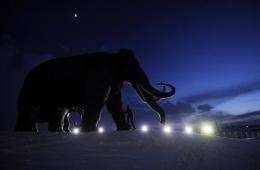
A man climbs a bronze sculpture of a mammoth in the western Siberian city of Khanty-Mansiysk on March 24, 2010. The last known population of woolly mammoths, roaming a remote Arctic island long after humans invented writing, were wiped out quickly, reports a study released Wednesday.

The last known population of woolly mammoths, roaming a remote Arctic island long after humans invented writing, were wiped out quickly, reports a study released Wednesday.

The culprit might have been disease, humans or a catastrophic weather event, but was almost certainly not climate change, suggests the study, published in the .

Exactly why a majority of the huge tuskers that once strode in large herds across Eurasia and north America died out toward the end of the last ice age has generated fiery debate.

Some experts hold that mammoths were hunted to extinction beginning some 10,000 years ago by the species that was to become the planet's dominant predator -- humans.

Others argue that was more to blame, leaving a species adapted for frigid climes ill-equipped to cope with a warming world.

It has long been known that a colony of survived up until about four thousand years ago on what is today Russia's Wrangel Island, north of Siberia in the .

dating shows that at least a few hardy individuals were still hanging on as late as 1700 B.C.

To better understand their demise, researchers led by Anders Angerbjorn of Stockholm University analysed bits of -- genetic material inherited through females -- extracted from bone and tusk.

They reasoned that signs of dwindling would mean that too much inbreeding among a small population could have partially caused the animals to die out.

"It could be that the island was simply too small to support a long-term viable population," the authors speculated.

About 7,600 square kilometres (2,900 square miles) in area, Wrangel Island is a bit smaller than Corsica or Puerto Rico.

Once connected to the mainland by an ice bridge, Wrangel was gradually cut off by water 12,000 to 9,000 years ago.

A loss of could also have resulted from the shift in climate as Earth entered the so-called interglacial period, a boon for many animals, but not for the giant tuskers, the study said.

To their surprise, however, the researchers found that genetic diversity remained stable, and even increased slightly, right up to the bitter end.

"This suggests that the final extinction was caused by a relatively sudden, rather than gradual, change in the mammoths' environment," the study said.

Humans appear to have arrived on the island about 100 years after the huge mammals had vanished, according to archeological data.

This would exculpate homo sapiens from killing off the last mammoths, though it is possible humans arrived earlier but left no trace.

That leaves climate or disease, the researchers hypothesise, noting that a sudden event -- a mega-storm, for example -- or a novel bacteria or virus could have wiped out the remaining population.

The fate of mammoths on Wrangel Island, they caution, is not necessarily a microcosm for the species as a whole because islands exert unique evolutionary pressures on animal species.

One theory is that expanding forests in Europe and parts of Asia robbed the grass-eating mammoths of their preferred habitat, gradually starving them to death.

(c) 2010 AFP

4.9 /5 (7 votes)  

Filter


Move the slider to adjust rank threshold, so that you can hide some of the comments.


Display comments: newest first

mikehevans
Mar 31, 2010

Rank: 5 / 5 (2)
Oh, come on! A hundred years, given the dating method's accuracy, is well within the margin for error. In an environment where the only large land animal was more interested in eating you than you were in eating it (polar bears), the discovery of a population of mammoths would have been like a ticket to the buffet.
dmcl
Apr 01, 2010

Rank: not rated yet
And if not previously accustomed to being hunted, they might not have had any fear of the first humans on the island. Like spearing cows, only bigger.
bluehigh
Apr 01, 2010

Rank: not rated yet
Humans arrived because it got hot enough to be habitable for humans. I side with the argument that the onset of the Holocene made living conditions for the Mammoths intolerable. To argue otherwise would be to deny Darwinian adaptation.
Rank 4.9 /5 (7 votes)
Relevant PhysicsForums posts
  • Mitosis
    created4 hours ago
  • Stem cell question.
    created5 hours ago
  • Protease cleavage
    created12 hours ago
  • Pertubance in a model
    created18 hours ago
  • Cancer drugs and Alzheimer's, Oh my!
    createdFeb 09, 2012
  • Squishing cells
    createdFeb 09, 2012
  • More from Physics Forums - Biology

More news stories

The power of estrogen -- male snakes attract other males

A new study has shown that boosting the estrogen levels of male garter snakes causes them to secrete the same pheromones that females use to attract suitors, and turned the males into just about the sexiest ...

Biology / Plants & Animals

created 17 hours ago | popularity 4.8 / 5 (6) | comments 2 | with audio podcast

Grass to gas: Researchers' genome map speeds biofuel development

Researchers at the University of Georgia have taken a major step in the ongoing effort to find sources of cleaner, renewable energy by mapping the genomes of two originator cells of Miscanthus x giganteus, a large perenn ...

Biology / Biotechnology

created 14 hours ago | popularity 3.8 / 5 (5) | comments 0 | with audio podcast

Miami battling invasion of giant African snails

No one knows how they got there. But an invasion of African giant snails has southern Florida in a panic over potential crop damage, disease and general yuckiness surrounding the slimy gastropods.

Biology / Ecology

created 21 hours ago | popularity 4 / 5 (1) | comments 4

Experts reveal how plants don't get sunburn

(PhysOrg.com) -- Experts at the University of Glasgow have discovered how plants survive the harmful rays of the sun.

Biology / Cell & Microbiology

created 17 hours ago | popularity 4.8 / 5 (5) | comments 0 | with audio podcast

Protein libraries in a snap

(PhysOrg.com) -- A Rice University undergraduate will depart with not only a degree but also a possible patent for his invention of an efficient way to create protein libraries, an important component of biomolecular ...

Biology / Cell & Microbiology

created 20 hours ago | popularity 4.8 / 5 (4) | comments 1 | with audio podcast


Anonymous knocks CIA website offline (Update)

The website of the Central Intelligence Agency was inaccessible on Friday after the hacker group Anonymous claimed to have knocked it offline.

New error-correcting codes guarantee the fastest possible rate of data transmission

Error-correcting codes are one of the triumphs of the digital age. They’re a way of encoding information so that it can be transmitted across a communication channel — such as an optical fiber o ...

Google users warned of threat to smartphone wallets

Users of Google smartphone wallets were being warned on Friday that there is a way to crack pass codes intended to thwart thieves from going on illicit shopping sprees.

Humans may have helped the decline of African rainforests 3000 years ago

(PhysOrg.com) -- Large areas of rainforests in Central Africa mysteriously disappeared over three thousand years ago, to be replaced by savannas. The prevailing theory has been that the cause was a change ...

New power source discovered

(PhysOrg.com) -- Researchers at the Massachusetts Institute of Technology (MIT) and RMIT University have made a breakthrough in energy storage and power generation.

Small modular reactor design could be a 'SUPERSTAR'

(PhysOrg.com) -- Though most of today's nuclear reactors are cooled by water, we've long known that there are alternatives; in fact, the world's first nuclear-powered electricity in 1951 came from a reactor ...