Paintable Electronics? Scientists Study Spray-On Manufacturing of Transistors
March 31, 2010
Paintable Electronics? Scientists Study Spray-On Manufacturing of Transistors

Enlarge

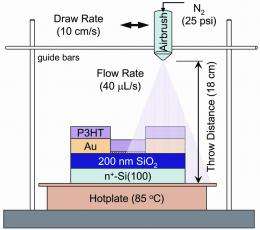
This airbrush technique deposits a well-studied material called P3HT to create spray-on transistors, which perform comparably to lab-standard equivalents made by spin coating. Credit: NIST

(PhysOrg.com) -- A multidisciplinary research team at the National Institute of Standards and Technology has found* that an organic semiconductor may be a viable candidate for creating large-area electronics, such as solar cells and displays that can be sprayed onto a surface as easily as paint.

While the electronics will not be ready for market anytime soon, the research team says the material they studied could overcome one of the main cost hurdles blocking the large-scale manufacture of organic thin-film transistors, the development of which also could lead to a host of devices inexpensive enough to be disposable.

Silicon is the iconic material of the electronics industry, the basic material for most microprocessors and . Silicon has proved highly successful as a substance because billions of computer elements can be crammed into a tiny area, and the manufacturing process behind these high-performance chips is well-established.

But the electronics industry for a long time has been pursuing novel organic materials to create semiconductor products—materials that perhaps could not be packed as densely as state-of-the-art silicon chips, but that would require less power, cost less and do things silicon devices cannot: bend and fold, for example. Proponents predict that organic semiconductors, once perfected, might permit the construction of low-cost and video displays that could be sprayed onto a surface just as paint is.

“At this stage, there is no established best material or manufacturing process for creating low-cost, large-area electronics,” says Calvin Chan, an electrical engineer at NIST. “What our team has done is to translate a classic material deposition method, spray painting, to a way of manufacturing cheap electronic devices.”

The team’s work showed that a commonly used organic transistor material, poly(3-hexylthiophene), or P3HT, works well as a spray-on transistor material because, like beauty, transistors aren’t very deep. When sprayed onto a flat surface, inhomogeneities give the P3HT film a rough and uneven top surface that causes problems in other applications. But because the transistor effects occur along its lower surface—where it contacts the substrate—it functions quite well.

Chan says the simplicity of spray-on electronics gives it a potential cost advantage over other manufacturing processes for organic electronics. Other candidate processes, he says, require costly equipment to function or are simply not suitable for use in high-volume manufacturing.

More information: * C.K. Chan, L.J. Richter, B.Dinardo, C.Jaye, B.R. Conrad, H.W. Ro, D. S. Germack, D.A. Fischer, D.M. DeLongchamp, D. J. Gundlach. High performance airbrushed organic thin film transistors. Applied Physics Letters, 96, 133304. March 30, 2010. doi:10.1063/1.3360230

Provided by National Institute of Standards and Technology (news : web)

3.8 /5 (5 votes)  

Filter


Move the slider to adjust rank threshold, so that you can hide some of the comments.


Display comments: newest first

Lolipop
Apr 01, 2010

Rank: not rated yet
First thought this was Aprils-fools-article... but it turns out it's solid. :)
Rank 3.8 /5 (5 votes)
Relevant PhysicsForums posts
  • excited U-236 decay time in the U235 fission chain
    created16 hours ago
  • Polar catastrophe?
    created19 hours ago
  • Large scale field sonication
    created22 hours ago
  • states and energy of paired electrons in BCS
    createdFeb 08, 2012
  • difference between longitudinal and transverse refractive indices
    createdFeb 08, 2012
  • Monte Carlo simulation
    createdFeb 07, 2012
  • More from Physics Forums - Atomic, Solid State, Comp. Physics

More news stories

SLAC, Stanford team focuses on high-energy electrons to treat cancer

Accelerator physicists at SLAC and cancer specialists from Stanford are working on a new technology that could dramatically reduce the time needed for cancer radiation treatments. The team ran an initial experiment ...

Physics / General Physics

created 44 minutes ago | popularity not rated yet | comments 0

Measurements from high-energy collisions lead to better understanding of why meson particles disappear

For several years, physicists at the Relativistic Heavy Ion Collider (RHIC) at Brookhaven National Laboratory (BNL), USA, have studied an unusual state of matter called the quark–gluon plasma, which they ...

Physics / General Physics

created 1 hour ago | popularity not rated yet | comments 0

Quantum physicist explains $100K offer for proof scaled-up quantum computing is impossible

(PhysOrg.com) -- MIT researcher Scott Aaronson has certainly riled the physics community with his offer this past Friday, of $100,000 to anyone who can prove that scaled-up quantum computing is impossible. ...

Physics / Quantum Physics

created Feb 08, 2012 | popularity 4.1 / 5 (11) | comments 32 | with audio podcast weblog

Explained: Sigma

It's a question that arises with virtually every major new finding in science or medicine: What makes a result reliable enough to be taken seriously? The answer has to do with statistical significance -- but ...

Physics / General Physics

created Feb 09, 2012 | popularity 5 / 5 (13) | comments 26

Physicists 'record' magnetic breakthrough

An international team of scientists has demonstrated a revolutionary new way of magnetic recording which will allow information to be processed hundreds of times faster than by current hard drive technology.

Physics / General Physics

created Feb 07, 2012 | popularity 4.5 / 5 (39) | comments 14 | with audio podcast


The power of estrogen -- male snakes attract other males

A new study has shown that boosting the estrogen levels of male garter snakes causes them to secrete the same pheromones that females use to attract suitors, and turned the males into just about the sexiest ...

Could Venus be shifting gear?

(PhysOrg.com) -- ESA’s Venus Express spacecraft has discovered that our cloud-covered neighbour spins a little slower than previously measured. Peering through the dense atmosphere in the infrared, the ...

Experts reveal how plants don't get sunburn

(PhysOrg.com) -- Experts at the University of Glasgow have discovered how plants survive the harmful rays of the sun.

Team isolates nerve cells involved in storing long term memory and gene proteins associated with them

(Medical Xpress) -- A research team in Taiwan has succeeded in isolating two nerve cells in fruit fly brains that are believed to be the major players in allowing for the formation of long term memories. Furthermore, ...

Fool's gold may prove an unlikely alternative to overexploited catalytic materials

Catalytic materials, which lower the energy barriers for chemical reactions, are used in everything from the commercial production of chemicals to catalytic converters in car engines. However, with current catalytic materials ...

News of plaque-clearing drug tops week of major advances against Alzheimer's disease

In the last eight days, scientists have delivered a powerful one-two punch in the fight to defeat Alzheimer's disease. At the same time, the White House and members of Congress are proposing increases in Alzheimer's research ...