Was a giant comet responsible for a North American catastrophe in 11000 BC?
April 1, 2010 by Robert Massey
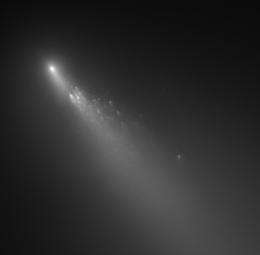
HST image of fragment B of Comet Schwassmann-Wachmann 3. Credit: NASA / ESA / H. Weaver (JHU/APL) / M. Mutchler / Z. Levay (STScI)
(PhysOrg.com) -- 13,000 years ago the Earth was struck by thousands of Tunguska-sized cometary fragments over the course of an hour, leading to a dramatic cooling of the planet, according to astronomer Professor Bill Napier of the Cardiff University Astrobiology Centre. He presents his new model in the journal Monthly Notices of the Royal Astronomical Society.
The cooling, by as much as 8°C, interrupted the warming which was occurring at the end of the last ice age and caused glaciers to readvance. Evidence has been found that this catastrophic change was associated with some extraordinary extraterrestrial event. The boundary is marked by the occurrence of a "black mat" layer a few centimetres thick found at many sites throughout the United States containing high levels of soot indicative of continental-scale wildfires, as well as microscopic hexagonal diamonds (nanodiamonds) which are produced by shocks and are only found in meteorites or impact craters. These findings led to the suggestion that the catastrophic changes of that time were caused by the impact of an asteroid or comet 4 km across on the Laurentide ice sheet, which at that time covered what would become Canada and the northern part of the United States.
The cooling lasted over a thousand years, and its onset coincides with the rapid extinction of 35 genera of North American mammals, as well as the disruption of the Palaeoindian culture. The chief objection to the idea of a big impact is that the odds against the Earth being struck by an asteroid this large only 13,000 years ago are a thousand to one against. And the heat generated by the rising fireball would be limited by the curvature of the horizon and could not explain the continent-wide occurrence of wildfires.
Professor Napier has now come up with an astronomical model which accounts for the major features of the catastrophe without involving such an improbable event. According to his model, the Earth ran into a dense trail of material from a large disintegrating comet. He points out that there is compelling evidence that such a comet entered the inner planetary system between 20 000 and 30 000 years ago and has been fragmenting ever since, giving rise to a number of closely related meteor streams and comoving asteroids known as the Taurid Complex.
In the course of the giant comet's disintegration, the environment of the interplanetary system would have been hazardous and the Earth would probably have run through at least one dense swarm of cometary material. The new model indicates that such an encounter would last for about an hour during which thousands of impacts would take place over continental dimensions, each releasing the energy of a megaton-class nuclear bomb, generating the extensive wildfires which took place at that time. The nanodiamonds at the extinction boundary would then be explained as having come in with the comet swarm.
One recent meteorite is known which may have come from this giant comet progenitor: the Tagish Lake meteorite, which fell over Yukon Territory in January 2000. It has the highest abundance of nanodiamonds of any meteorite so far analysed.
Professor Napier sums up his model: "A large comet has been disintegrating in the near-Earth environment for the past 20,000 to 30,000 years, and running into thousands of fragments from this comet is a much more likely event than a single large collision. It gives a convincing match to the major geophysical features at this boundary."
More information: The paper will appear in journal Monthly Notices of the Royal Astronomical Society. A preprint can be seen at http://arxiv.org/abs/1003.0744
-
Scientists say comet killed off mammoths, saber-toothed tigers
Jan 02, 2009 |
not rated yet |
0
-
Kansas scientists probe mysterious possible comet strikes on Earth
Dec 14, 2009 |
not rated yet |
0
-
How a cometary boulder lit up the Spanish sky
Feb 13, 2009 |
not rated yet |
0
-
NASA probe could reveal comet life, scientists claim
Jun 29, 2005 |
not rated yet |
0
-
Spitzer Telescope Sees Trail of Comet Crumbs
May 11, 2006 |
not rated yet |
0
-
Engineers build first sub-10-nm carbon nanotube transistor
Feb 01, 2012 |
4.9 / 5 (30) |
30
-
Something old, something new: Evolution and the structural divergence of duplicate genes
Jan 31, 2012 |
4.6 / 5 (7) |
1
-
The hidden nanoworld of ice crystals: Revealing the dynamic behavior of quasi-liquid layers
Jan 30, 2012 |
5 / 5 (3) |
1
-
Stock market network reveals investor clustering
Jan 27, 2012 |
3.9 / 5 (23) |
8
-
Of microchemistry and molecules: Electronic microfluidic device synthesizes biocompatible probes
Jan 26, 2012 |
5 / 5 (1) |
0
-
Titan's lack of impact craters
17 hours ago
-
Real pictures of black hole eating a star?
Feb 08, 2012
-
Hypothetical way to travel faster than light, but not technically exceed lightspeed
Feb 06, 2012
-
How do scientists monitor the Sun's activity?
Feb 05, 2012
-
Search patterns in observational studies
Feb 05, 2012
-
Derivation of Pogson's law
Feb 03, 2012
- More from Physics Forums - General Astronomy
More news stories
New views show old NASA Mars landers
(PhysOrg.com) -- The High Resolution Imaging Science Experiment (HiRISE) camera on NASA's Mars Reconnaissance Orbiter recorded a scene on Jan. 29, 2012, that includes the first color image from orbit showing ...
Space & Earth / Space Exploration
20 hours ago |
4.9 / 5 (7) |
8
|
Deconstructing a mystery: What caused Snowmaggedon?
In the quiet after the storms, streets and cars had all but disappeared under piles of snow. The U.S. Postal Service suspended service for the first time in 30 years. Snow plows struggled to push the evidence ...
Space & Earth / Earth Sciences
12 hours ago |
4.7 / 5 (3) |
1
|
Black holes and star formation
(PhysOrg.com) -- It has long been recognized that galaxy mergers or even close interactions can play a vital role in shaping the morphology of galaxies. One way they can do so, it is thought, is by triggering ...
19 hours ago |
4.1 / 5 (7) |
5
|
Ocean microbe communities changing, but long-term environmental impact is unclear
As oceans warm due to climate change, water layers will mix less and affect the microbes and plankton that pump carbon out of the atmosphere but researchers say it's still unclear whether these processes ...
Space & Earth / Earth Sciences
14 hours ago |
5 / 5 (2) |
2
|
Researchers create 3-D laser maps that show how earthquake changes landscape
Geologists have a new tool to study how earthquakes change the landscape down to a few inches, and it's giving them insight into how earthquake faults behave. In the Feb. 10 issue of the journal Science, a team ...
Space & Earth / Earth Sciences
14 hours ago |
5 / 5 (4) |
0
|
'Dark plasmons' transmit energy
Microscopic channels of gold nanoparticles have the ability to transmit electromagnetic energy that starts as light and propagates via "dark plasmons," according to researchers at Rice University.
FDA-approved drug rapidly clears amyloid from the brain, reverses Alzheimer's symptoms in mice
Neuroscientists at Case Western Reserve University School of Medicine have made a dramatic breakthrough in their efforts to find a cure for Alzheimer's disease. The researchers' findings, published in the journal Science, show t ...
Hydrogen from acidic water: Researchers develop potential low cost alternative to platinum for splitting water
A technique for creating a new molecule that structurally and chemically replicates the active part of the widely used industrial catalyst molybdenite has been developed by researchers with the Lawrence Berkeley ...
Ultraviolet protection molecule in plants yields its secrets
Lying around in the sun all day is hazardous not just for humans but also for plants, which have no means of escape. Ultraviolet (UV) radiation from the sun can damage proteins and DNA inside cells, leading ...
Soraa LED light may dim 50-watt halogen rivals
(PhysOrg.com) -- Soraa, a Fremont, California company founded in 2008, this week launched its first product, a light that uses LEDS (light emitting diodes). The "Soraa LED MR16 lamp" is the "perfect" replacement ...
Anyone can learn to be more inventive, cognitive researcher says
There will always be a wild and unpredictable quality to creativity and invention, says Anthony McCaffrey, a cognitive psychology researcher at the University of Massachusetts Amherst, because an "Aha moment" is rare and ...
Apr 01, 2010
Rank: 5 / 5 (4)
March 31, 2010
The main cause of a rapid global cooling period, known as the Big Freeze or Younger Dryas - which occurred nearly 13,000 years ago - has been identified thanks to the help of an academic at the University of Sheffield."
-Is this the same event? Are these guys at odds with each other? Did comets cause the great flood? Does somebody need to make a few phone calls?
Apr 02, 2010
Rank: 1 / 5 (2)
Apr 02, 2010
Rank: 3 / 5 (2)
At odds with each other? No. The putative comet caused the flood.
Apr 02, 2010
Rank: 1 / 5 (3)
Abstract: Using Google Earth and browsing the geographic appearance of the Earth’s crust starting from the South Pacific Ocean right above Antarctica and traveling over to Drake’s Passage and into the South Atlantic Ocean there seems to be a visual trace that some sort of cosmic collision occurred in that area. The impact of the object surfed across the ocean and collided with the bottom of South America where it once connected to Antarctica creating Drake’s Passage opening. This impact also may have had the kinetic energy to break the Earth’s crustal plate and create the fault lines in addition to changing Earth’s axial tilt. [Report and Opinion. 2010;2(2):1-2]. (ISSN: 1553-9873).
http://www.scienc..._1_2.pdf