Tracking down rust
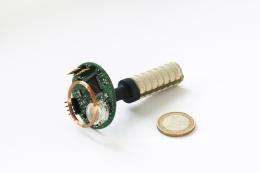
April 5, 2010The passive sensor-transponder continuously monitors the protective coating of concrete bridges, allowing corrosion damage to be detected at an early stage. (© Fraunhofer IMS)
(PhysOrg.com) -- Damage to concrete bridges caused by rust can have fatal consequences, at worst leading to a total collapse. Now, researchers have developed an early-warning system for rust. Sensor-transponders integrated in the concrete allow the extent of corrosion to be measured.
Concrete bridges have to be strong enough to cope with a wide variety of different impacts: frost, heavy traffic and emissions all take their toll on these structures. And then there are the various types of road salt used in winter to combat icy roads. The most common of these is sodium chloride, which is deployed in large amounts on Germany's roads. When the ice thaws, these salts break down into their ionic components that penetrate the concrete, destroying its five-centimeter thick protective alkaline layer. Any salt that leaches through to the steel rods used to reinforce the concrete pad will cause them to rust, resulting in structural damage. The result is cracks. In a worst-case scenario the bridge itself could collapse.
Until now there have been no effective tests to determine how deep the ions have penetrated the concrete and what damage they have already caused. Current practice is time-consuming and involves construction workers hammering on the reinforced concrete in search of cavities, which are a sure sign of corrosion damage. But experts at the Fraunhofer Institute for Microelectronic Circuits and Systems IMS in Duisburg, Germany, have now hit upon a more reliable and cost-effective method for detecting rust corrosion at an early stage. With a new sensor-transponder they can continuously measure and monitor how deep the ions have penetrated the concrete. While the sensor was developed by the building materials testing facility in Braunschweig (MPA Braunschweig), the integrated passive wireless transponder system is the work of IMS researchers.
The sensor itself is crisscrossed by very fine iron wires, laid down at even distances. "If the dissolved salts reach the iron wires, these begin to corrode and break. The number of defective iron wires is an indicator of the extent of corrosion and the depth to which the concrete's protective layer has been penetrated. This allows us to determine when the next repair work needs to be carried out," explains Frederic Meyer, a researcher at the IMS. The transponder transmits the measured data by wireless to the reading device carried by the construction workers. "Our transponder does not get the energy it needs to measure the corrosion from a battery, but from a magnetic field. This means it does not need to be replaced and can remain within the concrete structure permanently," says Meyer.
The first field tests are already underway, with the sensor-transponder being integrated and put through its paces in a test bridge constructed by the MPA Braunschweig. The researchers will be exhibiting a prototype at the EURO ID trade fair, to be held in Cologne, Germany, from May 4 through 6.
-
Advanced Bridge Materials’ Efficacy Tested at NC State University
Aug 03, 2005 |
not rated yet |
0
-
Scientists work to stop bridge corrosion
Dec 08, 2005 |
not rated yet |
0
-
Software for safe bridges
Nov 03, 2008 |
not rated yet |
0
-
Pressure sensors on alert
Mar 24, 2010 |
not rated yet |
0
-
Electronic components integrated into textile-reinforced composites
Sep 05, 2006 |
not rated yet |
0
-
Engineers build first sub-10-nm carbon nanotube transistor
Feb 01, 2012 |
4.9 / 5 (31) |
30
-
Something old, something new: Evolution and the structural divergence of duplicate genes
Jan 31, 2012 |
4.6 / 5 (7) |
1
-
The hidden nanoworld of ice crystals: Revealing the dynamic behavior of quasi-liquid layers
Jan 30, 2012 |
5 / 5 (3) |
1
-
Stock market network reveals investor clustering
Jan 27, 2012 |
3.9 / 5 (23) |
8
-
Of microchemistry and molecules: Electronic microfluidic device synthesizes biocompatible probes
Jan 26, 2012 |
5 / 5 (1) |
0
-
Calling function with no input argument
4 hours ago
-
Force free body diagram problem on gym equipment
5 hours ago
-
Empirical data regarding shower heads and water
13 hours ago
-
feed hold button on CNC lathe
Feb 09, 2012
-
RFAC in Fortran
Feb 09, 2012
-
dynamics 2/32
Feb 08, 2012
- More from Physics Forums - General Engineering
More news stories
Expat French get Internet vote for first time
French citizens will for the first time this year be able to vote in a parliamentary election over the Internet, an experiment that could be extended to other elections if successful.
1 hour ago |
not rated yet |
0
"Twisted Metal" gamers get shot at real gunplay
Fans of "Twisted Metal" will get to welcome a long-awaited sequel of the car-battle videogame with a real-world bang by blasting an ice cream truck to bits with a machine gun.
56 minutes ago |
not rated yet |
0
New error-correcting codes guarantee the fastest possible rate of data transmission
Error-correcting codes are one of the triumphs of the digital age. Theyre a way of encoding information so that it can be transmitted across a communication channel such as an optical fiber o ...
Technology / Computer Sciences
7 hours ago |
5 / 5 (3) |
4
|
Small modular reactor design could be a 'SUPERSTAR'
(PhysOrg.com) -- Though most of today's nuclear reactors are cooled by water, we've long known that there are alternatives; in fact, the world's first nuclear-powered electricity in 1951 came from a reactor ...
Technology / Energy & Green Tech
6 hours ago |
4.2 / 5 (10) |
14
|
Advanced power-grid model finds low-cost, low-carbon future in West
(PhysOrg.com) -- The least expensive way for the Western U.S. to reduce greenhouse gas emissions enough to help prevent the worst consequences of global warming is to replace coal with renewable and other ...
Technology / Energy & Green Tech
6 hours ago |
5 / 5 (2) |
6
|
Putting the squeeze on planets outside our solar system
(PhysOrg.com) -- Using high-powered lasers, scientists at Lawrence Livermore National Laboratory and collaborators discovered that molten magnesium silicate undergoes a phase change in the liquid state, abruptly ...
Employers feel no love for unscrupulous practice of 'service sweethearting'
A new study led by two Florida State University marketing professors finds that some frontline service employees who are rewarded for hikes in customer loyalty and satisfaction also may engage in "service ...
Human cognitive performance suffers following natural disasters, researchers find
Not surprisingly, victims of a natural disaster can experience stress and anxiety, but a new study indicates that it might also cause them to make more errors - some serious - in their daily lives. In their upcoming Human Fa ...
The power of estrogen -- male snakes attract other males
A new study has shown that boosting the estrogen levels of male garter snakes causes them to secrete the same pheromones that females use to attract suitors, and turned the males into just about the sexiest ...
Curry spice component may help slow prostate tumor growth
Curcumin, an active component of the Indian curry spice turmeric, may help slow down tumor growth in castration-resistant prostate cancer patients on androgen deprivation therapy (ADT), a study from researchers ...
Fool's gold may prove an unlikely alternative to overexploited catalytic materials
Catalytic materials, which lower the energy barriers for chemical reactions, are used in everything from the commercial production of chemicals to catalytic converters in car engines. However, with current catalytic materials ...