Proposed wind power grid to make wind power more reliable
April 5, 2010
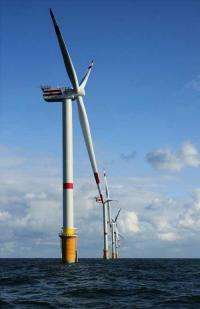
Researchers analyzed hypothetical power output from five-megawatt offshore turbines similar to the one shown here off the coast of Belgium. Credit: Hans Hillewaert
The energy needs of the entire human population could potentially be met by converting wind energy to electricity by means of wind turbines. While offshore wind power resources are abundant, wind turbines are currently unable to provide steady power due to natural fluctuations in wind direction and strength. However, offshore wind power output can be made more consistent by choosing project development locations that take advantage of regional weather patterns and by connecting wind power generators with a shared power line, according to a paper by researchers from the University of Delaware and Stony Brook University that is published in the April 5 issue of the Proceedings of the National Academy of Sciences.
"Making wind-generated electricity more steady will enable wind power to become a much larger fraction of our electric sources," said the paper's lead author Willett Kempton, UD professor of marine policy in UD's College of Earth, Ocean, and Environment and director of its Center for Carbon-free Power Integration.
The research team — which also included UD alumnus Felipe Pimenta, UD research faculty member Dana Veron, and Brian Colle, associate professor in the School of Marine and Atmospheric Sciences at Stony Brook University — demonstrated that thoughtful design of offshore wind power projects can minimize the impacts of local weather on power fluctuations.
The researchers analyzed five years of wind observations from 11 monitoring stations along the U.S. East Coast from Florida to Maine. Based on wind speeds at each location, they estimated electrical power output from a hypothetical five-megawatt offshore turbine. After analyzing the patterns of wind energy among the stations along the coast, the team explored the seasonal effects on power output.
"Our analysis shows that when transmission systems will carry power from renewable sources, such as wind, they should be designed to consider large-scale meteorology, including the prevailing movement of high- and low-pressure systems," said Dr. Kempton.
Dr. Colle explained the ideal configuration. "A north-south transmission geometry fits nicely with the storm track that shifts northward or southward along the U.S. East Coast on a weekly or seasonal time scale," he said. "Because then at any one time a high or low pressure system is likely to be producing wind (and thus power) somewhere along the coast."
The researchers found that each hypothetical power generation site exhibited the expected ups and downs, but when they simulated a power line connecting them, the overall power output was smoothed so that maximum or minimum output was rare. In the particular five-year period studied, the power output of the simulated grid never stopped completely.
No wind turbines are presently located in U.S. waters, although projects have been proposed off the coasts of several Atlantic states. This research could prove useful as project sites are selected and developed.
Reducing the severity of wind power fluctuations would allow sufficient time for power suppliers to ramp up or down power production from other energy sources as needed. Solutions that reduce power fluctuations also are important if wind is to displace significant amounts of carbon-emitting energy sources, the researchers said.
-
Methods for regulating wind power's variability under development by electrical engineer
Oct 16, 2007 |
not rated yet |
0
-
Engineer aims to regulate varying wind power
Oct 19, 2007 |
not rated yet |
0
-
Japan to support wind power electricity
Jul 20, 2005 |
not rated yet |
0
-
Tilting at wind farms
Jan 07, 2009 |
not rated yet |
0
-
Recycling wind turbines
Sep 21, 2007 |
not rated yet |
0
-
Engineers build first sub-10-nm carbon nanotube transistor
Feb 01, 2012 |
4.9 / 5 (29) |
30
-
Something old, something new: Evolution and the structural divergence of duplicate genes
Jan 31, 2012 |
4.6 / 5 (7) |
1
-
The hidden nanoworld of ice crystals: Revealing the dynamic behavior of quasi-liquid layers
Jan 30, 2012 |
5 / 5 (3) |
1
-
Stock market network reveals investor clustering
Jan 27, 2012 |
3.9 / 5 (23) |
8
-
Of microchemistry and molecules: Electronic microfluidic device synthesizes biocompatible probes
Jan 26, 2012 |
5 / 5 (1) |
0
-
feed hold button on CNC lathe
7 hours ago
-
Mechanics of Solids ( Final exam question) plz help!
9 hours ago
-
RFAC in Fortran
11 hours ago
-
dynamics 2/32
17 hours ago
-
dynamics
17 hours ago
-
Vibration Absorbtion Problem
22 hours ago
- More from Physics Forums - General Engineering
More news stories
Touch screens create online shopping experiences at stores
Imagine browsing knife sets in an airport and then ordering one before you board your plane, or going to a department store to look at makeup without having to bounce from counter to counter to check out each brand's selection.
55 minutes ago |
not rated yet |
0
Model analyzes shape-memory alloys for use in earthquake-resistant structures
Recent earthquake damage has exposed the vulnerability of existing structures to strong ground movement. At the Georgia Institute of Technology, researchers are analyzing shape-memory alloys for their potential ...
2 hours ago |
not rated yet |
0
|
Fuel from market waste
Mushy tomatoes, brown bananas and overripe cherries -- to date, waste from wholesale markets has ended up on the compost heap at best. In future it will be put to better use: Researchers have developed a new ...
Technology / Energy & Green Tech
1 hour ago |
5 / 5 (1) |
1
Digital photos could put kids at risk
A study published in the International Journal of Electronic Security and Digital Forensics this month suggests that parents and carers could be putting children at risk if they upload digital photos that are automatically "geota ...
1 hour ago |
not rated yet |
2
New battery could lead to cheaper, more efficient solar energy
A joint research project between the University of Southampton and lithium battery technology company REAPsystems has found that a new type of battery has the potential to improve the efficiency and reduce the cost of solar ...
Technology / Energy & Green Tech
2 hours ago |
not rated yet |
1
Secrets of immune response illuminated in new study
When disease-causing invaders like bacteria infect a human host, cells of various types swing into action, coordinating their activities to address the threat.
Nanotube therapy takes aim at breast cancer stem cells
Wake Forest Baptist Medical Center researchers have again proven that injecting multiwalled carbon nanotubes (MWCNTs) into tumors and heating them with a quick, 30-second laser treatment can kill them.
Potentially important new mechanisms found anti-aging effects of resveratrol
A well-conducted experimental study in mice has provided potentially important new insights into the association of the intake of resveratrol and like compounds with health benefits. Resveratrol is a constituent of red wine ...
Doctors telling more adults: Get out and exercise
(AP) -- More and more U.S. adults are being told by their doctor to get out and exercise, according to government survey released Thursday.
Study shows fainting factor in cardiac arrests
A new study by Dr. Andrew Krahn shows that over a quarter of unexplained cardiac arrests occurred after the patient had an event of fainting, known as syncope. According to Dr. Krahn, a Cardiologist at London Health Sciences ...
Researchers find important 'target' playing role in tobacco-related lung cancers
Researchers at Moffitt Cancer Center in Tampa, Fla., have discovered that the immune response regulator IKBKE (serine/threonine kinase) plays two roles in tobacco-related non-small cell lung cancers. Tobacco carcinogens induce ...
Apr 05, 2010
Rank: not rated yet
It would be interesting to see how much 'excess' wind power generation capability must be installed in order to guarantee this. but seeing that off-shore space is practically limitless that shouldn't be too much of a problem (except for the cost - which should go down with mass production).
I'm thinking that simply distributing the generated power north/south is not enough. The overall fluctuations must also be dampened by means of storing excess production (either via pressurized air or by generating hydrogen or thorugh some other means of storing power for longer periods).
Apr 05, 2010
Rank: 1 / 5 (1)
Apr 05, 2010
Rank: not rated yet
Apr 06, 2010
Rank: not rated yet
I would be very surprised if it met more than 5-10% of human needs in 50 years.
Apr 06, 2010
Rank: not rated yet