NREL Finds a Way to Give LEDs the Green Light
April 5, 2010 by Bill Scanlon
NREL Finds a Way to Give LEDs the Green Light

Enlarge

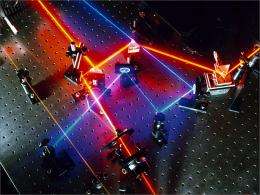
NREL's Solar Energy Research Facility is the site of experiments using lasers to probe the light-emitting properties of gallium indium phosphide alloys for making light-emitting diodes. Credit: NREL file photo

(PhysOrg.com) -- Light bulbs that last 100 years and fill rooms with brilliant ambiance may become a reality sooner rather than later, thanks to a National Renewable Energy Laboratory discovery.

NREL scientists found a way to generate a tricky combination of green and red that may just prove to be the biggest boost for illumination since Edison's .

Green isn't just a symbol of environmentalism, it is a real color, and a desperately needed one for researchers looking for a way to light homes, streets and buildings at a fraction of today's costs.

LEDs — light-emitting diodes — are the promise of the future because unlike tungsten bulbs or compact fluorescent bulbs, they deliver most of their energy as light, rather than heat. An extra plus is that they don't contain dangerous mercury.

The era of LEDs is fast approaching. The U.S. Department of Energy expects to phase out tungsten bulbs in four years and compact-fluorescents in 10 years. That will leave LEDs with virtually 100 percent of the market.

To make an LED that appears white, researchers minimally need the colors red, green and blue. The white light from the sun is really all the colors of the rainbow. Without at least red, blue and green from the spectrum, no will be practical for home or office use.

Red proved easy to generate, and about 15 years ago, Japanese scientists found a way to generate blue, thus providing two of the key colors from the spectrum of white light.

But green has been elusive. In fact, the $10 LEDs that people can buy now are made to look white by aiming the blue light at a , which then emits green. It works OK, but the clunky process saps a big chunk of the efficiency from the light.

NREL Jumps into LED Research via Solar Cells

Along came NREL, a world leader in designing , but a neophyte in the lighting realm.

NREL scientist Angelo Mascarenhas, who holds patents in solar-cell technology, realized that an LED is just the reverse of a solar cell. One takes electricity and turns it into light; the other takes sunlight and turns it into electricity.

"We'd been working with solar cells for 30 years," Mascarenhas said. "Could we find some device where we could just reverse the process of making solar cells?"

Indeed, Mascarenhas found it. NREL had won major scientific awards with its inverted metamorphic solar cells, in which the cells are built by combining layers of different lattice sizes to optimally capture solar energy. In fact, an NREL-produced IMM cell set a world record by converting 40 percent of absorbed sunlight into electricity.

Along the way, "We had already developed some of the know-how to capture sunlight in this green spectral region," Mascarenhas said. They hadn't reached there, because solar cells don't need a green, but they had begun to understand the challenges of getting to a green.
NREL Finds a Way to Give LEDs the Green Light
Enlarge

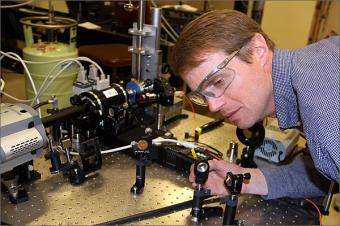
NREL Senior Scientist Brian Flugel adjusts mirrors to set up an experiment aimed at testing the quality of a green LED. Credit: Bill Scanlon

Solving a Decade-Old Conundrum

For a decade, LED researchers had tried and failed to make a reliable efficient green light by putting indium into gallium nitride.

"All signs indicated an impasse," Mascarenhas said. "When you come across an impasse, you don't just bang your head against the wall. You end up breaking your head, not the wall.

"Instead, you move away from the wall, you find a different path."

He and his fellow solar-cell researchers had dealt with the same problem trying to build a solar cell with gallium indium nitride. The problem with trying to make a green on gallium nitride is that the indium phase separates and cracks. When the lattices created by molecular gases don't match up with the lattices of the layer below, "It can't grow well and the efficiency is very, very poor," Mascarenhas said.

NREL's solar cell experts found a way around that. They put in some extra layers that gradually bridge the gap between the mismatched lattices of the cell layers.

"The approach is to grow a different material with an in-between lattice," Mascarenhas said.

The researchers deposited layers that had lattice patterns of atoms close to, but not exactly matching, the layers below. The tiny gap in size was at the so-called "elastic limit" of the material — close enough that the lattices bonded to each other and impurities were deflected away.

Then, add a third layer, this one again at the precise "elastic limit" of the one below. After about seven microns of layering, the result is a solar cell with a firm bond and almost no impurities.

Why not try that same process, only in reverse, to make a reliable deep-green LED using gallium nitride and indium?

A Deep Green on the Very First Try

Astonishingly, once the concept was understood, Mascarenhas's team produced a radiant deep green on their very first try — without any money backing the effort.

The aim now is to provide a fourth color to make that white light even whiter.

NREL plans to use a slightly deeper red and a lemony green, which would then be combined with a blue and a very deep green made using the gallium nitride based technology.

In three years, NREL should have a bi-colored device that when teamed with blue and deep green can produce a sterling LED with a color-rendering index well over 90, Mascarenhas said.

"It will give you one of the finest color-rendering white lights" and the manufacturing costs shouldn't increase, he said.

"We have a patent on a device that will provide these two colors, as one unit, to industry," Mascarenhas said. "They will arrange them like the mosaic in a fly's eye — our units side by side with the blue and deep green combination, alternating in a pattern."

"From afar, it will look like white. You won't be able to see the individual colors of the mosaic structure."

"We have full confidence that this is achievable," Mascarenhas said.

"The technical things will be solved," he said. "This is practical science, not pie-in-the-sky science."

The resulting white light LED will be intelligent. "We'll be able to electronically control the hue of the lamp," he said. "We can vary the combination of intensities of these four colors on an electronic circuit. By slightly increasing the blue, we can make it more suitable for daylight. By turning down the blue and increasing the reddish yellow, we can make it softer, more suitable for night. We can smoothly control the hue throughout the day like nobody has imagined. "

And, by the way, the move toward all LEDs all the time will save some $120 billion in electricity between now and 2030, the Department of Energy forecasts. Not to mention tens of millions of tons of greenhouse gases.

"This is reality," Mascarenhas said. "This is going to happen."

Provided by National Renewable Energy Laboratory

4.7 /5 (52 votes)  

Filter


Move the slider to adjust rank threshold, so that you can hide some of the comments.


Display comments: newest first

ThomasS
Apr 05, 2010

Rank: 4.5 / 5 (2)
they sure are confident!
edit: then again, they already have the green. This is great!
jamey
Apr 05, 2010

Rank: 3 / 5 (5)
Um... I would *SWEAR* I could buy green LEDs quite a few years ago - and even tri-color (red/yellow/green) LEDs (yellow being red and green alternately lit by AC current).
El_Nose
Apr 05, 2010

Rank: 2 / 5 (6)
Its pretty darn awesome -- kids born after 2025 will never remember shaking a lightbulb by their ear to hear if the filament is broken - they will never burn there hands touching a hot lightbulb --they will not remember changing a light bulb -- they may not even realize that you CAN change a lightbulb, and call an electrician when it finally goes ( wow that might be bad ) -- because all you need then is the fact that lightbulbs never burn out to fuel the fact very few people will be buying them - so only electricians may have access to niche suppliers -- this could be bad...

Can anyone thing of a common item that has an extrememly low fail rate that consumers still have access to -- even thumbtacs break down nowadays

- This product though useful and awesome will probably never see the light of day in its current form -- they will make it so that it can break and be constantly repurchased

-- there will be people when a building is going to be demolished will go unscrew bulbs
jamey
Apr 05, 2010

Rank: 1.8 / 5 (6)
I was right - green LEDs are available. This company may have found a way to make more efficient ones, but green is *NOT* a new LED color, as the article states - "But green has been elusive. In fact, the $10 LEDs that people can buy now are made to look white by aiming the blue light at a phosphor, which then emits green. It works OK, but the clunky process saps a big chunk of the efficiency from the light." This is *completely* bogus. PhysOrg, we expect better from you!
maxcypher
Apr 05, 2010

Rank: 3 / 5 (1)
iamey: Please show what you found to confirm that you are right about the availability of efficient, green LEDs.
DGBEACH
Apr 05, 2010

Rank: 3 / 5 (1)
I also wonder why they have made the statement about green LEDs not being available...I have been using Red, Blue, AND Green 3-Watt LEDs for over 5 years now (made by Phillips http://www.future...5C.aspx)
DGBEACH
Apr 05, 2010

Rank: 3 / 5 (1)
link doesn't work...sorry I forgot how to post them properly here...but futureelectronics.com lists reems of them :)
eachus
Apr 05, 2010

Rank: 4.5 / 5 (2)
"I was right - green LEDs are available. This company may have found a way to make more efficient ones, but green is *NOT* a new LED color, as the article states."

Sigh! This is one of those cases where editing to tone down the technical content completely obscured the story. I don't have to go shopping for LEDs to find green ones, I can just look at my computer, or for that matter my cell phone. But these are the "lemony green" mentioned not a pure deep green. And yes the lemony green is not only easy to produce, but you can produce a nice red from the same LED. Mix the two and your eye sees yellow.

Think of what NREL is doing as providing the third of four colors evenly spaced across the (solar output times human eye sensitivity) spectrum. The confusion from calling the colors carmine, lime green, forest green, and electric blue can be cleared up by looking at the actual emission spectra. ;-)
Sonhouse
Apr 05, 2010

Rank: 3 / 5 (3)
I was right - green LEDs are available. This company may have found a way to make more efficient ones, but green is *NOT* a new LED color, as the article states - "But green has been elusive. In fact, the $10 LEDs that people can buy now are made to look white by aiming the blue light at a phosphor, which then emits green. It works OK, but the clunky process saps a big chunk of the efficiency from the light." This is *completely* bogus. PhysOrg, we expect better from you!

There have been green LED's, of course. But the way they do it is to take an IR LED and put a non-linear crystal in front which doubles the frequency at the expense of efficiency which means you have a lop-sided energy budget, you need a lot more green light than blue or red with those LED's making the whole thing almost unsellable for white light.
jamey
Apr 05, 2010

Rank: not rated yet
@Sonhouse - I've seen that scheme mentioned for making green semiconductor laser pointers, but not LEDs. However, you could be right.

@eachus: I'm not so sure the distinction between "lemony green" and "deep pure green" is that critical. And were lighting panels to use arrays in a bayer pattern of 4-6 different color LEDs, I suspect the "lemony green" would result in a better spread with cyan than the "deep green" would. (Said panels generally being quite far enough that they would appear to the eye as white).
mrwolfe
Apr 06, 2010

Rank: 5 / 5 (1)
A quick look at Wikipedia http://en.wikiped...wiki/Led solves this dispute. Green LED's based on Gallium Phosphide and Gallium Nitride (et al) have been available for decades. I first used green LEDs in a project in the late 70's. The factor that governs emitted wavelength is the band gap between the dopants in the active region, so green isn't that hard to do. Easier than Blue in fact. WHITE LED's are a fairly recent development, and typically use a YAG phosphor to downconvert light from a high intensity blue LED to yellow. When mixed with the original wavelength the result appears white(ish). This is NOT the only way, nor the most common way of producing green light from a semiconductor!
CarolinaScotsman
Apr 06, 2010

Rank: not rated yet
Cree, a company that specializes in LED lighting ( www.cree.com ), developed green LEDs some years ago.
Sanescience
Apr 06, 2010

Rank: not rated yet
This all may be moot, LED lighting has other hurdles to conquer before primacy, like it's heat intolerance, luminosity "ceiling" from droop, spectral shift over time, and loss of luminosity and efficiency over time.

I've been following electron emission lighting that leverages decades of know how from television manufacturing to make cheap, non-toxic, easy to recycle, and durable lighting with excellent spectral properties and quick response. And no I am not associated with or investing in this tech (heh). Here is a company coming out with a product of this type...

http://www.vu1.co...logy.htm
stealthc
Apr 06, 2010

Rank: not rated yet
Yes bogus indeed, they aren't trying to emit white light, only green. Once they have the green, they are attempting to modify the light.

I would suggest creating as intense and efficient of a light as possible and use a waveguide to disperse the light across the spectrum. At least they should combine the colors on to one unit, this way the pixels blend in more seamlessly.

I was right - green LEDs are available. This company may have found a way to make more efficient ones, but green is *NOT* a new LED color, as the article states - "But green has been elusive. In fact, the $10 LEDs that people can buy now are made to look white by aiming the blue light at a phosphor, which then emits green. It works OK, but the clunky process saps a big chunk of the efficiency from the light." This is *completely* bogus. PhysOrg, we expect better from you!

tpb
Apr 06, 2010

Rank: not rated yet
Actually, the Japanese company mentioned in the article is Nichia, and they invented a process to manufacture the green gallium nitride LED. The Blue came next.
jerryd
Apr 06, 2010

Rank: 1.5 / 5 (2)
LED's are no more eff than CFL's that cost 1/50 the cost. Until they can close that gap, CFL's will rule in most cases. Each of my mainly used CFL'S THAT COST $2.50 EACH SAVE ME ABOUT $2/MONTH
El_Nose
Apr 08, 2010

Rank: 1 / 5 (2)
really I deserved a 1 for my statement???
jgelt
Apr 10, 2010

Rank: not rated yet
The color aliasing produced by the current white LED lights does not flatter the ladies who spent time with the makeup. They won't be allowed in the house until they do. Maybe in the workshop...
RobertKLR
Apr 11, 2010

Rank: not rated yet
LED's are no more eff than CFL's that cost 1/50 the cost. Until they can close that gap, CFL's will rule in most cases. Each of my mainly used CFL'S THAT COST $2.50 EACH SAVE ME ABOUT $2/MONTH


If you are an electrician then every time you have to go up a ladder to change a CFL you risk a fall. One fall could wipe out years worth of savings. LED lights last much longer than CFL (and they don't break or shatter in your hand) so factor in the fewer trips up the ladder and falls to the floor. Several of us in the engineering dept of the Veteran's Administration pointed that out when the cost savings of LED vs CFL was brought up. It raised a few eyebrows.
RobertKLR
Apr 11, 2010

Rank: not rated yet
LED's are no more eff than CFL's that cost 1/50 the cost. Until they can close that gap, CFL's will rule in most cases. Each of my mainly used CFL'S THAT COST $2.50 EACH SAVE ME ABOUT $2/MONTH


If you are an electrician then every time you have to go up a ladder to change a CFL you risk a fall. One fall could wipe out years worth of savings. LEDs are safer in the long run. LED lights last much longer than CFL and they don't break or shatter in your hand or when they fall to the floor so factor in the fewer trips up the ladder and falls to the floor. Several of us in the engineering dept of the Veteran's Administration pointed that out when the cost savings of LED vs CFL was brought up. It raised a few eyebrows.
Rank 4.7 /5 (52 votes)
Related Stories
Relevant PhysicsForums posts
  • Empirical data regarding shower heads and water
    created4 hours ago
  • feed hold button on CNC lathe
    created23 hours ago
  • RFAC in Fortran
    createdFeb 09, 2012
  • dynamics 2/32
    createdFeb 08, 2012
  • dynamics
    createdFeb 08, 2012
  • Vibration Absorbtion Problem
    createdFeb 08, 2012
  • More from Physics Forums - General Engineering

More news stories

US video game sales fall 34 percent in January

(AP) -- U.S. retail sales of video game hardware, software and accessories fell 34 percent in January from a year earlier to $751 million due to the lack of new game titles, according to market researcher NPD Group.

Technology / Business

created 46 minutes ago | popularity not rated yet | comments 0

Zynga partners with toy maker Hasbro

Old school toy maker Hasbro and online social game star Zynga on Thursday announced a partnership to mesh the Internet firm's hits with real-world products.

Technology / Business

created 5 minutes ago | popularity not rated yet | comments 0

Samsung can continue selling Galaxy tabs in Germany: court

South Korea's Samsung Electronics can continue to sell its Galaxy Tab 10.1N tablet computer in Germany, a German court ruled Thursday, rejecting a bid by arch-rival Apple to have them banned.

Technology / Business

created 22 hours ago | popularity 4 / 5 (4) | comments 3

Digital photos could put kids at risk

A study published in the International Journal of Electronic Security and Digital Forensics this month suggests that parents and carers could be putting children at risk if they upload digital photos that are automatically "geota ...

Technology / Internet

created 18 hours ago | popularity 5 / 5 (1) | comments 3

Google launches Chrome browser for Android smartphones

With more and more people connecting to the Internet through a phone or a tablet instead of a PC, Google Inc. is bringing its fast-growing browser, Chrome, to the newest Android-powered mobile devices.

Technology / Software

created 20 hours ago | popularity 5 / 5 (5) | comments 0


Humans may have helped the decline of African rainforests 3000 years ago

(PhysOrg.com) -- Large areas of rainforests in Central Africa mysteriously disappeared over three thousand years ago, to be replaced by savannas. The prevailing theory has been that the cause was a change ...

Japan scientist makes 'Avatar' robot

A Japanese-developed robot that mimics the movements of its human controller is bringing the Hollywood blockbuster "Avatar" one step closer to reality.

Fighting crimes against biodiversity: How to catch a killer weed

Invasive species which have the potential to destroy biodiversity and influence global change could be tracked and controlled in the same way as wanted criminals, according to new research from Queen Mary, University of London.

Metastatic breast cancer hitches a free ride from the immune system

Inflammatory breast cancer (IBC) is the most lethal form of breast cancer . It spreads easily through the lymphatic and blood vessels, forming metastasis which can lead to multi-organ failure. New research published in BioMed ...

A novel method for simultaneously measuring blood pressure and arterial stiffness

Arterial stiffness due to is a major contributor to cardiovascular disease but is very difficult to measure. It also can influence blood pressure readings since these rely on the time taken for arteries to return to normal ...

Sleep breathing machine shows clear benefits in children with sleep apnea

Children and adolescents with obstructive sleep apnea had substantial improvements in attention, anxiety and quality of life after treatment with positive airway pressure (PAP)—a nighttime therapy in which a machine ...