Berkeley Researchers Light Up White OLEDs
April 6, 2010 by Aditi Risbud
Berkeley Researchers Light Up White OLEDs

Enlarge

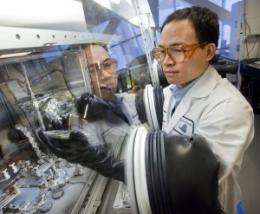
Biwu Ma, a staff scientist with the Molecular Foundry, was part of a research team that found a new way to process white OLEDs for solid state lighting. (Photo by Roy Kaltschmidt, Berkeley Lab Public Affairs)

(PhysOrg.com) -- Light-emitting diodes, which employ semiconductors to produce artificial light, could reduce electricity consumption and lighten the impact of greenhouse gas emissions. However, moving this technology beyond traffic signals and laser pointers to illumination for office buildings and homes -- the single largest use of electricity -- requires materials that emit bright, white light cheaply and efficiently. White light is the mix of all the colors, or wavelengths, in the visible spectrum.

Organic light-emitting diodes (OLEDs), based on organic and/or polymer , are promising candidates for general lighting applications, as they can cover large-area displays or panels using low-cost processing techniques. Indeed, single-color OLED displays are already available commercially. A mix of red-, green- and blue-emitting materials can be used to generate white light, but these bands of color often interact with one another, degrading device performance and reducing color quality.

Using polymer nanoparticles to house light-emitting ‘inks’, scientists at the Molecular Foundry, a U.S. Department of Energy nanoscience center located at Berkeley Lab, and the University of California, Berkeley, have made a thin film OLED using iridium-based guest molecules to emit various colors of visible light. The polymer nanoparticle surrounding a guest light-emitter serves as a ‘do not disturb’ sign, isolating guest molecules from one another. Each guest can then emit light without pesky interactions with neighboring nanoparticles, resulting in white luminescence.

“This simple and bright approach to achieving nanoscale site isolation of phosphors opens a new door for facile processing of white OLEDs for ,” said Biwu Ma, a staff scientist with the Molecular Foundry’s Organic Nanostructures Facility who contributed to this study. With this proof-of-concept device under their belts, Ma and his colleagues plan to vary the ratio of each color nanoparticle in the OLED to enhance efficiency and brightness. from OLEDs can be adjusted from cooler to warmer whites, making these materials easy to use in office or home environments. Buildings account for more than 40 percent of carbon emissions in the United States, so replacing even a fraction of conventional lighting with OLEDs could result in a significant reduction in electricity use.

A paper reporting this research titled, “Site isolation of emitters within cross-linked polymer nanoparticles for white electroluminescence,” appears in the journal Nano Letters.

Provided by Lawrence Berkeley National Laboratory (news : web)

4.4 /5 (21 votes)  

Filter


Move the slider to adjust rank threshold, so that you can hide some of the comments.


Display comments: newest first

gunslingor1
Apr 06, 2010

Rank: 1 / 5 (1)
Enough research already, start production! We need laws protecting consumers as well related to these issues. For example, when the recent high efficiency bulbs came out they were designed to last 10 years. Now they are down to 5 and soon to 3. We need to be protected from these intentionally included design flaws. LEDs can last indefinitely, and we should regultate their production as such. Artificially designing them to only last a couple of years should be outlawed.

Keep up the good work guys! But enough research already, the solution is there, start mass production.
Foolish1
Apr 06, 2010

Rank: 5 / 5 (1)
Enough research already, start production! We need laws protecting consumers as well related to these issues. For example, when the recent high efficiency bulbs came out they were designed to last 10 years. Now they are down to 5 and soon to 3.


Until the droop issues have been resolved LEDs will remain a poor and ineffecient choice for general purpose lighting. High output LEDs have a shorter lifespan and typically come stock with massive heatsinks to address droop with brute force. Its a fundemtal issue with the technology NOT a conspiracy. Although I'm sure there are plenty of those too :-)
Sanescience
Apr 06, 2010

Rank: not rated yet
"Artificially designing them to only last a couple of years should be outlawed."

Your heart is in the right place but your understanding of technical and social issues would destroy the industry we need to make these advances in science and manufacturing. Look at it this way, if a person knew there was no future in one of many possible career choices, why would he choose it? Business are run by individuals that think the same way. If 3 year bulbs is the revenue stream that attracts investment into science and manufacturing that will get rid of all these ghastly CF bulbs, then that is the *real* cost of this technology, not the science fantasy cost from someone's imagination.
Sanescience
Apr 06, 2010

Rank: not rated yet
"Until the droop issues have been resolved LEDs will remain a poor and ineffecient choice for general purpose lighting."

I've read that to. I have been following this technology that seems like a good compromise of efficiency, non-toxic, recyclable, and visual ergonomics.

http://www.vu1.co...logy.htm

stealthc
Apr 06, 2010

Rank: not rated yet
Why not just design a nano-scale molecule that contains an oled portion regulated by this nanopolymer surface with the wiring for these molecules attached on the outside and rely on self-assembly of these molecules to form an array so that you can just fill a cavity with this molecular liquid and produce a display?

You could even have UV reactivity built in to harden the structure into a display sheet, so that it is no longer a liquid once cured?

The way I see it, this technology is dead soon enough and replaced by this, now if only to create a effective means of synthesizing a molecule to do this.
PinkElephant
Apr 06, 2010

Rank: not rated yet
They'll need to switch over into "phosphors" that aren't iridium-based, before this sort of thing can become widely applicable. Iridium is too rare and expensive to be broadly deployed for mass-lighting needs.
Bob_Kob
Apr 07, 2010

Rank: not rated yet
Surely they only need a few micro grams of iridium for the semiconductor.
Rank 4.4 /5 (21 votes)
Related Stories
Relevant PhysicsForums posts
  • Books To Inspire a Beginnig Physics Student
    created2 hours ago
  • Pith balls problem
    created3 hours ago
  • Electrostatics
    created3 hours ago
  • what is phase constant
    created3 hours ago
  • Basics In electromagnetic wave
    created3 hours ago
  • How to calculate theoretical initial velocity?
    created4 hours ago
  • More from Physics Forums - General Physics

More news stories

What lies beneath: Mapping hidden nanostructures

The ability to diagnose and predict the properties of materials is vital, particularly in the expanding field of nanotechnology. Electron and atom-probe microscopy can categorize atoms in thin sheets of material, ...

Nanotechnology / Nanophysics

created 17 hours ago | popularity 5 / 5 (3) | comments 1

New kind of solar cell could capture significantly more energy than current cells

New solar cells could increase the maximum efficiency of solar panels by over 25%, according to scientists from the University of Cambridge.

Nanotechnology / Nanophysics

created Feb 08, 2012 | popularity 4.5 / 5 (12) | comments 14 | with audio podcast

Nanoshell whispering galleries improve thin solar panels

Visitors to Statuary Hall in the U.S. Capitol Building may have experienced a curious acoustic feature that allows a person to whisper softly at one side of the cavernous, half-domed room and for another on ...

Nanotechnology / Nanomaterials

created Feb 07, 2012 | popularity 4.3 / 5 (6) | comments 6 | with audio podcast

'Dark plasmons' transmit energy

Microscopic channels of gold nanoparticles have the ability to transmit electromagnetic energy that starts as light and propagates via "dark plasmons," according to researchers at Rice University.

Nanotechnology / Nanophysics

created Feb 09, 2012 | popularity 4.8 / 5 (9) | comments 1 | with audio podcast

Revealing how a battery material works

Since its discovery 15 years ago, lithium iron phosphate (LiFePO4) has become one of the most promising materials for rechargeable batteries because of its stability, durability, safety and ability to deliver ...

Nanotechnology / Nanomaterials

created Feb 08, 2012 | popularity 5 / 5 (5) | comments 0 | with audio podcast


Anonymous knocks CIA website offline (Update)

The website of the Central Intelligence Agency was inaccessible on Friday after the hacker group Anonymous claimed to have knocked it offline.

New error-correcting codes guarantee the fastest possible rate of data transmission

Error-correcting codes are one of the triumphs of the digital age. They’re a way of encoding information so that it can be transmitted across a communication channel — such as an optical fiber o ...

Humans may have helped the decline of African rainforests 3000 years ago

(PhysOrg.com) -- Large areas of rainforests in Central Africa mysteriously disappeared over three thousand years ago, to be replaced by savannas. The prevailing theory has been that the cause was a change ...

Google users warned of threat to smartphone wallets

Users of Google smartphone wallets were being warned on Friday that there is a way to crack pass codes intended to thwart thieves from going on illicit shopping sprees.

New power source discovered

(PhysOrg.com) -- Researchers at the Massachusetts Institute of Technology (MIT) and RMIT University have made a breakthrough in energy storage and power generation.

Small modular reactor design could be a 'SUPERSTAR'

(PhysOrg.com) -- Though most of today's nuclear reactors are cooled by water, we've long known that there are alternatives; in fact, the world's first nuclear-powered electricity in 1951 came from a reactor ...