Scientists discover first multicellular life that doesn't need oxygen
April 7, 2010 by Lisa Zyga
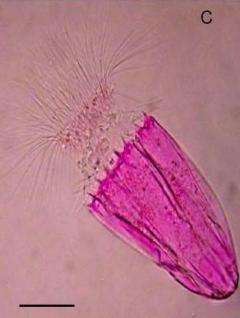
Light microscopy image of the undescribed species of Spinoloricus, stained with Rose Bengal. The scale bar is 50 micrometers. Image credit: Danovaro, et al.
(PhysOrg.com) -- Oxygen may not be the staple of modern complex life that scientists once thought. Until now, the only life forms known to live exclusively in anoxic conditions were viruses, bacteria and Archaea. But in a new study, scientists have discovered three new multicellular marine species that appear to have never lived in aerobic conditions, and never metabolized oxygen.
The discovery of the new species, which live buried in sediment under the Mediterranean seafloor, is significant in that it marks the first observation of multicellular organisms, or metazoans, that spend their entire lifecycle under permanently anoxic conditions. A few metazoans have been known to tolerate anoxic conditions, but only for limited periods of time.
The team of Italian and Danish researchers, Roberto Danovaro, et al., that discovered the new life forms has identified the creatures as belonging to the animal phylum Loricifera, the most recently described animal phylum. Loriciferans, which have a length of less than one millimeter, typically live in sediment. The three new organisms belong to different genera (Spinoloricus, Rugiloricus, and Pliciloricus), although their species have not yet been named.
Despite belonging to previously known taxonomic groups, the new species possess some radical differences compared with other metazoans. Most significantly, the new species do not have mitochondria, the cellular organelles that use oxygen and sugar to generate the cell’s energy. Instead, the new loriciferans have organelles that resemble hydrogenosomes, which are used by some single-celled eukaryotes to generate energy without oxygen. However, this is the first time that these organelles have been observed in multicellular organisms. Previous research has indicated that hydrogenosomes may have evolved from mitochondria, while other research suggests they evolved independently.
To find the new species, the researchers carried out three oceanographic expeditions from 1998 to 2008 to search for life in the extreme environments located more than 3,000 meters (about two miles) under the Mediterranean Sea. The researchers focused on an area called the L’Atalante basin, which is located off the southern coast of Greece. As the scientists explain, this type of “deep hypersaline anoxic basin” was created by the flooding of mineral sediments from 5.5 million years ago. For the past 50,000 years, the basin has possessed a dense hypersaline brine layer up to 60 meters thick. The brine serves as a physical barrier that prohibits oxygen exchange between the water and sediment, making the basin completely oxygen-free. In addition, the basin is rich in methane and hydrogen sulphide, and is also home to a diverse assembly of prokaryotes that have adapted to these conditions.
Because previous studies have reported the presence of cadaverous metazoans that had sunk to anoxic deep-sea sediments in the Black Sea, the researchers here stained the newly collected specimens with Rose Bengal, a protein binding stain that colors living organisms with a much greater intensity than deceased organisms, demonstrating that the new species were indeed alive. In addition, the scientists observed specimens of the undescribed species of both genera Spinoloricus and Rugiloricus that had a large oocyte in their ovary, which showed a nucleus containing a nucleolus, providing evidence of reproduction.
LM image of the undescribed species of Spinoloricus stained with Rose Bengal showing the presence of an oocyte. Image credit: Roberto Danovaro.
“The results reported here support the hypothesis that the loriciferans inhabiting the anoxic sediments of the L’Atalante basin have developed an obligate anaerobic metabolism and specific adaptations to live without oxygen,” the researchers conclude. “Although the evolutionary/adaptative mechanisms leading to the colonization of such extreme environments by these metazoans remain an enigma, this discovery opens new perspectives for the study of metazoan life in habitats lacking molecular oxygen.”The work is financially supported by the EU within the framework of the HERMES (Hot Spot Ecosystem Research on the Margins of European Seas) and HERMIONE (Hotspot Ecosystem Research and Man's Impact On European Seas) projects.
More information: Roberto Danovaro, et al. “The first metazoa living in permanently anoxic conditions.” BMC Biology 2010, 8:30 doi:10.1186/1741-7007-8-30
© 2010 PhysOrg.com
-
Researchers discover new microbial life in the Mediterranean
Mar 13, 2006 |
not rated yet |
0
-
New life discovered in the deep Mediterranean
Jan 14, 2005 |
not rated yet |
0
-
Don’t hold your breath: Carp can manage without oxygen for months
Apr 07, 2006 |
not rated yet |
0
-
Hypoxic event ends off Oregon coast
Oct 30, 2006 |
not rated yet |
0
-
Global warming led to atmospheric hydrogen sulfide and permian extinction
Feb 21, 2005 |
not rated yet |
0
-
Engineers build first sub-10-nm carbon nanotube transistor
Feb 01, 2012 |
4.9 / 5 (31) |
30
-
Something old, something new: Evolution and the structural divergence of duplicate genes
Jan 31, 2012 |
4.6 / 5 (7) |
1
-
The hidden nanoworld of ice crystals: Revealing the dynamic behavior of quasi-liquid layers
Jan 30, 2012 |
5 / 5 (3) |
1
-
Stock market network reveals investor clustering
Jan 27, 2012 |
3.9 / 5 (23) |
8
-
Of microchemistry and molecules: Electronic microfluidic device synthesizes biocompatible probes
Jan 26, 2012 |
5 / 5 (1) |
0
-
Mitosis
1 hour ago
-
Stem cell question.
3 hours ago
-
Protease cleavage
9 hours ago
-
Pertubance in a model
16 hours ago
-
Cancer drugs and Alzheimer's, Oh my!
Feb 09, 2012
-
Squishing cells
Feb 09, 2012
- More from Physics Forums - Biology
More news stories
The power of estrogen -- male snakes attract other males
A new study has shown that boosting the estrogen levels of male garter snakes causes them to secrete the same pheromones that females use to attract suitors, and turned the males into just about the sexiest ...
14 hours ago |
4.8 / 5 (6) |
1
|
Grass to gas: Researchers' genome map speeds biofuel development
Researchers at the University of Georgia have taken a major step in the ongoing effort to find sources of cleaner, renewable energy by mapping the genomes of two originator cells of Miscanthus x giganteus, a large perenn ...
11 hours ago |
3.8 / 5 (5) |
0
|
Experts reveal how plants don't get sunburn
(PhysOrg.com) -- Experts at the University of Glasgow have discovered how plants survive the harmful rays of the sun.
14 hours ago |
4.8 / 5 (5) |
0
|
Miami battling invasion of giant African snails
No one knows how they got there. But an invasion of African giant snails has southern Florida in a panic over potential crop damage, disease and general yuckiness surrounding the slimy gastropods.
18 hours ago |
4 / 5 (1) |
4
Protein libraries in a snap
(PhysOrg.com) -- A Rice University undergraduate will depart with not only a degree but also a possible patent for his invention of an efficient way to create protein libraries, an important component of biomolecular ...
17 hours ago |
4.8 / 5 (4) |
0
|
Google users warned of threat to smartphone wallets
Users of Google smartphone wallets were being warned on Friday that there is a way to crack pass codes intended to thwart thieves from going on illicit shopping sprees.
Anonymous knocks CIA website offline (Update)
The website of the Central Intelligence Agency was inaccessible on Friday after the hacker group Anonymous claimed to have knocked it offline.
New error-correcting codes guarantee the fastest possible rate of data transmission
Error-correcting codes are one of the triumphs of the digital age. Theyre a way of encoding information so that it can be transmitted across a communication channel such as an optical fiber o ...
Complex wiring of the nervous system may rely on a just a handful of genes and proteins
Researchers at the Salk Institute have discovered a startling feature of early brain development that helps to explain how complex neuron wiring patterns are programmed using just a handful of critical genes. ...
Humans may have helped the decline of African rainforests 3000 years ago
(PhysOrg.com) -- Large areas of rainforests in Central Africa mysteriously disappeared over three thousand years ago, to be replaced by savannas. The prevailing theory has been that the cause was a change ...
New power source discovered
(PhysOrg.com) -- Researchers at the Massachusetts Institute of Technology (MIT) and RMIT University have made a breakthrough in energy storage and power generation.

Apr 07, 2010
Rank: 4.2 / 5 (13)
Apr 07, 2010
Rank: 4.7 / 5 (9)
Apr 07, 2010
Rank: 4.4 / 5 (5)
They should take some of these organisms and put them in Mars-like conditions and see if they are able to survive.
Apr 07, 2010
Rank: 3.5 / 5 (2)
Apr 07, 2010
Rank: 4.4 / 5 (5)
I think research on hydrogenosomes can start a new way to manipulate energy production
Apr 07, 2010
Rank: 4 / 5 (3)
'Has the planet an oxygen rich atmosphere' pointless when looking for life.
Apr 07, 2010
Rank: 3 / 5 (2)
Apr 07, 2010
Rank: 3.5 / 5 (2)
The original full text may give the answer, or as indicated it may as yet be a mystery.
Mars, with ice, water vapor, methane, hydrogen sulphide, and nearly no free oxygen, and, 4 billion years time? Our science is bound by a pervasive liquid water state filter, preventing a larger catalog of possibilities elsewhere.
Apr 07, 2010
Rank: 4.6 / 5 (5)
@kedas
by the way scientists when looking for planets to support life we do not look for oxygen rich atmospheres -- Earth isn't even an oxygen rich atmosphere its mostly nitrogen - we look for atmosphere's that have either water or water like molecules like hydroxyl -
Apr 07, 2010
Rank: 2.7 / 5 (3)
Apr 09, 2010
Rank: not rated yet
Apr 09, 2010
Rank: 2.5 / 5 (2)
As Parsec pointed out- the earth had already been around for quite a while before oxygen became plentiful enough to be used for metabolism.
But why should that have stopped Life?
Apr 09, 2010
Rank: not rated yet
Apr 10, 2010
Rank: 5 / 5 (1)
Apr 11, 2010
Rank: not rated yet
Med. rock samples such as Melanophlogite, with embedded methane in silica deposits give a story of historical methane in the 'periodic' Med. Sea. Can fossils of these be distinguished from other oxygen demand types? How deep would caverns be from the drying Med, area between multiple flooding and deep sea water presence? These are two miles depth, and then cavernous passages possibly for stable long term survival for many millions of years?