Sound bullets could treat cancers and replace ultrasound (w/ Video)

April 7, 2010 by Lin Edwards report
Newton's cradle

Enlarge

Newton's cradle

(PhysOrg.com) -- Acoustic devices are used in a range of applications such as ultrasound scanners, but their performance is limited for some uses by their inaccurate focusing and low focal power. Now a group of scientists in the US have developed an acoustic lens that can focus acoustic waves with greater energy than ever before possible to produce "sound bullets" that could find many uses, including effective, nonintrusive sonic scalpels for destroying tumors or kidney stones.

Researchers, Alessandro Spadoni, from Graduate Aerospace Laboratories, and Chiara Daraio of Applied Physics, at the California Institute of Technology, at Pasadena, California, designed the new acoustic lens for use in medical applications. The high pressure induced by the compact acoustic pulses, or sound bullets, causes the temperature at the focal point to rise, so the bullets could be used to burn tissue without affecting surrounding tissues. If modulated differently, it could also be used to produce near photo-quality images of the inside of the body, but without the radiation risks of X-rays.

The new acoustic lens is made of a metamaterial and uses the Newton’s cradle principle, which is familiar to many people from a toy with identical metal balls suspended on strings, designed to demonstrate the conservation of energy. When the ball at one end is pulled out and released, the ball at the other end swings out at the same speed. The metamaterial comprises 21 parallel chains, each containing 21 stainless steel spheres, but instead of channeling motion, the balls channel , which are converted to a shock wave called a “solitary wave”. The energy leaving the lens does not bounce back through the chains because of the length of the chains, and instead is focused on a spot a few centimeters in front of it.
Sound bullets could treat cancers and replace ultrasound
Enlarge

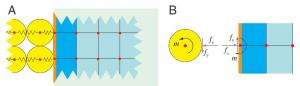
Combined DP/FE model. (A) Arrays of spheres interact with a baffle (orange lines) which in turn interacts with the adjacent fluid. (B) The interaction of granular media and baffle. Image: Spadoni et al. 10.1073/pnas.1001514107

Professor Daraio said the conversion of sound to a solitary wave is essential because solitary waves are easier to control than sound, and enabled them to achieve high focal intensities in the sound wave emitted, and its position could be controlled without needing to change the lens structure. Daraio said that if the outer chains are squeezed together closer than the inner chains, the solitary waves travel faster in the outer chains, resulting in successive sound pulses. The scientists can also adjust the intensity of the sound bullets emitted, so they can be powerful enough to be used as sonic scalpels or gentle enough for internal body imaging. The latter use would be an improvement on ultrasound because the sound is more highly focused, and can be repositioned easily.

This video is not supported by your browser at this time.

Stress waves traveling in a nonlinear acoustic lens and sound bullet formation in the adjacent fluid medium (numerical results). In the lens, the sphere colors are proportional to the contact-force amplitude. Waves emitted by the nonlinear acoustic lens reach the host medium (via an elastic interface), where they generate compact spherical pressure waves. The pressure waves coalesce in the host medium and form a sound bullet. The color bar on the right represents the scale of pressure intensity (Pa) in the host medium.

The system is still under development and has not yet been tested on living cells. It is likely to be some years before it is available for medical or other applications.

The research paper is published in this week’s issue of the Proceedings of the National Academy of Sciences journal.

More information: Alessandro Spadoni and Chiara Daraiob, Generation and control of sound bullets with a nonlinear acoustic lens, Published online before print April 5, 2010, doi:10.1073/pnas.1001514107

© 2010 PhysOrg.com

4.9 /5 (16 votes)  

Filter


Move the slider to adjust rank threshold, so that you can hide some of the comments.


Display comments: newest first

Birger
Apr 07, 2010

Rank: not rated yet
Aren't solitons conceptually related to tsunami waves?
Rank 4.9 /5 (16 votes)
Related Stories
Relevant PhysicsForums posts
  • changing electric flux caused by a resistor
    created56 minutes ago
  • Does path integral and loop integral in a Feynman diagram violate special relativity?
    created1 hour ago
  • Simple Torque from Gravity Problem
    created3 hours ago
  • Books To Inspire a Beginnig Physics Student
    created5 hours ago
  • Pith balls problem
    created5 hours ago
  • Electrostatics
    created5 hours ago
  • More from Physics Forums - General Physics

More news stories

Putting the squeeze on planets outside our solar system

(PhysOrg.com) -- Using high-powered lasers, scientists at Lawrence Livermore National Laboratory and collaborators discovered that molten magnesium silicate undergoes a phase change in the liquid state, abruptly ...

Physics / Condensed Matter

created 16 hours ago | popularity 4.3 / 5 (7) | comments 0 | with audio podcast

Hovering not hard if you're top-heavy, researchers find

Top-heavy structures are more likely to maintain their balance while hovering in the air than are those that bear a lower center of gravity, researchers at New York University's Courant Institute of Mathematical Sciences ...

Physics / General Physics

created 17 hours ago | popularity 5 / 5 (2) | comments 1 | with audio podcast

SLAC, Stanford team focuses on high-energy electrons to treat cancer

Accelerator physicists at SLAC and cancer specialists from Stanford are working on a new technology that could dramatically reduce the time needed for cancer radiation treatments. The team ran an initial experiment ...

Physics / General Physics

created 20 hours ago | popularity 5 / 5 (2) | comments 0

Measurements from high-energy collisions lead to better understanding of why meson particles disappear

For several years, physicists at the Relativistic Heavy Ion Collider (RHIC) at Brookhaven National Laboratory (BNL), USA, have studied an unusual state of matter called the quark–gluon plasma, which they ...

Physics / General Physics

created 21 hours ago | popularity 4.5 / 5 (4) | comments 0

Explained: Sigma

It's a question that arises with virtually every major new finding in science or medicine: What makes a result reliable enough to be taken seriously? The answer has to do with statistical significance -- but ...

Physics / General Physics

created Feb 09, 2012 | popularity 5 / 5 (16) | comments 53


Anonymous knocks CIA website offline (Update)

The website of the Central Intelligence Agency was inaccessible on Friday after the hacker group Anonymous claimed to have knocked it offline.

New error-correcting codes guarantee the fastest possible rate of data transmission

Error-correcting codes are one of the triumphs of the digital age. They’re a way of encoding information so that it can be transmitted across a communication channel — such as an optical fiber o ...

Small modular reactor design could be a 'SUPERSTAR'

(PhysOrg.com) -- Though most of today's nuclear reactors are cooled by water, we've long known that there are alternatives; in fact, the world's first nuclear-powered electricity in 1951 came from a reactor ...

New power source discovered

(PhysOrg.com) -- Researchers at the Massachusetts Institute of Technology (MIT) and RMIT University have made a breakthrough in energy storage and power generation.

The power of estrogen -- male snakes attract other males

A new study has shown that boosting the estrogen levels of male garter snakes causes them to secrete the same pheromones that females use to attract suitors, and turned the males into just about the sexiest ...

Advanced power-grid model finds low-cost, low-carbon future in West

(PhysOrg.com) -- The least expensive way for the Western U.S. to reduce greenhouse gas emissions enough to help prevent the worst consequences of global warming is to replace coal with renewable and other ...