Discovery that quasars don't show time dilation mystifies astronomers
April 9, 2010 by Lisa Zyga
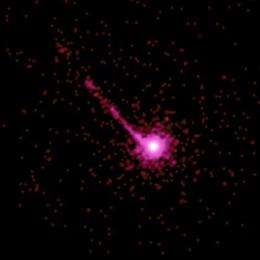
This X-ray image shows the quasar PKS 1127-145, a highly luminous source of X-rays and visible light located about 10 billion light years from Earth. Its X-ray jet extends at least a million light years from the quasar. Credit: NASA.
(PhysOrg.com) -- The phenomenon of time dilation is a strange yet experimentally confirmed effect of relativity theory. One of its implications is that events occurring in distant parts of the universe should appear to occur more slowly than events located closer to us. For example, when observing supernovae, scientists have found that distant explosions seem to fade more slowly than the quickly-fading nearby supernovae.
The effect can be explained because (1) the speed of light is a constant (independent of how fast a light source is moving toward or away from an observer) and (2) the universe is expanding at an accelerating rate, which causes light from distant objects to redshift (i.e. the wavelengths to become longer) in relation to how far away the objects are from observers on Earth. In other words, as space expands, the interval between light pulses also lengthens. Since expansion occurs throughout the universe, it seems that time dilation should be a property of the universe that holds true everywhere, regardless of the specific object or event being observed. However, a new study has found that this doesn’t seem to be the case - quasars, it seems, give off light pulses at the same rate no matter their distance from the Earth, without a hint of time dilation.
Astronomer Mike Hawkins from the Royal Observatory in Edinburgh came to this conclusion after looking at nearly 900 quasars over periods of up to 28 years. When comparing the light patterns of quasars located about 6 billion light years from us and those located 10 billion light years away, he was surprised to find that the light signatures of the two samples were exactly the same. If these quasars were like the previously observed supernovae, an observer would expect to see longer, “stretched” timescales for the distant, “stretched” high-redshift quasars. But even though the distant quasars were more strongly redshifted than the closer quasars, there was no difference in the time it took the light to reach Earth.
This quasar conundrum doesn’t seem to have an obvious explanation, although Hawkins has a few ideas. For some background, quasars are extreme objects in many ways: they are the most luminous and energetic objects known in the universe, and also one of the most distant (and thus, oldest) known objects. Officially called “quasi-stellar radio sources,” quasars are dense regions surrounding the central supermassive black holes in the centers of massive galaxies. They feed off an accretion disc that surrounds each black hole, which powers the quasars’ extreme luminosity and makes them visible to Earth.
One of Hawkins’ possible explanations for quasars’ lack of time dilation is that light from the quasars is being bent by black holes scattered throughout the universe. These black holes, which may have formed shortly after the big bang, would have a gravitational distortion that affects the time dilation of distant quasars. However, this idea of “gravitational microlensing” is a controversial suggestion, as it requires that there be enough black holes to account for all of the universe’s dark matter. As Hawkins explains, most physicists predict that dark matter consists of undiscovered subatomic particles rather than primordial black holes.
There’s also a possibility that the explanation could be even more far-reaching, such as that the universe is not expanding and that the big bang theory is wrong. Or, quasars may not be located at the distances indicated by their redshifts, although this suggestion has previously been discredited. Although these explanations are controversial, Hawkins plans to continue investigating the quasar mystery, and maybe solve a few other problems along the way.
Hawkins’ paper will be published in an upcoming issue of the Monthly Notices of the Royal Astronomical Society.
More information: * On time dilation in quasar light curves, M. R. S. Hawkins, DOI:10.1111/j.1365-2966.2010.16581.x
Via: New Scientist
© 2010 PhysOrg.com
-
Quasar Dust in the Early Universe
Mar 26, 2010 |
not rated yet |
0
-
Astronomers observe fast growing primitive black holes
Mar 17, 2010 |
not rated yet |
0
-
Hidden Population of Powerful Black Holes Revealed in Large Sky Survey
Jan 09, 2008 |
not rated yet |
0
-
NASA's Spitzer Finds Hidden, Hungry Black Holes
Aug 03, 2005 |
not rated yet |
0
-
Merging galaxies create a binary quasar (w/ Video)
Feb 03, 2010 |
not rated yet |
0
-
Engineers build first sub-10-nm carbon nanotube transistor
Feb 01, 2012 |
4.9 / 5 (30) |
30
-
Something old, something new: Evolution and the structural divergence of duplicate genes
Jan 31, 2012 |
4.6 / 5 (7) |
1
-
The hidden nanoworld of ice crystals: Revealing the dynamic behavior of quasi-liquid layers
Jan 30, 2012 |
5 / 5 (3) |
1
-
Stock market network reveals investor clustering
Jan 27, 2012 |
3.9 / 5 (23) |
8
-
Of microchemistry and molecules: Electronic microfluidic device synthesizes biocompatible probes
Jan 26, 2012 |
5 / 5 (1) |
0
-
Titan's lack of impact craters
14 hours ago
-
Real pictures of black hole eating a star?
Feb 08, 2012
-
Hypothetical way to travel faster than light, but not technically exceed lightspeed
Feb 06, 2012
-
How do scientists monitor the Sun's activity?
Feb 05, 2012
-
Search patterns in observational studies
Feb 05, 2012
-
Derivation of Pogson's law
Feb 03, 2012
- More from Physics Forums - General Astronomy
More news stories
Deconstructing a mystery: What caused Snowmaggedon?
In the quiet after the storms, streets and cars had all but disappeared under piles of snow. The U.S. Postal Service suspended service for the first time in 30 years. Snow plows struggled to push the evidence ...
Space & Earth / Earth Sciences
9 hours ago |
4.7 / 5 (3) |
1
|
New views show old NASA Mars landers
(PhysOrg.com) -- The High Resolution Imaging Science Experiment (HiRISE) camera on NASA's Mars Reconnaissance Orbiter recorded a scene on Jan. 29, 2012, that includes the first color image from orbit showing ...
Space & Earth / Space Exploration
17 hours ago |
4.9 / 5 (7) |
7
|
Researchers create 3-D laser maps that show how earthquake changes landscape
Geologists have a new tool to study how earthquakes change the landscape down to a few inches, and it's giving them insight into how earthquake faults behave. In the Feb. 10 issue of the journal Science, a team ...
Space & Earth / Earth Sciences
11 hours ago |
5 / 5 (4) |
0
|
Ocean microbe communities changing, but long-term environmental impact is unclear
As oceans warm due to climate change, water layers will mix less and affect the microbes and plankton that pump carbon out of the atmosphere but researchers say it's still unclear whether these processes ...
Space & Earth / Earth Sciences
11 hours ago |
5 / 5 (2) |
2
|
Black holes and star formation
(PhysOrg.com) -- It has long been recognized that galaxy mergers or even close interactions can play a vital role in shaping the morphology of galaxies. One way they can do so, it is thought, is by triggering ...
16 hours ago |
4 / 5 (6) |
4
|
'Dark plasmons' transmit energy
Microscopic channels of gold nanoparticles have the ability to transmit electromagnetic energy that starts as light and propagates via "dark plasmons," according to researchers at Rice University.
FDA-approved drug rapidly clears amyloid from the brain, reverses Alzheimer's symptoms in mice
Neuroscientists at Case Western Reserve University School of Medicine have made a dramatic breakthrough in their efforts to find a cure for Alzheimer's disease. The researchers' findings, published in the journal Science, show t ...
Hydrogen from acidic water: Researchers develop potential low cost alternative to platinum for splitting water
A technique for creating a new molecule that structurally and chemically replicates the active part of the widely used industrial catalyst molybdenite has been developed by researchers with the Lawrence Berkeley ...
Ultraviolet protection molecule in plants yields its secrets
Lying around in the sun all day is hazardous not just for humans but also for plants, which have no means of escape. Ultraviolet (UV) radiation from the sun can damage proteins and DNA inside cells, leading ...
Anyone can learn to be more inventive, cognitive researcher says
There will always be a wild and unpredictable quality to creativity and invention, says Anthony McCaffrey, a cognitive psychology researcher at the University of Massachusetts Amherst, because an "Aha moment" is rare and ...
Soraa LED light may dim 50-watt halogen rivals
(PhysOrg.com) -- Soraa, a Fremont, California company founded in 2008, this week launched its first product, a light that uses LEDS (light emitting diodes). The "Soraa LED MR16 lamp" is the "perfect" replacement ...
Apr 09, 2010
Rank: 4.9 / 5 (15)
Apr 09, 2010
Rank: 4.6 / 5 (12)
However, I do prefer the theory that so-called 'dark matter' consists of such 'normal' things as singularities, rather than "ghostly" wimps and other boojums and bandersnatchi.
Apr 09, 2010
Rank: 4 / 5 (2)
I agree, I think this is where the theory of relativity goes into effect. The immense amount of gravity is bending space causing the discrepancy. Maybe they need to solve the bending in space around first and then make appropriate adjustments.
Apr 09, 2010
Rank: not rated yet
Apr 09, 2010
Rank: 2.2 / 5 (10)
UNPOSSIBLE! Let us never speak of this heresy again. You better wise up, Hawkins.
Apr 09, 2010
Rank: 3.7 / 5 (13)
The odd and interesting piece is that as the universe expands these distant quasars should be moving away from us at ever increasing speeds or moving closer to us at ever decreasing speeds. From observation of the jets we're not seeing this phenomina and that is nonsensical as either the speed of the material or the speed of the galaxy should correspond to standard observational extrapolation.
In essence it appears we're viewing these distant objects in realtime as opposed to slow motion as we should view them.
Apr 09, 2010
Rank: 2.8 / 5 (14)
It should always be expected for people to have differences. Likely Mr. Hawkins was put on the spot when someone asked him the question and he threw out a few not-so-well thought out suppositions. Those who think they know everything usually have quite a bit left to learn, and lets face it; we keep learning new things about our universe, and as long as we continue to do so, we shouldn't be in such a hurry to act as if we know it all.
Apr 09, 2010
Rank: 4.8 / 5 (5)
Apr 09, 2010
Rank: 4 / 5 (8)
The significant difference, and I think we all know this, is whether you consider science a religion or not, that science postualtes a theory and attempts to prove or disprove that theory through observation and testing. Religion just says it is, so it is....
Apr 09, 2010
Rank: 2.2 / 5 (6)
Apr 09, 2010
Rank: 1.5 / 5 (10)
Apr 09, 2010
Rank: 4 / 5 (4)
If this is true, the easiest way to prove it would be to look at a single quasar in different frequency bands--either infrared for distant quasars, or UV for a (realatively) nearby quasar. If the power spectra of the light variations are different at different wavelengths, the problem goes away.
Alternatively, look at the variations at one particular source wavelength. (Say, one of the highly ionized iron lines.) If this power spectrum shows the expected effect, no problem.
Why should this be true? The accretion disk around a supermassive black hole will be hotter nearer the black hole. This will allow us to see higher frequency changes at higher frequencies.
Apr 09, 2010
Rank: 2.3 / 5 (3)
Can anyone explain, though, how they determine the distances of the quasars if not through standard EM methodologies? How do they know the 6 vs 10 billion LY?
Apr 09, 2010
Rank: 4.3 / 5 (6)
That link is full of waffle
Apr 09, 2010
Rank: 3.5 / 5 (8)
I can think of at least one person, but I think it's forbidden to mention Halton Arp's name... Oops. My bad.
Apr 09, 2010
Rank: 5 / 5 (3)
Apr 09, 2010
Rank: 5 / 5 (1)
Apr 09, 2010
Rank: 3.7 / 5 (6)
I can think of a few possible explanations, outside of the currently accepted theory, but well-known nevertheless.
For instance, light speed might've been changing over time. If it was much faster in the past, it would also make all reactions (and thus perceived time) go faster. If it then slowed in proportion to the expansion of space, the two effects would cancel each other out. This dependency would need to have abated in recent times, however: because otherwise we wouldn't be observing dilation in supernovae...
Another possibility is that there is more than one mechanism contributing to redshift, so that our interpretation of it purely in terms of space expansion would be incorrect. It could be, for example, that "dark matter" and "dark energy" are responsible or involved somehow, in the nature of redshift.
Apr 09, 2010
Rank: 3.4 / 5 (8)
On the religion front, it is a copout to say "Religion just says it is, so it is....". Really? Kind of like saying "Let there be global warming!"?
Look, I am not saying that there is not a true global warming, but scientists can make statistics lie, just like Christians can make a mockery of religion. That doesn't make all of religion OR science bad. I am not a new-ager, but I like the sign that says "COEXIST". I think scientists and religious people both show their ignorance when they attack the other side. Usually, it is dogmatic junk, having nothing to do with truth or Truth. Genesis is a wonderful account of evolution of the universe, if taken in its context as a non-scientific account written thousands of years ago.
Apr 09, 2010
Rank: 1.8 / 5 (10)
So, scientists and religious people, I say to you both: take your medicine and admit that you both could be right, but are just to prideful and stubborn to admit it!
I guess that is too big a miracle to ask for since you have so much time and effort expended in proving each other wrong.
Apr 09, 2010
Rank: 4.4 / 5 (7)
Since these quasars operate at energy levels more like those in existence at the big bang- they may in some way provide evidence, as Pink Elephant suggests, that the speed of light has indeed not been constant over time, and that, in turn may provide real proof for the Inflation Model.
Which would lead to some additional insight into the fundamental nature of things. Excellent work, Dr. Hawkins!
Apr 09, 2010
Rank: 3 / 5 (3)
On the other hand, there is no objective, empirical proof of Genesis. You can choose to believe in Genesis, but in the end, that is what it is- belief.
Science does not require an unprovable/disprovable prime mover to explain the forces at work in the universe.
Apr 09, 2010
Rank: 4.5 / 5 (6)
So our speed relative to that matter reduces and the spectrum tends to maybe even slightly blueshift for nearby quasars and slightly redshift for far away quasars.
Also taking into account that this is no precise science and only gives a slight idea about how far these quasars might be from us.
Apr 09, 2010
Rank: 3 / 5 (2)
Apr 09, 2010
Rank: not rated yet
kshultz222 and Caliban make very good points, both.
A simpler way to analogue is this:
The biblical Genesis account just says "Up is up, down is down" whereas scientific method says "Up is up because ... and down is down because ..."
Apr 09, 2010
Rank: not rated yet
Not a measure of age and distance? Your theory is testable. The math for GR is readily available. All you have to do is solve Einstein's equations in a manner that supports your conjecture. Einstein too tough? Try Maxwell. Or Faraday. Or Newton.
None of them agree? Guess you'll have to find a different math.
Apr 09, 2010
Rank: 4.6 / 5 (5)
Apr 09, 2010
Rank: 3.4 / 5 (5)
Arp objects are real, not some measurement mistake, so he was ostracized by the mainstream "keepers" of the SM because it didn't fit the dogma. Obviously, something is seriously wrong w/ cosmology and the SM (unmeasurable "dark" fudges??? c'mon!) and this report is just more evidence for that camp.
Apr 09, 2010
Rank: 2.8 / 5 (5)
Perhaps out of phase with observable matter. Perhaps Dark Matter/Energy? Damn- this stuff is freaking me out!
Ordinary matter in our universe being sucked out by black holes, while dark matter is pumped in by quasars, in a cosmic respiration or re-substantiation process. This goes hand-in-hand with this other article, I feel certain:
http://www.physor...839.html
A huge foam/membrane, with input/output singularities worming their ways throughout, simultaneously subtracting and adding space, replacing one type of matter with the other.
Quite a bit to try to wrap the mind around. But I guess that's the fun of it!
Apr 09, 2010
Rank: not rated yet
Apr 09, 2010
Rank: 4.3 / 5 (6)
Quasars are found only at great distances (multiple billions of light-years.) There are no nearby quasars. Yet there are plenty of nearby black holes. So you can forget about the white hole notion, lest you want to argue that we're once again at the center of the universe (i.e. our location in space is somehow privileged.)
It really wouldn't matter what the exact mechanism of quasar emission might be. The variations in emission should still be slowed down as the photons travel to us.
Strictly speaking, this isn't relativistic time dilation as posed by SR, because it isn't due to an object actually flying through space relative to us. Rather, it's dilation due to space expanding between us and the object. So the object itself evolves just as rapidly as we do, but the signals from that object ought to appear "slow" by the time they reach us. Yet in this study, they don't. That's the real puzzler.
Apr 09, 2010
Rank: 5 / 5 (3)
I suppose they want to say, there was no difference in the light pulse interval.
It is weird unless maybe the quasar frequency is related to the root of the size of the universe or something weird like that.
Apr 09, 2010
Rank: 1 / 5 (2)
I know. I don't know how much room there is for the argument that possibly quasars aren't emitting the same stuff as we're used to calling matter and energy, though. Perhaps the same rules don't apply.
And again, there's the question here of just exactly where are they- as in how far away?
I'm just throwing it out there- you never know when something will stick!
Also, it occurs to me that if C has not always been constant, then how much more of "our" universe is there, and how much older might it be?
If it were a few billions older, and maybe 2-5 times larger than is visible to us, might we not wake up one day, and discover that it was coming back- in the form of one or more ultra-mega-supermassive black holes?-or that maybe it already is? that would explain the apparent limits of observation, and also perhaps the mysterious flow of matter already observed-possibly just the beginning of a gravitational vortex, aka "circling the drain", CONT"D
Apr 09, 2010
Rank: 1 / 5 (4)
Perhaps black holes/white holes(quasars?) themselves are only manifestations of gradients in the density of matter/energy and dark matter/dark energy. Maybe that is what complementarity, parity, symmetry really consist of-in the sense of being the two sides of the same coin, yin-yang unit of duality.
Maybe as the "normal" matter of our universe is completely sucked out, space collapses and compresses dark matter/dark energy into the singularity the produces the next big bang(or Big Suck, depending on how you look at it)!
It's speculation, I know, but why not?
Apr 09, 2010
Rank: 1 / 5 (5)
http://scienceali...ples.jpg
Due the presence of CMB noise vacuum is inhomogeneous stuff and every wave is dispersed in it into extra-dimensions. In this way, the distant waves are moving slowly, which can be interpreted like omni-directional expansion of space-time from perspective of observer inside of it. But because pulsars do not actually moving, they don't change their frequency by Doppler shift.
Apr 09, 2010
Rank: 1 / 5 (5)
As you can see, it's all basically about physics of Victorian era and it can be understood quite easily in this way as a product of energy dispersion inside of inhomogeneous environment.
Apr 09, 2010
Rank: 2.6 / 5 (15)
Apr 09, 2010
Rank: 1.6 / 5 (7)
Apr 09, 2010
Rank: 2.8 / 5 (16)
Apr 09, 2010
Rank: 1.8 / 5 (5)
Sorry, but the predicate logics doesn't work in such way. If you admit A, then you should admit B, providing the A implies B. Because every black hole is formed by dense matter, then the vacuum of Universe, formed by interior of black hole must be of material nature, too.
Apr 09, 2010
Rank: 1.4 / 5 (11)
Apr 09, 2010
Rank: 1.7 / 5 (6)
Apr 09, 2010
Rank: 3 / 5 (2)
That just about covers it.
Electric universe.
Apr 09, 2010
Rank: 1.7 / 5 (11)
Apr 09, 2010
Rank: 2.7 / 5 (7)
Apr 09, 2010
Rank: 5 / 5 (1)
And this affects ONLY quasars WHY exactly? Thanks for any further info, have a good one!
Apr 09, 2010
Rank: 3.4 / 5 (5)
Now the whole situation just repeats at another level: existing model seems to be working well, only isolated observations are indicating, there may be something completely wrong with it.
Apr 09, 2010
Rank: 2.3 / 5 (6)
Apr 09, 2010
Rank: 2.6 / 5 (5)
Apr 09, 2010
Rank: 4.7 / 5 (3)
To test this, one would look at super-distant supernovae, and try to see if their time-evolution is similarly affected. Trouble is, they're so faint at these distances that one needs very large and very sensitive telescopes focusing on them for a very long time, to collect even a quasi-static picture as the photons trickle in, never mind generating a movie. To even detect supernovae at such distances, is a herculean task. Quasars are much more easily detected, imaged, and reliably observable, which evidences the availability of time-series data for them.
Apr 09, 2010
Rank: 5 / 5 (6)
There were fewer large galaxies (detectable at large distances) in the past. That's why they don't look as crowded as you imagined they should. There were correspondingly many more dwarf galaxies, but you can't see them with the current generation of telescopes at these distances.
Aside from its other failings, your aether idea would fail to explain the time dilation in supernovae (as mentioned in the article above.) It's not just a redshift; it's a literal time dilation -- meaning the further away they are, the slower they appear to evolve.
By the way, to correct another misunderstanding of yours: redshift is not due to light "slowing down". Light of all wavelengths propagates in vacuum at the same speed. Redshift is an increase in wavelength (or reduction in frequency, whichever you prefer).
Apr 09, 2010
Rank: 1 / 5 (3)
Other way: Close to a black hole (or big mass), or when traveling close to the speed of light, time slows down (proven fact).
So, light-speed itself doesn't change, but the energy state of light (and any other radiation) compensates for the slowing down of time.
Apr 10, 2010
Rank: 1 / 5 (2)
Sorry, but the predicate logics doesn't work in such way. If you admit A, then you should admit B, providing the A implies B. Because every black hole is formed by dense matter, then the vacuum of Universe, formed by interior of black hole must be of material nature, too.[/quote]
No, vacuum is (potential) energy, energy at ground state.
1 cm3 of vacuum would contain so much energy it can vaporize the whole milky way.
Apr 10, 2010
Rank: 5 / 5 (1)
Popper's Partypooper:
“The criterion of falsifiability… says that statements or systems of statements, in order to
be ranked as scientific, must be capable of conflicting with possible, or conceivable,
observations.”
The research simply attempts to established criterion of falsifiability. Alternate criterion actually appears in the comments above - conceivably helpful in Hawkin's quest for criterion.
in7x said it best in jest:
Apr 10, 2010
Rank: not rated yet
Apr 10, 2010
Rank: 1 / 5 (1)
Apr 10, 2010
Rank: 1 / 5 (2)
If a quasar is a black hole sucking in the IGM, then the density of the IGM nearby will be greater and the light from the quasar's core will be redshifted more than in the uncompressed IGM. This would explain the wide variations in quasar redshift with respect to their observed luminosity. It would mean quasars are closer and smaller than assumed in the Big Bang Theory - and that we would observe none of the time-dilation which is required if the BBT is true.
There's 100 characters left ... More on all this at http://astroneu.com
- Robin
Apr 10, 2010
Rank: 1 / 5 (1)
Apr 10, 2010
Rank: 1 / 5 (2)
Has anyone thought to calculate the relative motion of the quasar to the plasma jet? I mean, isn't it odd that these plasma jets which stream out over tremendous distances remain straight relative to their source? Shouldn't they curve over time (unless of course they are always in line with the quasar's trajectory)?
Apr 10, 2010
Rank: 1 / 5 (1)
Why in the world would the jet curve? Especially when there are no forces acting upon it to do so?
Apr 10, 2010
Rank: 1 / 5 (2)
http://bymyart.fi...big1.jpg
http://www.legis....mages/74 black hole jets_tif.jpg
Apr 10, 2010
Rank: 1 / 5 (3)
Apr 10, 2010
Rank: 4 / 5 (4)
Why would the explosion be more massive simply because it's further away?
Apr 10, 2010
Rank: 1 / 5 (4)
If the jet is coming toward us at a tangent, and space/time is accelerating the quasar away from us, there should be an apparent (but slight) drift of the ejected matter's alignment with its source (the space/time acceleration rates should differ by relative distance).
Apr 10, 2010
Rank: not rated yet
Just maybe Swartzschild worm holes are not unstable under certain conditions. Were quasars white holes they would be connected to future black holes through an Einstein-Rosen bridge (wormhole) and exhibit higher levels of radiation in shorter periods of time depending on age, not distance. This could indeed explain Hawkins findings. All very unsettling because this could validate multiple universes, branes of higher dimensions, etc.
Apr 10, 2010
Rank: 3 / 5 (2)
Except for the fact that all of space is expanding, not just accelerating away from us. If anything the jets should appear to not be perturbed to our observation unless at utterly extreme distances and well outside of our observable wavelenghts with minor exception as noted by the perceived perturbation in those objects that are satisfying those considerations.
Apr 10, 2010
Rank: 3 / 5 (2)
This is why redshifts change with distance.
Apr 10, 2010
Rank: 1 / 5 (1)
I think uvavont may be right- but the apparent lack of curvature in the jet is probably the result of its relatively quick loss of heat/energy/coherency, and thus visibility.
Apr 10, 2010
Rank: 1 / 5 (2)
Well, the visible portion is quite huge. I imagine it's even better in other frequencies. A measurement of this curvature could provide accurate answers to the rate of expansion. With this information, by comparing the expansion rate to the redshift, we could more accurately determine and verify distances, expansion, and dark energy acceleration.
Of course, this is supposing such a measurement is possible.
(Don't forget to give me credit if you use this idea)
Apr 10, 2010
Rank: 5 / 5 (4)
Imagine spacetime as a sheet of flat rubber. Initially relaxed. On this, you draw a straight line segment (the jet.) You also draw a point far away, which represents our position as observers. Now, tug on the sheet so as to stretch it UNIFORMLY along the segment-observer direction. The projection of the segment onto the observer will remain straight. Not only that, but even the perceived length of that projection will not change -- quite regardless of the segment's orientation with respect to the observer's line of sight (unless you stretched the sheet in ALL directions simultaneously...)
What will change, is the length of the segment on the rubber sheet (in space.) The observer could conceivably measure that (through redshift.) But the segment itself isn't typically long enough to detect significant change in redshift between its origin and its terminus (just one million light-years worth, even if it's parallel to the observer's line of sight...)
Apr 10, 2010
Rank: 1 / 5 (1)
Well, the visible portion is quite huge. I imagine it's even better in other frequencies. A measurement of this curvature could provide accurate answers to the rate of expansion. With this information, by comparing the expansion rate to the redshift, we could more accurately determine and verify distances, expansion, and dark energy acceleration.
Of course, this is supposing such a measurement is possible.
(Don't forget to give me credit if you use this idea)
Crikey! Do I sound like someone who possesses the maths to develop such a model? I appreciate the compliment, but really all I'm doing is conceptualizing. A terrible lot of fun, though.
And at the same time time serious- like I said earlier, you can never be sure when something might stick!
Apr 10, 2010
Rank: 1 / 5 (1)
@Pink Elephant,
Isn't this actually the case?
This is the basis of my problem with relativity- objects at a distance are supposed, in conformity with the notion, to behave differently from nearby objects.
For instance- it is possible for a(apparently, very) nearby object to approach us, but, the way I understand it, an object at a distance is ALWAYS moving away from us, and the further away it is, the faster it is fleeing.
Please feel free to correct any errors in regards to my understanding of cosmology.
Apr 10, 2010
Rank: not rated yet
Apr 10, 2010
Rank: 1 / 5 (3)
Apr 10, 2010
Rank: 1 / 5 (1)
Apr 10, 2010
Rank: 1 / 5 (2)
I suppose your 2D central observer might actually see the whole system turning away (but not a curvature). I think a 3D observer should detect a curve.
The line isn't static. It's made of material moving away from the quasar.
Apr 10, 2010
Rank: 5 / 5 (2)
Apr 10, 2010
Rank: 1 / 5 (2)
Apr 10, 2010
Rank: 1 / 5 (1)
Not when we view it as snapshots and do a compare and contrast.
Apr 10, 2010
Rank: 5 / 5 (3)
Apr 10, 2010
Rank: 1 / 5 (2)
Apr 10, 2010
Rank: 5 / 5 (1)
Apr 10, 2010
Rank: 1 / 5 (1)
Apr 10, 2010
Rank: 5 / 5 (3)
Cosmologists talk about "open" vs. "closed" spacetime -- either of which is a nonlinear/non-Euclidean geometry -- but this applies only to the combined 4-dimensional space-time. When plotting object or photon trajectories on a 4-D spacetime diagram, you can indeed observe curves due to space expansion or contraction. However, within space itself those curves don't exist. These curves are created only by connecting corresponding points across instantaneous spacelike snapshots of the universe.
Apr 11, 2010
Rank: 5 / 5 (1)
The LHC may give some added fuel to the fire soon. Will it be sufficient to open a new door to items not bound by speed, EM, or photonic, interaction?
Will we find items which transition to varied force responses at timings?
Why does the jet appear very straight in our perception over a timing of millions of light years travel? Why does the entire structure (distance) of millions of 'light years' appear cohesive and structurally stable? We have a variance of that magnitude, with a snapshot of the greater distance, in alignment to our movement across our galaxy. Impressions of many types give illusions of stable force and positioning but the Jet should define a pattern of local timing/angles. Does the jet show variance measurable? Too much noise at the jet? Needing more resolution?
Apr 11, 2010
Rank: not rated yet
Does anyone else have a problem with this sentence?
Apr 11, 2010
Rank: 1 / 5 (1)
Apr 11, 2010
Rank: 1 / 5 (1)
Obviously the author wanted to express that the "light signatures" (whatever this is supposed to mean) of quasars at different distances don't show any time dilation effect.
Apr 11, 2010
Rank: 5 / 5 (4)
Apr 11, 2010
Rank: 1 / 5 (3)
http://news.scien...ted.html
Most funny thing is, these Americans are probably right regarding Big Bang theory and they can serve as an evidence of the power of human intuition over science. The religiosity of contemporary science is in censorship and the point, it prefers straightforwardly computable models over these multicomponent ones (typically systems of many particles).
Apr 11, 2010
Rank: 3 / 5 (6)
What prohibits us to think about vacuum like about dense dispersing superfluid? Absolutely nothing, in fact - it's boring physical model like many others. Nevertheless, due its resemblance to ancient luminiferous aether model this model is widely ignored by mainstream physicists for fear of being accused from incompetence. In such way, mainstream science proponents are psychologically trapped into black hole of their own ignorance. I'm just describing, how human society is working.
Apr 11, 2010
Rank: 3.3 / 5 (7)
It's called plasma physics. We study it often, especially when theorizing the superfluidic nature of neutron stars and other degenerate objects.
We do not assume that the universe is composed of such things because there is not a shred of evidence for it.
Apr 11, 2010
Rank: 1.8 / 5 (5)
Apr 11, 2010
Rank: not rated yet
"For example, when observing supernovae, scientists have found that distant explosions seem to fade more slowly than the quickly-fading nearby supernovae."
From
http://www.scienc...3934.htm
"The intrinsically brighter .. flare and fade more slowly, and the correlation between brightness and light curve allows ... astronomers measure the light curve of a type 1a supernova, calculate its intrinsic brightness, and then determine how far away it is, since the apparent brightness diminishes with distance "
You'd like to see the detail but it seems one direct observation, the time to "flare and fade", is used to infer the intrinsic luminosity and a second the "observed luminosity", is used to infer the distance.
Surely a third direct observation is required to be able to talk about variation due to relativistic dilation?
Apr 11, 2010
Rank: 2 / 5 (4)
We can compare the light spreading through vacuum foam to the dark Apollonian band between primary and secondary rainbows, which can be observed during heavy rain - the closeness of droplets gives a foam character. It would mean, for remote radio-wave sources we should observe a BLUE shift with distance - only sources of light with wavelength smaller then the CMB wavelength would exhibit normal red shift.
And this prediction is testable by observation of remote radio sources - and it would enable to falsify whole aether model in this way easily.
Apr 11, 2010
Rank: not rated yet
Image overlay on the 3 sections shows some pattern repeats. Jet curvature is repeated, but node 'stars' and the jet are differing in angles, largely at the quasar itself.
Apr 11, 2010
Rank: 1 / 5 (1)
Okay. I've worked on this enough to tentatively concede that my initial gut instinct was most likely wrong and a curvature would probably not be detectable.
However, I'm getting some very interesting results. I'm beginning to think this article is more poorly written than it first appears. I think the redshift problem they're talking about might be the expected redshift variation along the length of the jet.
I'll have to work on this one for awhile...
Apr 11, 2010
Rank: not rated yet
Just a very interesting issue being discussed at RAS, of which i am a member.
See the arXiv posting from M.R.S. Hawkins in May 4th 2001 here: http://arxiv.org/...105073v1
/Best regards Henrik
Apr 11, 2010
Rank: 5 / 5 (1)
The problem is not that the light from the most distant quasars is not delayed or redshiftet, but that the extra-redshift - which should shorten the duration of events - does not have this effect.
H.M.S. Hawkins describes the problem in this manner:
"..We find that the timescale of quasar variation does not increase with redshift as required by time dilation"
/BR Henrik
Apr 11, 2010
Rank: not rated yet
Apr 11, 2010
Rank: 5 / 5 (6)
The article isn't talking about any problems with redshift. They're talking about patterns in light variation over time. It seems quasars are variable-brightness light sources, varying rapidly enough for us to detect the changes over relatively brief periods of observation. The variation has a certain time-scale, which would show up as specific harmonics on a Fourier spectrum of light intensity as a function of time.
Quasars that are farther away from us (the distances are estimated based on redshift), ought to feature a slow-down in their perceived (measured) brightness variation, due to time-dilation because they're rapidly "moving away from us" due to space expansion. IOW, the Fourier spectra of the variations ought to shift toward lower frequencies, the farther away the quasar is. No such pattern was detected by the study in question.
Does that make it a bit more clear?
Apr 11, 2010
Rank: 1 / 5 (1)
Apr 11, 2010
Rank: not rated yet
"Quasars are emitting light faster than the expansion of the universe and faster than the speed of light."
I am not an expert by any stretch of the imagination in this area but i feel that it might explain why the light emissions from the two very distant objects appear to be at the same distance: matter is moving faster than we expected.
If there is someone that can debunk my idea, please do so and send me a personal message with your counter-theory.
Thanks,
Dan
Apr 11, 2010
Rank: not rated yet
Apr 12, 2010
Rank: 2 / 5 (4)
Apr 12, 2010
Rank: 2 / 5 (2)
Your aether model suggests we live within a superfluid. Evidence your superfluid or step aside.
Apr 12, 2010
Rank: not rated yet
Apr 12, 2010
Rank: 4.6 / 5 (5)
Do not confuse cosmological redshift with Doppler shift. Cosmological redshift is not due to objects moving through space relative to each other. It is due to photons being literally stretched out (thus increasing their wavelength) as they propagate through expanding space. Or at least that's the prevailing theory.
Expansion of space cannot result in blueshift. In an expanding space, every point is becoming more distant from every other point, and all photons traveling in all directions are being stretched.
The concept of expanding space is preferable to the concept of Doppler shift. This is because the latter would place us somehow magically at the center of the universe (i.e. we're stationary, while the rest of the universe is flying away from us in all directions.) With space expansion, everything is "moving away" from everything else (due to more space being inserted in-between), so there's no center and no privileged coordinate system.
Apr 12, 2010
Rank: 1 / 5 (1)
Apr 12, 2010
Rank: not rated yet
Thanks for the correction, but in an ever expanding universe what inserts the "space between objects" and on what distance scale? Galaxies frequently collide and swing around each other and somewhere there has to be a galaxy that has negative velocity relative to us. It would exhibit blueshift in its spectra, would it not?
What I'm suspicious of is the prevalent theory that the universe is expanding in all directions based solely (as far as I can tell) on redshift. What if there is another explanation for redshift other than expansion? What if Hubble was wrong? The article seems to poke some doubt at it.
Apr 12, 2010
Rank: 4.8 / 5 (5)
No, expansion is in 3 dimensions (i.e space is expanding in all directions.) There's nothing currently being said about time.
But think about it: how can you even conceptualize expansion, unless you relate it to the flow of time. To describe expansion (or any process whatsoever), you take imaginary instantaneous snapshots of the whole system, over time, and then compare them against each other. Whatever changes you notice between adjacent snapshots, would represent the set of processes that have been occurring over the corresponding interval of time.
Now, of course personally I think it's a conceptual misappropriation to treat time as a true dimension. It is very convenient in terms of math, but in reality I see no reason to believe that a continuum of time exists in the same way that there's a continuum of space. IMHO, there's only the present. The past is merely representational (a memory), and the future is merely an estimate (projection from the present.)
Apr 12, 2010
Rank: 5 / 5 (2)
Apr 12, 2010
Rank: 1 / 5 (1)
Apr 12, 2010
Rank: 5 / 5 (4)
It's a common misconception to think of the Big Bang as an "explosion". It isn't an explosion. It is an expansion of space, with matter/energy embedded into the ever-stretching 3-dimensional membrane.
If you think carefully about a typical explosion, where pieces are flying away from the center, you will realize that:
1) There's a stationary center, and thus a privileged position in space. It is then statistically VERY unlikely for us to be located at such a position (yet we observe distant galaxies receding from us at the same speeds relative to distance, in all directions.)
2) The separation velocity between the ejecta and the center, is not the same as the separation velocity between nearby ejecta on the surface of a concentric sphere. Again, there's inhomogeneity in motion, and thus the presence of an implied absolute reference frame: which is anathema to Relativity.
For these reasons (and some more esoteric ones), physicists vastly prefer the space-expansion model.
Apr 12, 2010
Rank: 3 / 5 (2)
Apr 12, 2010
Rank: 3 / 5 (2)
http://arxiv.org/.../0005091
http://arxiv.org/abs/1004.0597
http://guidetorea...rse.html
Apr 12, 2010
Rank: 5 / 5 (4)
That's the problem with postulates. Can't live with them, can't live without them.
For example, we postulate "space" as some sort of an abstract continuous coordinate system that is miraculously not biased in any direction even in the slightest. Is such a mathematically depicted space a real entity, or a figment of our imaginations? Or is space tangible -- made of something (i.e. does it have fine structure?) But if so, what is that fine structure made of? How is it glued together, or interrelated? In a coordinate system of some sort? So on, ad infinitum. At some point, you just have to say the hell with it, and plop down a postulate or two, until some empirical data comes along to provide a few more hints...
Apr 12, 2010
Rank: 2.3 / 5 (3)
After then we forced to model randomness in space and only the system of mutually colliding (i.e. countable) particles is able to model such randomness in physically relevant way. After all, entropy concept is based on Boltzmann gas, too. We don't know, from the Universe was made of, but we can estimate, how it should appear, if it would be inhomogeneous and completely random.
Most of Universe understanding consist in understanding, how very dense random system of colliding particles should appear and behave. Currently, the geometry of dense gas fluctuations is virtually ignored by mainstream science from apparent reason - while it remains completely real, it defies the attempts for description by formal math - it can be studied only by computer simulations.
Apr 12, 2010
Rank: 2.3 / 5 (3)
http://tanzanite....mos.html
There exists a monster symmetry group, describing the most general geometry of kissing hyperspheres. With compare to E8 group it describes structure of hyperspheres in the hyperspace, formed by these hyperspheres itself.
http://en.wikiped...er_group
Apr 12, 2010
Rank: 2.3 / 5 (3)
http://mathworld....ing.html
The surface/volume ratio is significant for creatures, who are using surface waves, i.e. transversal waves of light for mediation of information at distance. In this way aether theory explains, why just 3D space appears so large for us with compare to all other hyperspaces. We can see, even if we reduce the number of postulates to absolute minimum and if we reduce physical system to gas of colliding particles, we can still extrapolate some significant predictions about it.
Apr 12, 2010
Rank: 2.3 / 5 (3)
The Big Bang model demonstrates, the deeper understanding of Universe we are searching for, the more counterintuitive assumptions we are required to assume for such explanation. We didn't throw out the belief in impossible at all, we only justified it in Lambda-CDM model. The Aether model just extrapolates the scope of assumptions even deeper: while providing deeper insight, the infinite hot & dense vacuum violates the conservation laws even more, then the initial singularity of Big Bang model.
The conclusion is, the more we understand about Universe, the more we are forced to believe about it: science=religion. We can consider it as a generalization of uncertainty principle.
Apr 13, 2010
Rank: not rated yet
Apr 13, 2010
Rank: 1 / 5 (1)
Okay. I officially concede that expansion acceleration effects would not be detectable in quasar jet curvature (but curvature is studied for other reasons).
Anyway, I understand why no one likes the currently proposed hypotheses for the time dilation discrepancy. M.R.S. Hawkins seems to prefer primordial black holes (as dark matter) for a solution. I don't buy that, because they should then affect all distant observations, similarly.
I would propose three hypotheses that I think make more sense (if anyone cares).
1. That these active galactic nuclei (AGN) are more populous in the past, indicates an aging process. Part of the aging process may be a slowing down of accretion activity, which just happens to correspond to our perception of their distance.
2. That at least one is detected with a redshift that would indicate it's twice as old as the universe, indicates their apparent redshifts may be distorted.
3. Is too wacky an idea to fit here..
Apr 13, 2010
Rank: 1 / 5 (1)
3. Optically (but not physically), they're all about the same distance away. That's to say, by looking toward their event horizons, we're looking so far into the past that the intervening physical time/distance, relative to the optically perceived time/distance, is generally irrelevant. Or to put it another way, the energy pulses we're viewing are energy fossils from a far distant past, that are irrespective of the quasars' apparent positions and activities.
Like I said, it's wacky...
Apr 13, 2010
Rank: 1 / 5 (1)
Apr 13, 2010
Rank: 1 / 5 (2)
you are wrong.quasars are all over the universe because the are created when 2 supermassive black holes merge.
Apr 13, 2010
Rank: 1 / 5 (1)
Apr 13, 2010
Rank: 1 / 5 (1)
Apr 13, 2010
Rank: 3 / 5 (2)
Apr 13, 2010
Rank: 1 / 5 (1)
Apr 13, 2010
Rank: 1 / 5 (1)
Apr 13, 2010
Rank: 1 / 5 (2)
This requires a super dimensional explanation. The light is traveling via some external carrier wave which is not subject to the laws of relativity within our space.
Apr 13, 2010
Rank: 3 / 5 (2)
Any reason why? Simple magnetics tell us why it occurs in magnetars and neutron stars, strangely requiring no mention of superdimensional carrier waves.
Apr 14, 2010
Rank: 1 / 5 (1)
So, I'll leave aside the "white hole" question for now- even though I don't see how we could predict what distribution they would have in "our" universe- obviously a more fundamental objection is that they should be spewing matter at us.
I've been giving some thought to the idea of expansion of space. Is space expanding isotropically, or heterotropically? If iso- then at what rate? It couldn't be much, or else the universe would be much larger than we observe, with much larger redshift.
Is it expanding at a rate faster than the velocity of matter in the universe?
And, if there is an actual or accepted as actual maximum extent to the observable universe- then there must be a "center" or "origin"-for lack of a better term. I understand that the universe didn't explode into being, and I feel like I've got a good conceptual grip on the inflating mechanism- sort of like an expanding foam, with matter concentrated on the dividing walls that separate the voids in the "foam"
Apr 14, 2010
Rank: 1 / 5 (2)
But if there is no center, then that means that, essentially, matter is continually being produced out of nothing, and that this is happening everywhere, and continuously, since the relative density of matter in the universe appears to be constant. Entirely possible, of course- nobody said that the big bang OR a white hole are operating in visible light- or at least not initially.
Perhaps the "Big Bang" is, in fact a White Hole, and it is ongoing, rather than being a discreet event.
None of this, however, helps with the paradox of quasars at hugely disparate distances not having differential light-pulse redshift relative to earthly observers.
Apr 14, 2010
Rank: 1 / 5 (1)
Since I'll not just be asking for my own sake, can you recommend one or two books that can manage the job of clearly and concisely explaining the currently accepted cosmology?
It has become only too apparent that there are some largish holes in my understanding of it.
Apr 14, 2010
Rank: 3 / 5 (2)
Apr 14, 2010
Rank: 1 / 5 (1)
Yeah, but who's going to write that one? At least the current theory can provide a jumping-off point.
Apr 14, 2010
Rank: not rated yet
You don't ask for much, do you? =P
Anyway, just to answer some of your questions...According to current theories (and measurements), yes.74.2 ± 3.6 (km/s)/Mpc. See here:
http://en.wikiped...le's_law
To unpack it a bit, over a span of 1 megaparsec (3.26 million light-years, or about 3 x 10^19 km), about 74 km of new space is being inserted every second.Not sure what you mean by this. But certainly, at any given rate of expansion (assuming it holds constant, even though it appears to be accelerating at the moment), if you sum it up over a sufficient stretch of space, the amount of extra space added per second will exceed the amount of space light can cover per second. So, light emitted at one end of such a span, is guaranteed to never reach the other end.
Apr 14, 2010
Rank: 1 / 5 (1)
Indeed, since light travels in vacuum at about 300,000 km/s, then currently the absolute optical horizon is located at the _current_ distance of about (300,000/74)*3,260,000 =~ 13,000,000,000 light-years. IOW, any light emitted right now at such a distance from any observer that is stationary with respect to the emitter, will never reach the observer -- unless, of course, cosmic expansion slows down, stops, or reverses at some point in the future.The actual accepted limit to the observable universe is defined by its age (estimated at 13.75 billion years), past which there were supposedly no objects, no light, and no space for the light to travel through... So this produces an absolute cut-off at 13.75 billion light-years from any observer.
Apr 14, 2010
Rank: 3 / 5 (2)
Note that already, some really ancient objects we might theoretically detect right now because light from them has been traveling to us almost since right after Big Bang, are already beyond the cutoff produced by expansion itself, and so in the future are doomed to fade into nothingness and become forever undetectable. If space expansion continues unabated, this fade-out will gradually engulf more and more of currently-visible distant galaxies, then closer galaxies, and eventually even our immediate neighbors.
If expansion continues to accelerate, it will eventually rip apart our galaxy, then our solar system (or what's left of it by then), then every molecule, every atom, and every elementary particle. That's the so-called "Big Rip", and it's a possible future of ours. Not to worry though, even if it does happen, it isn't scheduled to hit us for a good few billion years longer.
http://en.wikiped.../Big_Rip
Apr 14, 2010
Rank: not rated yet
Apr 14, 2010
Rank: 3 / 5 (2)
As for "center" or "origin", that would be wherever a given observer (such as yourself, for example) happens to be. All observers everywhere are equivalent, and all observers everywhere, would perceive a universe that looks similar in all directions.No, that's incorrect. Space is expanding everywhere, including inside dense objects and inside atoms. However, dense objects and atoms are constrained by forces that maintain their geometry and structure against this ongoing minuscule internal expansion, so the extra space sort of just "leaks" out of them.
It's true that at mega-scales, the universe looks like a bvoids surrounded by thin walls and filaments of matter. Initial inhomogeneities at Big Bang -- quantum fluctuations, inflated to cosmic proportions -- followed by subsequent gravitational condensation are responsible for such structure.
Apr 14, 2010
Rank: 3 / 5 (2)
Of course, this expansion is introducing extra energy into the universe (in the form of potential energy, as well as probably in the form of extra particles -- such as photons -- emitted by matter 'fighting' against the expansion.)
However, such a notion of energy imbalance over time is not a violation of conservation laws, rather it stems from a failure to consider other embedded reservoirs of energy. Current theory calls this hidden reservoir, "dark energy", and postulates that there is a whole lot more of it than all matter (including dark matter) and other types of energy, combined. There's also the somewhat fringe notion of vacuum energy. Then, there are things like ekpyrotic universe hypothesis, and other fun stuff...
Apr 14, 2010
Rank: not rated yet
Apr 14, 2010
Rank: 1 / 5 (1)
Brian Green - The Elegant Universe is a great one.
Apr 14, 2010
Rank: 1 / 5 (1)
Apr 14, 2010
Rank: 1 / 5 (1)
Apr 14, 2010
Rank: 1.8 / 5 (5)
Do you want to understand the Universe? Just sit down near water and throw some pebbles into it..
http://www.physor...830.html
This is an interesting observation, because from dense aether model of vacuum follows, the waves of wavelength smaller, then the wavelength of cosmic microwave background should disperse gradually, whereas the waves of longer wavelength should concentrate with distance.
Apr 14, 2010
Rank: 1 / 5 (1)
I appreciate your having taken the time for the tutorial. Very helpful.
@skeptic, frajo, et al. -thanks for chipping in.
This stuff I find endlessly fascinating, so it's important for me to have a solid grasp of the fundamentals in order to think clearly about what the implications of some of these articles are.
Think I'll go with the Hawking book- oddly enough, I was holding a copy of it in my hands only a few days ago, and I'd like to help keep my friendly neighborhood used bookseller in business.
Cheers, Everyone!
Apr 15, 2010
Rank: 1 / 5 (2)
For instance, if the quasar jets were reliably straight, and the tail was facing us at a tangent, wouldn't the tail appear to be shorter and more redshifted than it would if the expansion wasn't accelerating (the actual result of the curvature I mentioned)?
The reasoning is: If the jet is a million light years long, the light from the quasar has had a million more years to travel to get to us. It not only holds the same accelerated expansion information as the tail end's light, but it also holds a slower period's information. Therefore, the tail should appear flattened a little.
Hypothetically, if we could determine the actual orientation verus the perceived orientation, couldn't we use that information to more precisely measure and map the expansion acceleration?
I doubt this particular difference would be measurable, but could it be measured in more disperse objects?
Apr 15, 2010
Rank: 1 / 5 (1)
No, there's nothing to provide drag in the depths of space.
If you're traveling at a perfect 40 miles an hour in a vaccuum and throw a penny out the window perpendicular to the car, the speed of the penny along your axis of motion remains at 40 mph.
To an external observer, a stream of pennies being tossed out the window would appear as a straight line traveling in lockstep with the car.
Apr 15, 2010
Rank: 5 / 5 (1)
The rate of expansion appears to vary over time. It was super-high during the initial inflation period. It then spent billions of years gradually slowing down. Then, for some reason it reached an inflection point, and then began to speed up again. It is currently in the accelerating phase. Nobody knows what governs this dynamic, nor consequently what the long-term behavior will be.
The varying rate of expansion was discovered by correlating supernova brightness and redshift measurements (distance at emission time is estimated from supernova brightness, whereas total redshift imparted onto the light as it travels to us over that distance, is attributed to space expansion.)
The varying expansion will not curve jets as they project onto an observer's camera; however it can "curve" them in direction transverse to the camera (i.e. along the line of sight.) This would be analogous to the supernova brightness (distance) vs. redshift signal's deviation from linearity.
Apr 15, 2010
Rank: not rated yet
Apr 15, 2010
Rank: 1 / 5 (1)
Right, that's essentially what I said. I don't mean curve,but rather slightly shortened or elongated (depending on its orientation and such). You'd most likely notice it in the redshift.
What I'm wondering is, if the expansion acceleration is always comprehensive and homogeneous. Could it vary locally?
Apr 17, 2010
Rank: not rated yet
Apr 17, 2010
Rank: 3 / 5 (4)
You should not pay attention to confused people like seneca/broglia/ubavontuba.
Apr 17, 2010
Rank: 2.3 / 5 (3)
Apr 30, 2010
Rank: 3.7 / 5 (3)
May 01, 2010
Rank: 2 / 5 (4)
This just serves to show that LHC proponents really don't care about life.
May 01, 2010
Rank: not rated yet
May 03, 2010
Rank: 1 / 5 (1)
May 04, 2010
Rank: 1 / 5 (2)
Jun 03, 2010
Rank: not rated yet
Jun 03, 2010
Rank: 1 / 5 (1)
As SmartK8 points out, what if, at some point, DM/DE is capable of another phase/state change?