Cell phones that protect against deadly chemicals? Why not?
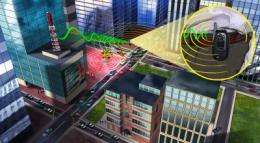
Do you carry a cell phone? Today, chances are it's called a "smartphone" and it came with a three-to-five megapixel lens built-in -- not to mention an MP3 player, GPS or even a bar code scanner. This 'Swiss-Army-knife' trend represents the natural progression of technology -- as chips become smaller/more advanced, cell phones absorb new functions.
What if, in the future, new functions on our cell phones could also protect us from toxic chemicals?
Homeland Security's Science and Technology Directorate (S&T)'s Cell-All is such an initiative. Cell-All aims to equip cell phones with a sensor capable of detecting deadly chemicals. The technology is ingenious. A chip costing less than a dollar is embedded in a cell phone and programmed to either alert the cell phone carrier to the presence of toxic chemicals in the air, and/or a central station that can monitor how many alerts in an area are being received. One might be a false positive. Hundreds might indicate the need for evacuation.
"Our goal is to create a lightweight, cost-effective, power-efficient solution," says Stephen Dennis, Cell-All's program manager.
How would this wizardry work? Just as antivirus software bides its time in the background and springs to life when it spies suspicious activity, so Cell-All would regularly sniffs the surrounding air for certain volatile chemical compounds.
When a threat is sensed, an alert ensues in one of two ways. For personal safety issues such as a chlorine gas leak, a warning is sounded; the user can choose a vibration, noise, text message or phone call. For catastrophes such as a sarin gas attack, details—including time, location and the compound—are phoned home to an emergency operations center. While the first warning is beamed to individuals, the second warning works best with crowds. And that's where the genius of Cell-All lies—in crowd sourcing human safety.
Currently, if a person suspects that something is amiss, he might dial 9-1-1, though behavioral science tells us that it's easier to do nothing. And, as is often the case when someone phones in an emergency, the caller may be difficult to understand, diminishing the quality of information that's relayed to first responders. An even worse scenario: the person may not even be aware of the danger, like the South Carolina woman who last year drove into a colorless, odorless, and poisonous ammonia cloud.
In contrast, anywhere a chemical threat breaks out—a mall, a bus, subway or office—Cell-All will alert the authorities automatically. Detection, identification, and notification all take place in less than 60 seconds. Because the data are delivered digitally, Cell-All reduces the chance of human error. And by activating alerts from many people at once, Cell-All cleverly avoids the long-standing problem of false positives. The end result: emergency responders can get to the scene sooner and cover a larger area—essentially anywhere people are, casting a wider net than stationary sensors can.
And the privacy issue? Does this always-on surveillance mean that the government can track your precise whereabouts whenever it wants? To the contrary, Cell-All will operate only on an opt-in basis and will transmit data anonymously.
"Privacy is as important as technology," says Dennis. "After all, for Cell-All to succeed, people must be comfortable enough to turn it on in the first place."
For years, the idea of a handheld weapons of mass destruction detector has engaged engineers. In 2007, S&T called upon the private sector to develop concepts of operations. Today, thanks to increasingly successful prototype demonstrations, the Directorate is actively funding the next step in R&D—a proof of principle—to see if the concept is workable.
To this end, three teams from Qualcomm, the National Aeronautics and Space Administration (NASA), and Rhevision Technology are perfecting their specific area of expertise. Qualcomm engineers specialize in miniaturization and know how to shepherd a product to market. Scientists from the Center for Nanotechnology at NASA's Ames Research Center have experience with chemical sensing on low-powered platforms, such as the International Space Station. And technologists from Rhevision have developed an artificial nose—a piece of porous silicon that changes colors in the presence of certain molecules, which can be read spectrographically.
Similarly, S&T is pursuing what's known as cooperative research and development agreements with four cell phone manufacturers: Qualcomm, LG, Apple and Samsung. These written agreements, which bring together a private company and a government agency for a specific project, often accelerate the commercialization of technology developed for government purposes. As a result, Dennis hopes to have 40 prototypes in about a year, the first of which will sniff out carbon monoxide and fire.
To be sure, Cell-All's commercialization may take several years. Yet the goal seems eminently achievable: Just as Gates once envisioned a computer on every desk in every home, so Dennis envisions a chemical sensor in every cell phone in every pocket, purse or belt holster.
And if it's not already the case, says Dennis, "Our smartphones may soon be smarter than we are."
Provided by US Department of Homeland Security


