Researchers harness viruses to split water: Crucial step toward turning water into hydrogen fuel
April 11, 2010
Researchers harness viruses to split water: Crucial step toward turning water into hydrogen fuel

Enlarge

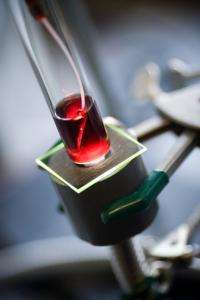
Photo: Dominick Reuter

(PhysOrg.com) -- A team of MIT researchers has found a novel way to mimic the process by which plants use the power of sunlight to split water and make chemical fuel to power their growth. In this case, the team used a modified virus as a kind of biological scaffold that can assemble the nanoscale components needed to split a water molecule into hydrogen and oxygen atoms.

Splitting is one way to solve the basic problem of solar energy: It's only available when the sun shines. By using sunlight to make hydrogen from water, the hydrogen can then be stored and used at any time to generate electricity using a , or to make liquid fuels (or be used directly) for cars and trucks.

Other researchers have made systems that use electricity, which can be provided by , to split , but the new biologically based system skips the intermediate steps and uses sunlight to power the reaction directly. The advance is described in a paper published on April 11 in Nature Nanotechnology.

The team, led by Angela Belcher, the Germeshausen Professor of Materials Science and Engineering and Biological Engineering, engineered a common, harmless bacterial virus called M13 so that it would attract and bind with molecules of a catalyst (the team used iridium oxide) and a biological pigment (zinc porphyrins). The viruses became wire-like devices that could very efficiently split the oxygen from water molecules.

Over time, however, the virus-wires would clump together and lose their effectiveness, so the researchers added an extra step: encapsulating them in a microgel matrix, so they maintained their uniform arrangement and kept their stability and efficiency.

While hydrogen obtained from water is the gas that would be used as a fuel, the splitting of oxygen from water is the more technically challenging "half-reaction" in the process, Belcher explains, so her team focused on this part. Plants and cyanobacteria (also called blue-green algae), she says, "have evolved highly organized photosynthetic systems for the efficient oxidation of water." Other researchers have tried to use the photosynthetic parts of plants directly for harnessing sunlight, but these materials can have structural stability issues.

Belcher decided that instead of borrowing plants' components, she would borrow their methods. In plant cells, natural pigments are used to absorb sunlight, while catalysts then promote the water-splitting reaction. That's the process Belcher and her team, including doctoral student Yoon Sung Nam, the lead author of the new paper, decided to imitate.

In the team's system, the viruses simply act as a kind of scaffolding, causing the pigments and catalysts to line up with the right kind of spacing to trigger the water-splitting reaction. The role of the pigments is "to act as an antenna to capture the light," Belcher explains, "and then transfer the energy down the length of the virus, like a wire. The virus is a very efficient harvester of light, with these porphyrins attached.

"We use components people have used before," she adds, "but we use biology to organize them for us, so you get better efficiency."

Using the virus to make the system assemble itself improves the efficiency of the oxygen production fourfold, Nam says. The researchers hope to find a similar biologically based system to perform the other half of the process, the production of hydrogen. Currently, the hydrogen atoms from the water get split into their component protons and electrons; a second part of the system, now being developed, would combine these back into hydrogen atoms and molecules. The team is also working to find a more commonplace, less-expensive material for the catalyst, to replace the relatively rare and costly used in this proof-of-concept study.

Thomas Mallouk, the DuPont Professor of Materials Chemistry and Physics at Pennsylvania State University, who was not involved in this work, says, "This is an extremely clever piece of work that addresses one of the most difficult problems in artificial photosynthesis, namely, the organization of the components in order to control electron transfer rates."

He adds: "There is a daunting combination of problems to be solved before this or any other artificial photosynthetic system could actually be useful for energy conversion." To be cost-competitive with other approaches to solar power, he says, the system would need to be at least 10 times more efficient than natural photosynthesis, be able to repeat the reaction a billion times, and use less expensive materials. "This is unlikely to happen in the near future," he says. "Nevertheless, the design idea illustrated in this paper could ultimately help with an important piece of the puzzle."

Belcher will not even speculate about how long it might take to develop this into a commercial product, but she says that within two years she expects to have a prototype device that can carry out the whole process of splitting water into and hydrogen, using a self-sustaining and durable system.

More information: "Biologically templated photocatalytic nanostructures for sustained light-driven water oxidation" Yoon Sung Nam, Andrew P. Magyar, Daeyeon Lee, Jin-Woong Kim, Dong Soo Yun, Heechul Park, Thomas S. Pollom Jr, David A. Weitz and Angela M. Belcher. Nature Nanotechnology, April 11, 2010

Provided by Massachusetts Institute of Technology (news : web)

4.7 /5 (40 votes)  

Filter


Move the slider to adjust rank threshold, so that you can hide some of the comments.


Display comments: newest first

CWFlink
Apr 11, 2010

Rank: 3.7 / 5 (3)
Anyone have a feel for the relative efficiency of photosynthesis and photovoltaics? Is there some chance that the process described here will be significantly more efficient than solar cells?
antialias
Apr 11, 2010

Rank: 3.5 / 5 (4)
Photosynthesis in plants is at about 3% efficient.

Commercial PV efficiency starts at 3% and you can get, I think, ones that are as high as 20% (depending on type) with experimental ones coming in around 20-40% (again depending on type).

This means the above process needs to improve quite a bit to get comparable output.

But you also have to factor in that conversion of electricity to hydrogen is currently, at best, a 60% efficient process. So it really depends on what you want here: electricity or hydrogen.

If it's hydrogen you're after then the above process needs not to improve quite that much in order to be competitive.
Nartoon
Apr 11, 2010

Rank: 1 / 5 (2)
Yabut, how much power are you going to waste to keep the water from freezing in Northern climates during their winters?
Caliban
Apr 11, 2010

Rank: 1 / 5 (1)
The consideration would actually be generation density. How much hydrogen/oxygen(or electricity) produced per unit volume per unit time.

@nartoon- since the reaction produces hydrogen and oxygen- shouldn't be a problem to burn part of that yield for heat, especially if the apparatus was enclosed in a greenhouse-type structure.

But the main consideration is that the fuel supply and/or electricity produced by the process has to be better than just par with fossil fuel generation methods, in order to create the economic pressure to convert.

Whether that cost calculation includes incentives for alternatives, and/or real cost accounting for the impact of fossil fuel use, is still up in the air, but we keep getting incrementally closer, and sooner or later, in one leap, or a series of smaller steps, we are going to get there.

It will be a happy day, indeed.
Mandan
Apr 12, 2010

Rank: not rated yet
As for problems with freezing water:

In most places in northern latitudes where there is sufficient winter population of humans to warrant producing the fuel locally, you would simply build the plants below the frost line, which is no deeper than the average structural footing or water main has to be laid.
PinkElephant
Apr 12, 2010

Rank: 5 / 5 (1)
The biggest issue isn't efficiency, but area. Whatever the harvesting method, at most latitudes other than equatorial you can't collect more than about 1 KW per square meter at high noon with no clouds. And that's assuming 100% energy capture (impossible.)

The neat thing about solar cells (producing electricity), is that they can be incorporated into building materials (roofs, external walls, windows, maybe even pavement) once they are cheap enough. You end up using surface area that was already being used anyway. And you end up generating electricity locally to fill demand on the spot, with minimal if any transmission losses.

But dedicated solar farms aren't the most efficient way to harvest solar energy. Better to focus on hydroelectric, wave, wind, or biomass energy: which harvests already naturally-concentrated solar power, and so doesn't need to occupy quite as large an area per kilowatt.
antialias
Apr 12, 2010

Rank: not rated yet
In most places in northern latitudes where there is sufficient winter population of humans to warrant producing the fuel locally, you would simply build the plants below the frost line, which is no deeper than the average structural footing or water main has to be laid.

And sunlight gets there how exactly?

Simply put a sheet of glass over the entire assembly and use a minimal amount of the produced hydrogen for heating when necessary.
Going
Apr 12, 2010

Rank: not rated yet
Another problem would be how to separate the Hydrogen gas from the Oxygen gas, both are being generated in the same water body. The two mixed together are highly explosive.
Nervous
Apr 13, 2010

Rank: not rated yet
This brings to mind some issues of safety. first, most living organisms (us) are a high percentage of H2O, not to mention the oceans. How are you going to control a VIRUS that can mutate.
OregonStorm
Apr 13, 2010

Rank: not rated yet
Do tell, since we are bombarded by scientists who are telling us that the next great shortage is to be water, why are we considering using it as fuel? Shall we then find some other material to drink or bathe in? I don't think oil would work.
gashog
Apr 14, 2010

Rank: not rated yet
Whenever you see the term "hydrogen economy"

just substitute teh word "Boondoggle"
Caliban
Apr 14, 2010

Rank: 3 / 5 (2)
Do tell, since we are bombarded by scientists who are telling us that the next great shortage is to be water, why are we considering using it as fuel? Shall we then find some other material to drink or bathe in? I don't think oil would work.

I think the shortage of which they speak is one of fresh, ie -"drinkable" water- not water in general.
lengould100
Apr 15, 2010

Rank: not rated yet
This is perhaps the third or fourth time I've seen researchers distinguish between separating hydrogen from water and separating oxygen from water
While hydrogen obtained from water is the gas that would be used as a fuel, the splitting of oxygen from water is the more technically challenging "half-reaction" in the process
What is left but oxygen when hydrogen is removed from water? Is it that the water goes to hydrogen peroxide (H2O2)? Why would anyone want oxygen from water?
Rank 4.7 /5 (40 votes)
Relevant PhysicsForums posts
  • Protease cleavage
    created3 hours ago
  • Pertubance in a model
    created10 hours ago
  • Cancer drugs and Alzheimer's, Oh my!
    created18 hours ago
  • Squishing cells
    created18 hours ago
  • Any books/articles for evolutionary stable strategy models in humans?
    createdFeb 09, 2012
  • Science behind the bore feeling?
    createdFeb 09, 2012
  • More from Physics Forums - Biology

More news stories

What lies beneath: Mapping hidden nanostructures

The ability to diagnose and predict the properties of materials is vital, particularly in the expanding field of nanotechnology. Electron and atom-probe microscopy can categorize atoms in thin sheets of material, ...

Nanotechnology / Nanophysics

created 8 hours ago | popularity 5 / 5 (1) | comments 1

New kind of solar cell could capture significantly more energy than current cells

New solar cells could increase the maximum efficiency of solar panels by over 25%, according to scientists from the University of Cambridge.

Nanotechnology / Nanophysics

created Feb 08, 2012 | popularity 4.5 / 5 (12) | comments 14 | with audio podcast

'Dark plasmons' transmit energy

Microscopic channels of gold nanoparticles have the ability to transmit electromagnetic energy that starts as light and propagates via "dark plasmons," according to researchers at Rice University.

Nanotechnology / Nanophysics

created Feb 09, 2012 | popularity 5 / 5 (6) | comments 1 | with audio podcast

Nanoshell whispering galleries improve thin solar panels

Visitors to Statuary Hall in the U.S. Capitol Building may have experienced a curious acoustic feature that allows a person to whisper softly at one side of the cavernous, half-domed room and for another on ...

Nanotechnology / Nanomaterials

created Feb 07, 2012 | popularity 4.3 / 5 (6) | comments 6 | with audio podcast

Nanotube therapy takes aim at breast cancer stem cells

Wake Forest Baptist Medical Center researchers have again proven that injecting multiwalled carbon nanotubes (MWCNTs) into tumors and heating them with a quick, 30-second laser treatment can kill them.

Nanotechnology / Bio & Medicine

created Feb 09, 2012 | popularity 5 / 5 (1) | comments 0 | with audio podcast


Google users warned of threat to smartphone wallets

Users of Google smartphone wallets were being warned on Friday that there is a way to crack pass codes intended to thwart thieves from going on illicit shopping sprees.

NASA sees wide-eyed cyclone Jasmine

Cyclone Jasmine's eye has opened wider on NASA satellite imagery, as it moves through the Southern Pacific Ocean.

NASA sees Giovanna reach cyclone strength, threaten Madagascar

Tropical Storm 12S built up steam and became a cyclone on February 10, 2012 as NASA's Terra satellite passed overhead. Residents of east-central Madagascar should prepare for this cyclone to make landfall ...

CIA website offline, Anonymous takes credit

The website of the Central Intelligence Agency was unresponsive on Friday after the hacker group Anonymous claimed to have knocked it offline.

Complex wiring of the nervous system may rely on a just a handful of genes and proteins

Researchers at the Salk Institute have discovered a startling feature of early brain development that helps to explain how complex neuron wiring patterns are programmed using just a handful of critical genes. ...

Putting the squeeze on planets outside our solar system

(PhysOrg.com) -- Using high-powered lasers, scientists at Lawrence Livermore National Laboratory and collaborators discovered that molten magnesium silicate undergoes a phase change in the liquid state, abruptly ...