Printed cells to treat burn victims
April 12, 2010 by Lin Edwards
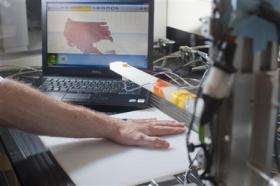
A device used to bioprint skin onto burns demonstration. Image credit: Wake Forest Institute of Regenerative Medicine/Handout
(PhysOrg.com) -- A medical device that works rather like an inkjet printer is being developed in the US to heal burns and other wounds by "printing" skin cells directly onto the wound. The device, called a bioprinter, may reduce the need for skin grafts. It would be mounted on a wheeled frame and positioned over the bed of the patient.
A laser inside the bioprinter, which was developed at Wake Forest University School of Medicine in Winston-Salem, North Carolina, first measures the size and shape of the wound and then applies specific skin cells precisely where they are needed. The skin cell spray is produced by dissolving cells from pieces of skin and then separating cell types such as keratinocytes and fibroblasts. The purified cells are then incubated in a nutrient solution where they multiply. They are then placed into sterilized cartridges and sprayed onto the wound by a similar process to a multi-color inkjet printer, with the fibroblasts sprayed on first followed by a layer of keratinocytes. The sprayed-on cells form a protective shield for the wound.
The device has so far only been tested on mice, but the initial results show wounds heal quickly and safely, with wounds healing three weeks faster than those that were untreated. Professor of regenerative medicine at the University, George Christ, said the group would next test the device on pigs, who have skin resembling human skin. They will eventually apply for approval from the US Food and Drug Administration to allow them to carry out human trials. The team is also liaising with the US Armed Forces Institute of Regenerative Medicine with the aim of producing a device that could be used to treat wounded soldiers in Afghanistan and Iraq.
Victims of severe burns can die of infection within a couple of weeks unless if they do not receive skin grafts, but the grafts can leave serious scarring. In the bioprinter the skin cells became integrated in the surrounding skin, which the researchers said was probably because the sprayed cells included immature stem cells. Student Kyle Binder, who helped design the device said when the cells were put into the wound, they “know what to do”.
© 2010 PhysOrg.com
-
Study uses bone marrow stem cells to regenerate skin
Jan 14, 2009 |
not rated yet |
0
-
Clinical trials of spray-on skin to start in US
Nov 24, 2009 |
not rated yet |
0
-
Artificial skin system can heal wounds
Dec 20, 2007 |
not rated yet |
0
-
Skin care: new research into scar-free healing
Jan 21, 2008 |
not rated yet |
0
-
From managing sugar to managing healing
Dec 10, 2006 |
not rated yet |
0
-
Engineers build first sub-10-nm carbon nanotube transistor
Feb 01, 2012 |
4.9 / 5 (30) |
30
-
Something old, something new: Evolution and the structural divergence of duplicate genes
Jan 31, 2012 |
4.6 / 5 (7) |
1
-
The hidden nanoworld of ice crystals: Revealing the dynamic behavior of quasi-liquid layers
Jan 30, 2012 |
5 / 5 (3) |
1
-
Stock market network reveals investor clustering
Jan 27, 2012 |
3.9 / 5 (23) |
8
-
Of microchemistry and molecules: Electronic microfluidic device synthesizes biocompatible probes
Jan 26, 2012 |
5 / 5 (1) |
0
-
Is Everyday Technology Killing Us?
Feb 08, 2012
-
Exercise and weight loss
Feb 08, 2012
-
Why do we have head aches? Our brains can't feel anything.
Feb 07, 2012
-
"The end of diseases" by David Agus, interview from Daily Show with Jon Stewart
Feb 04, 2012
-
Oncolytic adenovirus
Feb 04, 2012
-
Nutrition label stuffs and diets
Feb 02, 2012
- More from Physics Forums - Medical Sciences
More news stories
Seeing colors in music, tasting flavors in shapes may happen in life's early months
Famed violinist Itzhak Perlman sees a deep forest green whenever he plays a B-flat on his Stradivarius' G string. The A on the E string is red.
Medicine & Health / Psychology & Psychiatry
1 hour ago |
5 / 5 (1) |
0
|
Team isolates nerve cells involved in storing long term memory and gene proteins associated with them
(Medical Xpress) -- A research team in Taiwan has succeeded in isolating two nerve cells in fruit fly brains that are believed to be the major players in allowing for the formation of long term memories. Furthermore, ...
News of plaque-clearing drug tops week of major advances against Alzheimer's disease
In the last eight days, scientists have delivered a powerful one-two punch in the fight to defeat Alzheimer's disease. At the same time, the White House and members of Congress are proposing increases in Alzheimer's research ...
21 minutes ago |
not rated yet |
0
S.Africa in $208 mln AIDS drug venture with Swiss Lonza
South Africa on Friday unveiled plans for a 1.6 billion rand ($208 million, 157 million euro) pharmaceutical plant, in a joint venture with Swiss biochemicals group Lonza to produce anti-AIDS drugs.
Medicine & Health / HIV & AIDS
34 minutes ago |
not rated yet |
0
Russia sounds alarm over spiralling teenage suicides
Top Russian psychiatrists on Friday called for urgent measures to battle the soaring teenage suicide rate, one of the world's highest.
Medicine & Health / Psychology & Psychiatry
14 minutes ago |
not rated yet |
0
The power of estrogen -- male snakes attract other males
A new study has shown that boosting the estrogen levels of male garter snakes causes them to secrete the same pheromones that females use to attract suitors, and turned the males into just about the sexiest ...
Could Venus be shifting gear?
(PhysOrg.com) -- ESAs Venus Express spacecraft has discovered that our cloud-covered neighbour spins a little slower than previously measured. Peering through the dense atmosphere in the infrared, the ...
Experts reveal how plants don't get sunburn
(PhysOrg.com) -- Experts at the University of Glasgow have discovered how plants survive the harmful rays of the sun.
Engineering images bring life to submerged city
(PhysOrg.com) -- Photo-realistic 3D mapping and digital reconstruction of an ancient underwater city in Greece have earned a team from the University of Sydney's Faculty of Engineering and Information Technologies ...
New power source discovered
(PhysOrg.com) -- Researchers at the Massachusetts Institute of Technology (MIT) and RMIT University have made a breakthrough in energy storage and power generation.
The turbulent birth of super star clusters in galaxy mergers
By combining two of the most advanced telescopes in the world -- the new Atacama Large Millimeter Array (ALMA) and the Very Large Telescope (VLT) of ESO -- a team of French astronomers from the Institut d'astrophysique ...