Harnessing the Web and supercomputers to track pathogens as they evolve
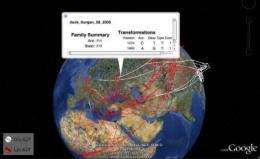
Pathogens can now be easily tracked in time and space as they evolve, an advance that could revolutionize both public health and inform national security in the fight against infectious diseases. Developed by researchers that include scientists at the American Museum of Natural History, Supramap is a new, powerful, web-based application that maps genetic mutations like those among the different strains of avian influenza onto the globe. The new application is published in the early online edition of Cladistics.
"Supramap does more that put points on a map—it is tracking a pathogen's evolution," says Daniel A. Janies, first author of the paper and an associate professor at Ohio State University. "We package the tools in an easy-to-use web-based application so that you don't need a Ph.D. in evolutionary biology and computer science to understand the trajectory and transmission of a disease."
"This tool also has a lot of predictive power," says lead author Ward Wheeler, curator in the Division of Invertebrate Zoology at the American Museum of Natural History. "If the movement of a pathogen is related to bird flyways, and those routes are shifting because of something like climate change, we can predict where the disease might logically emerge next."
In recent years, the collection of genomic sequences of the coronavirus that causes Severe Acute Respiratory syndrome (SARS) and various strains of the influenza A virus have become an vital part of fighting outbreaks of these infectious diseases. The initial jump of a pathogen into humans has become increasingly important to understand because of growing human-animal contact and global travel. Researchers now know, for example, that SARS has a deep evolutionary origin in bats. Another recent use of genetics, geography, and the phylogenetic trees that map the evolutionary relationships among different strains of pathogens is to predict hotspots of disease reemergence.
Operating on parallel programming on high-performance computing systems at Ohio State University and the Ohio Supercomputer Center, Supramap advances the use of genetic information in studying infectious outbreaks a step further. This application integrates genetic sequences of pathogens with geographic information so that researchers can track the spread of a disease among different hosts and follow the emergence of key mutations across time and space. With Supramap, users can submit raw genetic sequences and obtain a phylogenetic tree of strains of pathogens. The resulting tree is then projected onto the globe by Supramap and can be viewed with Google Earth. Each branch in the evolutionary tree is geo-located and time-stamped. Pop-up windows and color of branches show how pathogen strains mutate over space and time and infect new hosts.
Janies, Wheeler, and colleagues tested Supramap's capability by entering genetic and geographic data on recent isolates of avian influenza (H5N1). The diversity of viral strains from birds and mammals in China, Russia, the Middle East, Africa, and Europe are represented as they spread westward over four years. The evolutionary tree, based on 239 sequences of a specific gene, polymerase basic 2, shows that host shifts are highly correlated with a specific mutation (in E627K) that allows avian viruses to adapt to mammalian hosts.
"There are many efforts by governments and non-governmental organizations to encourage sharing of raw genomic information, especially for pathogens," says Janies. "But the raw genetic information still needs interpretation, and we are sharing our know-how and even our computers so that this can happen. We aim for our tools to inform decisions about potential global hotspots for the emergence of diseases from animals and areas of drug resistance."
"Biogeography and phylogeny, or the study of evolutionary and geographic relationships among organisms, are the core areas of research in the Museum," says Wheeler. "Our expertise is now being applied to a new, practical set of research questions, the spread of disease and human health. And this can expand to get a handle on other problems like the movement of invasive species."
More information: supramap.osu.edu


