Berkeley Lab Scientists Create 'Molecular Paper' (w/ Video)
April 12, 2010
Berkeley Lab Scientists Create 'Molecular Paper'

Enlarge

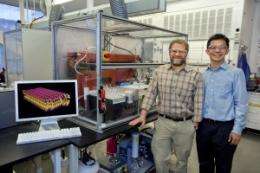
Ron Zuckermann (left) and Ki Tae Nam with Berkeley Lab’s Molecular Foundry, have developed a ‘molecular paper’ material whose properties can be precisely tailored to control the flow of molecules, or serve as a platform for chemical and biological detection (Photo by Roy Kaltschmidt, Berkeley Lab Public Affairs).

(PhysOrg.com) -- Berkeley Lab scientists have created "molecular paper," the largest two-dimensional polymer crystal self-assembled in water to date. This entirely new sheet material is made of peptoids, engineered polymers that can flex and fold like proteins while maintaining the robustness of synthetic materials.

Two-dimensional, “sheet-like” nanostructures are commonly employed in biological systems such as cell membranes, and their unique properties have inspired interest in materials such as . Now, Berkeley Lab scientists have made the largest two-dimensional polymer crystal self-assembled in water to date. This entirely new material mirrors the structural complexity of biological systems with the durable architecture needed for membranes or integration into functional devices.

These self-assembling sheets are made of peptoids, engineered polymers that can flex and fold like proteins while maintaining the robustness of manmade materials. Each sheet is just two molecules thick yet hundreds of square micrometers in area—akin to ‘molecular paper’ large enough to be visible to the naked eye. What’s more, unlike a typical polymer, each building block in a peptoid nanosheet is encoded with structural ‘marching orders’—suggesting its properties can be precisely tailored to an application. For example, these nanosheets could be used to control the flow of molecules, or serve as a platform for chemical and biological detection.

This video is not supported by your browser at this time.

These images show free-floating peptoid nanosheets in liquid. Each peptoid sheet is just two molecules thick yet up to hundreds of square micrometers in area—a ‘molecular paper’ large enough to be visible to the naked eye.

“Our findings bridge the gap between natural biopolymers and their synthetic counterparts, which is a fundamental problem in nanoscience,” said Ronald Zuckermann, Director of the Biological Nanostructures Facility at the Molecular Foundry. “We can now translate fundamental sequence information from proteins to a non-natural polymer, which results in a robust synthetic nanomaterial with an atomically-defined structure.”

The building blocks for peptoid polymers are cheap, readily available and generate a high yield of product, providing a huge advantage over other synthesis techniques. Zuckermann, instrumental in developing the Foundry’s one-of-a-kind robotic synthesis capabilities, worked with his team of coauthors to form libraries of peptoid materials. After screening many candidates, the team landed upon the unique combination of polymer building blocks that spontaneously formed peptoid nanosheets in water.

Zuckermann and coauthor Christian Kisielowski reached another first by using the TEAM 0.5 microscope at the National Center for Electron Microscopy (NCEM) to observe individual polymer chains within the peptoid material, confirming the precise ordering of these chains into sheets and their unprecedented stability while being bombarded with electrons during imaging.

“The design of nature-inspired, functional polymers that can be assembled into membranes of large lateral dimensions marks a new chapter for materials synthesis with direct impact on Berkeley Lab’s strategically relevant initiatives such as the Helios project or Carbon Cycle 2.0,” said NCEM’s Kisielowski. “The scientific possibilities that come with this achievement challenge our imagination, and will also help move electron microscopy toward direct imaging of soft materials.”

“This new material is a remarkable example of molecular biomimicry on many levels, and will no doubt lead to many applications in device fabrication, nanoscale synthesis and imaging,” Zuckermann added.

This research is reported in a paper titled, “Free floating ultra-thin two-dimensional crystals from sequence-specific peptoid polymers,” appearing in the journal Nature Materials.

Provided by Lawrence Berkeley National Laboratory (news : web)

4.7 /5 (10 votes)  

Rank 4.7 /5 (10 votes)
Related Stories
Relevant PhysicsForums posts
  • polymer nanocomposites
    created9 hours ago
  • Corrosion Tests on Magnesium
    created22 hours ago
  • polyethylene copper nanocomposite
    createdFeb 09, 2012
  • Output of xrd analysis
    createdFeb 08, 2012
  • Transport phenomena problem based on problems 18.B11 and 19B.6 from Bird, stewart, lw
    createdFeb 06, 2012
  • Help with material selection - Car Piston
    createdFeb 05, 2012
  • More from Physics Forums - Materials & Chemical Engineering

More news stories

What lies beneath: Mapping hidden nanostructures

The ability to diagnose and predict the properties of materials is vital, particularly in the expanding field of nanotechnology. Electron and atom-probe microscopy can categorize atoms in thin sheets of material, ...

Nanotechnology / Nanophysics

created 2 hours ago | popularity 5 / 5 (1) | comments 0

'Dark plasmons' transmit energy

Microscopic channels of gold nanoparticles have the ability to transmit electromagnetic energy that starts as light and propagates via "dark plasmons," according to researchers at Rice University.

Nanotechnology / Nanophysics

created 18 hours ago | popularity 5 / 5 (6) | comments 0 | with audio podcast

Nanotube therapy takes aim at breast cancer stem cells

Wake Forest Baptist Medical Center researchers have again proven that injecting multiwalled carbon nanotubes (MWCNTs) into tumors and heating them with a quick, 30-second laser treatment can kill them.

Nanotechnology / Bio & Medicine

created 23 hours ago | popularity 5 / 5 (1) | comments 0 | with audio podcast

New kind of solar cell could capture significantly more energy than current cells

New solar cells could increase the maximum efficiency of solar panels by over 25%, according to scientists from the University of Cambridge.

Nanotechnology / Nanophysics

created Feb 08, 2012 | popularity 4.5 / 5 (11) | comments 14 | with audio podcast

Nanoshell whispering galleries improve thin solar panels

Visitors to Statuary Hall in the U.S. Capitol Building may have experienced a curious acoustic feature that allows a person to whisper softly at one side of the cavernous, half-domed room and for another on ...

Nanotechnology / Nanomaterials

created Feb 07, 2012 | popularity 4.3 / 5 (6) | comments 6 | with audio podcast


New understanding of DNA repair could eventually lead to cancer therapy

A research group in the Faculty of Medicine & Dentistry at the University of Alberta is hoping its latest discovery could one day be used to develop new therapies that target certain types of cancers.

Zuckerberg's focus drives Facebook's ascent

When Mark Zuckerberg showed up to rent Judy Fusco's Los Altos, Calif., house in the fall of 2004, soon after he'd arrived in Silicon Valley, the landlord was immediately struck by his confidence.

Antidepressants and pregnancy: Women must consider the impact of drugs on baby, and of depression on baby, themselves

Upon learning they are pregnant, most women dutifully nix the alcohol, sushi and caffeine. But what about antidepressants?

Both maternal and paternal age linked to autism

Older maternal and paternal age are jointly associated with having a child with autism, according to a recently published study led by researchers at The University of Texas Health Science Center at Houston (UTHealth).

Night, weekend delivery OK for babies with birth defects

Weekday delivery is no better than night or weekend delivery for infants with birth defects, according to a new study presented today at The Pregnancy Meeting, the Society for Maternal-Fetal Medicine's annual conference. ...

From virginity to Viagra

Americans will spend more than $17 billion on Valentine's Day, but far less on programs like sex education for adolescents. The editors of the new book, Sex for Life, From Virginity to Viagra, How Sexuality Changes Throughout ...