Lightning really does make mushrooms multiply
April 13, 2010 by Lin Edwards
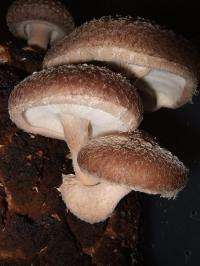
Shiitake mushroom growing on wood. Image credit: Wikipedia.
(PhysOrg.com) -- Japanese farming folklore has it that lightning makes mushrooms multiply, and new research supports the idea. Mushrooms form a staple part of the diet in Japan, and the fungi are in such high demand that around 50,000 tons are imported annually, so scientists have been experimenting with artificial lightning to see if it could increase the crop.
A four-year study carried out at Iwate University in northern Japan on ten species of mushroom (so far) has shown that for eight of the 10 mushroom species a bolt of lightning-strength electricity could double the crop yield. The best improvements were found in the popular nameko and shiitake mushrooms. The experiments were carried out by seeding logs with mushroom spores and then applying high-voltage electricity pulses to the logs.
A direct hit by natural lightning would burn and kill mushrooms with up to a billion volts of electricity, so the researchers, led by Associate Professor of Engineering, Koichi Takaki, thought the increase in numbers of mushrooms, if it occurred at all, could be caused by exposure to a weakened charge that would travel through the soil after a nearby lightning strike. They therefore used less damaging pulses of electricity.
The experiments showed mushrooms react best when exposed to a ten-millionth of a second burst of electricity at 50-100,000 volts. Under the best conditions the nameko yield was 80% greater than the untreated control crop, while the shiitake crop yield doubled. Takaki said the mushrooms initially decrease the enzyme and protein secretions from the hyphae (tiny filaments that spread under the surface, acting like roots and giving rise to the fruiting bodies such as mushrooms), but then suddenly increase production.
The reason for the reaction is unknown and the subject of further investigations. One of the researchers, Yuichi Sakamoto of the Iwate Biotechnology Research Center, said it is possible the reaction is a response to danger, and the mushrooms react by giving themselves a reproductive boost and increase the number of fruiting bodies so their chance of survival is maximized.
Takaki and Sakamoto think the equipment they used could eventually be adapted for use by commercial mushroom growers.
The effects of artificial lightning are also being studied by Takaki’s team on daikon radishes, and by other researchers on beans, rapeseed plants and some lily varieties. So far the early results look promising.
© 2010 PhysOrg.com
-
Button mushrooms contain as much anti-oxidants as expensive ones
Feb 06, 2008 |
not rated yet |
0
-
Modified mushrooms may yield human drugs
Jun 22, 2007 |
not rated yet |
0
-
Genetic technology reveals how poisonous mushrooms cook up toxins
Nov 12, 2007 |
not rated yet |
0
-
US shiitake market mushrooming
Feb 26, 2009 |
not rated yet |
0
-
Mushrooms as good an antioxidant source as more colorful veggies
Jun 26, 2006 |
not rated yet |
0
-
Engineers build first sub-10-nm carbon nanotube transistor
Feb 01, 2012 |
4.9 / 5 (31) |
30
-
Something old, something new: Evolution and the structural divergence of duplicate genes
Jan 31, 2012 |
4.6 / 5 (7) |
1
-
The hidden nanoworld of ice crystals: Revealing the dynamic behavior of quasi-liquid layers
Jan 30, 2012 |
5 / 5 (3) |
1
-
Stock market network reveals investor clustering
Jan 27, 2012 |
3.9 / 5 (23) |
8
-
Of microchemistry and molecules: Electronic microfluidic device synthesizes biocompatible probes
Jan 26, 2012 |
5 / 5 (1) |
0
-
Protease cleavage
2 hours ago
-
Pertubance in a model
9 hours ago
-
Cancer drugs and Alzheimer's, Oh my!
17 hours ago
-
Squishing cells
17 hours ago
-
Any books/articles for evolutionary stable strategy models in humans?
Feb 09, 2012
-
Science behind the bore feeling?
Feb 09, 2012
- More from Physics Forums - Biology
More news stories
The power of estrogen -- male snakes attract other males
A new study has shown that boosting the estrogen levels of male garter snakes causes them to secrete the same pheromones that females use to attract suitors, and turned the males into just about the sexiest ...
7 hours ago |
5 / 5 (3) |
0
|
Experts reveal how plants don't get sunburn
(PhysOrg.com) -- Experts at the University of Glasgow have discovered how plants survive the harmful rays of the sun.
7 hours ago |
5 / 5 (2) |
0
|
Protein libraries in a snap
(PhysOrg.com) -- A Rice University undergraduate will depart with not only a degree but also a possible patent for his invention of an efficient way to create protein libraries, an important component of biomolecular ...
10 hours ago |
5 / 5 (2) |
0
|
Grass to gas: Researchers' genome map speeds biofuel development
Researchers at the University of Georgia have taken a major step in the ongoing effort to find sources of cleaner, renewable energy by mapping the genomes of two originator cells of Miscanthus x giganteus, a large perenn ...
4 hours ago |
3.7 / 5 (3) |
0
|
Miami battling invasion of giant African snails
No one knows how they got there. But an invasion of African giant snails has southern Florida in a panic over potential crop damage, disease and general yuckiness surrounding the slimy gastropods.
11 hours ago |
not rated yet |
2
CIA website offline, Anonymous takes credit
The website of the Central Intelligence Agency was unresponsive on Friday after the hacker group Anonymous claimed to have knocked it offline.
Q&A: Obama and the birth control controversy
(AP) -- What birth control debate? A half-century after the introduction of the pill, acceptance of birth control by American women is virtually universal.
Complex wiring of the nervous system may rely on a just a handful of genes and proteins
Researchers at the Salk Institute have discovered a startling feature of early brain development that helps to explain how complex neuron wiring patterns are programmed using just a handful of critical genes. ...
New error-correcting codes guarantee the fastest possible rate of data transmission
Error-correcting codes are one of the triumphs of the digital age. Theyre a way of encoding information so that it can be transmitted across a communication channel such as an optical fiber o ...
Humans may have helped the decline of African rainforests 3000 years ago
(PhysOrg.com) -- Large areas of rainforests in Central Africa mysteriously disappeared over three thousand years ago, to be replaced by savannas. The prevailing theory has been that the cause was a change ...
Curry spice component may help slow prostate tumor growth
Curcumin, an active component of the Indian curry spice turmeric, may help slow down tumor growth in castration-resistant prostate cancer patients on androgen deprivation therapy (ADT), a study from researchers ...
Apr 13, 2010
Rank: 3 / 5 (2)
The attack of the mushrooms.
Apr 13, 2010
Rank: 3 / 5 (2)
Apr 13, 2010
Rank: 5 / 5 (5)
That may be, but many folklore things that are "common knowledge" or "well known" turn out to be untrue or even (in rare cases) to have the opposite effect of what is claimed (IE, the "well known" healing properties of megadoses of lead and arsnic in oriental "medicine". Heh). So these things need to get studied.
I love the reaction to articles like this.
When the folklore turns out to be false, the comments are filled with the "Duh, of course it's false. It's just folklore. Silly scientists are wasting money studying this!"
When the folklore turns out to be true people comment "Well duh, of course it's true! Everyone knows that it's true. This been known for thousands of years! Silly scientists are wasting money studying this!"
It looks like the poor scientists can't win for trying:P.
Apr 13, 2010
Rank: not rated yet
gopher65 Arsenic was studied and has now been proven to successfully treat leukemia. http://www.physor...435.html
Apr 13, 2010
Rank: 1 / 5 (6)
Apr 13, 2010
Rank: 3 / 5 (2)
Apr 14, 2010
Rank: not rated yet
Apr 14, 2010
Rank: 1 / 5 (3)
Apr 15, 2010
Rank: not rated yet
You eat live things? You monster, I make sure they are dead first. Additionally I hope everything you said was a troll.Otherwise the world has no hope, just none.
Apr 19, 2010
Rank: not rated yet
Apr 19, 2010
Rank: not rated yet
I remember my biology teacher coming in with a young pineapple plant and showing us how to make it bear fruit much earlier than it would under regular cultivation conditions: by smacking it around a lttle with a baseball bat.
It seems senisble that those plants that will bear fruit under stress early will gain an advantage over their more conservative competitors (which might not see fruit-bearing age if the danger persists)