Turning Planetary Theory Upside Down (w/ Video)
April 13, 2010
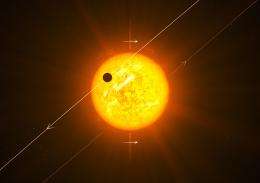
Up to now it was expected that exoplanets would all orbit in more or less the same plane, and that they would move along their orbits in the same direction as the star's rotation -- as they do in our solar system. However, new results unexpectedly show that many exoplanets actually orbit at a large angle to their star's spin axis. In the case shown here (WASP 8b) the orbit is completely reversed, or retrograde. Credit: ESO/L. Calçada
(PhysOrg.com) -- The discovery of nine new transiting exoplanets is announced today at the RAS National Astronomy Meeting. When these new results were combined with earlier observations of transiting exoplanets astronomers were surprised to find that six out of a larger sample of 27 were found to be orbiting in the opposite direction to the rotation of their host star -- the exact reverse of what is seen in our own solar system.
"This is a real bomb we are dropping into the field of exoplanets," says Amaury Triaud, a PhD student at the Geneva Observatory who, with Andrew Cameron and Didier Queloz, leads a major part of the observational campaign.
Planets are thought to form in the disc of gas and dust encircling a young star. This proto-planetary disc rotates in the same direction as the star itself, and up to now it was expected that planets that form from the disc would all orbit in more or less the same plane, and that they would move along their orbits in the same direction as the star's rotation. This is the case for the planets in the Solar System.
After the initial detection of the nine new exoplanets with the Wide Angle Search for Planets (WASP), the team of astronomers used the HARPS spectrograph on the 3.6-metre ESO telescope at the La Silla observatory in Chile, along with data from the Swiss Euler telescope, also at La Silla, and data from other telescopes to confirm the discoveries and characterise the transiting exoplanets found in both the new and older surveys. The current count of known exoplanets is 452.
This video is not supported by your browser at this time.
Up to now it was expected that exoplanets would all orbit in more or less the same plane, and that they would move along their orbits in the same direction as the stars rotation as they do in our Solar System. However, new results unexpectedly show that many exoplanets actually orbit at a large angle to their stars spin axis. In the case shown here (WASP 8b) the orbit is completely reversed, or retrograde. The star spins in one direction (towards the right as seen here) and the planet orbits the opposite way (towards the left). The speed of motion is greatly increased in this animation. Credit: ESO/L. Calçada
Surprisingly, when the team combined the new data with older observations they found that more than half of all the hot Jupiters studied have orbits that are misaligned with the rotation axis of their parent stars. They even found that six exoplanets in this extended study (of which two are new discoveries) have retrograde motion: they orbit their star in the "wrong" direction.Hot Jupiters are planets orbiting other stars that have masses similar to, or greater than, that of Jupiter, but that orbit their parent stars much more closely than any of the planets in our own Solar System. Because they are both large and close they are easier to detect from their gravitational effect on their stars and also more likely to transit the disc of the star. Most of the first exoplanets to be found were of this class.
"The new results really challenge the conventional wisdom that planets should always orbit in the same direction as their stars spin," says Andrew Cameron of the University of St Andrews, who presented the new results at the RAS National Astronomy Meeting (NAM2010) in Glasgow this week.
In the 15 years since the first hot Jupiters were discovered, their origin has been a puzzle. These are planets with masses similar to or greater than that of Jupiter, but that orbit very close to their suns. The cores of giant planets are thought to form from a mix of rock and ice particles found only in the cold outer reaches of planetary systems. Hot Jupiters must therefore form far from their star and subsequently migrate inwards to orbits much closer to the parent star. Many astronomers believed this was due to gravitational interactions with the disc of dust from which they formed. This scenario takes place over a few million years and results in an orbit aligned with the rotation axis of the parent star. It would also allow Earth-like rocky planets to form subsequently, but unfortunately it cannot account for the new observations.
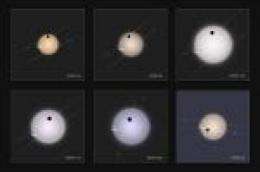
This is a gallery of exoplanets with retrograde orbits. Exoplanets, discovered by WASP together with ESO telescopes, that unexpectedly have been found to have retrograde orbits, are shown in this artist's conception. In all cases the star is shown to scale, with its rotation axis pointing up and with realistic colors. Credit: ESO/L. Calçada
To account for the new retrograde exoplanets an alternative migration theory suggests that the proximity of hot Jupiters to their stars is not due to interactions with the dust disc at all, but to a slower evolution process involving a gravitational tug-of-war with more distant planetary or stellar companions over hundreds of millions of years. After these disturbances have bounced a giant exoplanet into a tilted and elongated orbit it would suffer tidal friction, losing energy every time it swung close to the star. It would eventually become parked in a near circular, but randomly tilted, orbit close to the star. "A dramatic side-effect of this process is that it would wipe out any other smaller Earth-like planet in these systems," says Didier Queloz of Geneva Observatory.Two of the newly discovered retrograde planets have already been found to have more distant, massive companions that could potentially be the cause of the upset. These new results will trigger an intensive search for additional bodies in other planetary systems.
This research was presented at the Royal Astronomical Society National Astronomy Meeting (NAM2010) that is taking place this week in Glasgow, Scotland. Nine publications submitted to international journals will be released on this occasion, four of them using data from ESO facilities. On the same occasion, the WASP consortium was awarded the 2010 Royal Astronomical Society Group Achievement Award.
More information: The WASP page is at http://www.superwasp.org/
Animation showing how a gas giant planet can have its orbit dramatically disturbed by a distant stellar companion (Credit: Daniel Fabrycky): http://www.cfa.har … brycky/kctf/
-
Astronomers discover 'tilted planets'
Dec 22, 2009 |
not rated yet |
0
-
Is The Solar System Unique in The Universe?
Aug 03, 2004 |
not rated yet |
0
-
Mass Loss Leaves Close-In Exoplanets Exposed to the Core
Apr 21, 2009 |
not rated yet |
0
-
Discovery of a Retrograde or Highly Tilted Extrasolar Planet
Nov 18, 2009 |
not rated yet |
0
-
Odd discovery may help refine theories about how planets form
Jun 17, 2009 |
not rated yet |
0
-
Engineers build first sub-10-nm carbon nanotube transistor
Feb 01, 2012 |
4.9 / 5 (31) |
30
-
Something old, something new: Evolution and the structural divergence of duplicate genes
Jan 31, 2012 |
4.6 / 5 (7) |
1
-
The hidden nanoworld of ice crystals: Revealing the dynamic behavior of quasi-liquid layers
Jan 30, 2012 |
5 / 5 (3) |
1
-
Stock market network reveals investor clustering
Jan 27, 2012 |
3.9 / 5 (23) |
8
-
Of microchemistry and molecules: Electronic microfluidic device synthesizes biocompatible probes
Jan 26, 2012 |
5 / 5 (1) |
0
-
Titan's lack of impact craters
Feb 09, 2012
-
Real pictures of black hole eating a star?
Feb 08, 2012
-
Hypothetical way to travel faster than light, but not technically exceed lightspeed
Feb 06, 2012
-
How do scientists monitor the Sun's activity?
Feb 05, 2012
-
Search patterns in observational studies
Feb 05, 2012
-
Derivation of Pogson's law
Feb 03, 2012
- More from Physics Forums - General Astronomy
More news stories
Humans may have helped the decline of African rainforests 3000 years ago
(PhysOrg.com) -- Large areas of rainforests in Central Africa mysteriously disappeared over three thousand years ago, to be replaced by savannas. The prevailing theory has been that the cause was a change ...
Could Venus be shifting gear?
(PhysOrg.com) -- ESAs Venus Express spacecraft has discovered that our cloud-covered neighbour spins a little slower than previously measured. Peering through the dense atmosphere in the infrared, the ...
Space & Earth / Space Exploration
7 hours ago |
5 / 5 (5) |
7
|
Mars Science Laboratory computer issue resolved
(PhysOrg.com) -- Engineers have found the root cause of a computer reset that occurred two months ago on NASA's Mars Science Laboratory and have determined how to correct it.
Space & Earth / Space Exploration
8 hours ago |
5 / 5 (5) |
3
|
Clam fields found at deep, low-temperature Mariana vents
(PhysOrg.com) -- Scientists have marveled at the unusual life forms thriving at high temperature hydrothermal vents of the deep ocean.
Space & Earth / Earth Sciences
7 hours ago |
not rated yet |
0
|
Two new moons for Jupiter
Advances in technology have lead to the discovery of new planets outside of our Solar System, and now even new moons in our own backyard.
Space & Earth / Space Exploration
7 hours ago |
not rated yet |
5
Complex wiring of the nervous system may rely on a just a handful of genes and proteins
Researchers at the Salk Institute have discovered a startling feature of early brain development that helps to explain how complex neuron wiring patterns are programmed using just a handful of critical genes. ...
CIA website offline, Anonymous takes credit
The website of the Central Intelligence Agency was unresponsive on Friday after the hacker group Anonymous claimed to have knocked it offline.
Q&A: Obama and the birth control controversy
(AP) -- What birth control debate? A half-century after the introduction of the pill, acceptance of birth control by American women is virtually universal.
The power of estrogen -- male snakes attract other males
A new study has shown that boosting the estrogen levels of male garter snakes causes them to secrete the same pheromones that females use to attract suitors, and turned the males into just about the sexiest ...
New error-correcting codes guarantee the fastest possible rate of data transmission
Error-correcting codes are one of the triumphs of the digital age. Theyre a way of encoding information so that it can be transmitted across a communication channel such as an optical fiber o ...
Both maternal and paternal age linked to autism
Older maternal and paternal age are jointly associated with having a child with autism, according to a recently published study led by researchers at The University of Texas Health Science Center at Houston (UTHealth).

Apr 13, 2010
Rank: 2.5 / 5 (2)
Apr 13, 2010
Rank: 2 / 5 (8)
http://arxiv.org/.../0411255
Planetary theory will not be "turned upside down" by a few, much less precise observations on distant objects.
With kind regards,
Oliver K. Manuel
Apr 13, 2010
Rank: 4 / 5 (1)
I'd say this is a tad out of date...
Apr 13, 2010
Rank: 5 / 5 (2)
But it's the abundance of these distant objects that defy our theories that is the problem. Sure, our solar system is nice and fits our theories, but it's just one system. We can't base our theories exclusively on our solar system now. We know there are other planets are there are things we know about their orbits. We cannot ignore them in favour of keeping our theories.
Apr 13, 2010
Rank: 5 / 5 (1)
Apr 13, 2010
Rank: 5 / 5 (4)
No, it's not plane and level. He used the opportunity to spam us with a link to one of his nutjob articles claiming the sun has a neutron star at its core and rewriting nuclear physics by ignoring decades of study on the strong and weak nuclear forces.
Apr 13, 2010
Rank: not rated yet
Isn't the prevailing consensus about our moon that it formed from a giant collision that ejected the material that became the moon? Would it be possible for something to collide with a star and eject enough matter to form one of these "hot Jupiters"? It might explain why these things are so close to the star and why their direction of rotation doesn't correlate with the rotation of the star as they assumed it would. Then again, maybe the gravity of a star is too strong to allow this sort of thing...
Apr 13, 2010
Rank: 5 / 5 (2)
Don't be mislead by the "abundance". The sample is very strongly biased, because our detection methods limit us only to that small sub-population of stars featuring close-orbiting giant planets.
One would expect the majority of stars to be much more similar to the Sun and the solar system. Only problem is, our current techniques can't detect small planets close to the star, or giant planets far away from the star...
@paujpease,
Very interesting thought! Though I think the stellar wind would prevent any ejected material from coalescing into a planet -- particularly a close-orbiting one. The ejected plasma would tend to be blown away by the star... But who knows, maybe if you get the balance of mass just right, you could end up with a "hot Jupiter".
Apr 15, 2010
Rank: not rated yet
One last thought - perhaps the gravitational field of the star is "lop-sided" because of an un-uniform central mass.
Apr 15, 2010
Rank: not rated yet
Apr 19, 2010
Rank: 1 / 5 (2)
All we really have is theories trying to explain how things formed with no substantiating proof of ANY of them - right from galaxies, to star formation to formation of planets. Having successful, working computer models based on some arbitrary [ or not so arbitrary] assumptions does not constitute proof. We must keep this in mind. We simply DON'T understand how stars, galaxies and planets formed. The best we can do is theorise.
Is there not perhaps some other explanation that better fits the data?
Apr 19, 2010
Rank: 5 / 5 (1)
Apr 19, 2010
Rank: not rated yet
but i tend to agree with you...its not all observation either...the fact weve detected the chemical composition of stars for instance...we know how you have to smash certain molecules to create another, so its easy to put together what a star is doing in its most basic form based on that info...
Apr 20, 2010
Rank: 1 / 5 (1)
Not necessarily ignorant. Just pointing out that which people tend to forget, namely that we might have data, but how we interpret the data might lead to conclusions that are not necessarily valid since our starting assumptions could be at fault.
The statement stands and remains true as I've stated it. We simply don't understand how galaxies and planets formed. Just think about it.
Apr 20, 2010
Rank: 5 / 5 (1)
Are you saying that we shouldn't believe our own lyin' eyes??
Apr 21, 2010
Rank: 1 / 5 (1)
It's OK, it's Just me, Ignoramus, flashing my bright smile, please do not be alarmed.
You might be seeing things in the sky but it still doesn't mean you understand how stars and galaxies form. How do you know that what you are seeing is the actual formation of stars or just the appearance of light from them? If the latter then you are way too late to know how they formed.
There is certainly a theory that attempts to describe how stars form [supposedly from interstellar gas] but it's simply too full of holes to take seriously at this stage. So the point stands: We do not know how stars [ and hence by implication, planets] form. Check out the latest research papers on star-formation to confirm it.
Apr 21, 2010
Rank: 1 / 5 (1)
For, even if you could point your finger into the cloud which is about to form a star or a planet, how could you be sure that your neurons signal "correct" data into your brain?
Apr 21, 2010
Rank: 1 / 5 (2)
If your science is not about reality how come you're using a computer, the internet and cell-phones? All created from scientific [mathematical] models of how the physical world works.
Scientists set up models to explain the unknown in terms of the known.
I am simply making a point that precisely because we're using models, we should not lose sight of the fact that there are assumptions built into those models and those assumptions might be less than optimal or even totally incorrect.
So, I apologise for harping on the point, but we must realise that we still do not understand how stars form, and so in terms of the current model, neither do we undestand how planets form. The two go hand in hand in the current model.
Retrograde orbits defy the current thinking, hence the author's opening statement. So my suggestion is that maybe we need to revisit the assumptions we've made about the current model.
Apr 29, 2010
Rank: not rated yet