Argonne's CARIBU charge breeder breaks world record for efficiency
April 13, 2010
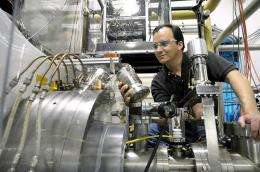
Engineer Richard Vondrasek installs a new turbo pump on the Californium Rare Isotope Breeder Upgrade (CARIBU). CARIBU reached world record efficiencies for ionization efficiency of solids.
(PhysOrg.com) -- Scientists at the U.S. Department of Energy’s Argonne National Laboratory have pushed the limits of charge breeding and broken a long-standing world record for ionization efficiency of solids.
Argonne's Californium Rare Isotope Breeder Upgrade (CARIBU) project has reached 11.9 percent efficiency with metallic particles of rubidium. The previous metal record was 6.5 percent, using potassium, achieved at Laboratory of Subatomic Physics and Cosmology (LPSC) in Grenoble.
“There have been several improvements made that increased efficiency little by little until we finally reached record numbers, and we foresee even higher efficiencies in the future,” said senior accelerator physicist Richard Pardo.
Beams of stable isotopes from elements across the entire periodic table have been used at the Argonne Tandem-Linac Accelerator System (ATLAS) for research in nuclear physics for many years.
But when additional protons or neutrons are added to originally stable isotopes, the nuclei eventually become 'particle unstable', emitting excess protons or neutrons. Neutrons, unlike protons and electrons, have no charge; therefore, many more can be added to a nucleus before it becomes unstable.
The CARIBU project will extend ATLAS's reach to include potentially hundreds of previously unstudied isotopes.
CARIBU will use californium-252 to create neutron-rich heavy fission fragments at a rate of more than one billion per second. These fragments are thermalized in helium gas and converted into a low-energy beam of singly charged ions.
The charge breeder, an electron cyclotron resonance (ECR) ion source, takes these beams, stops them in the plasma and strips them to higher-charged states for reacceleration in ATLAS.
Scientists used two radio frequencies (RF) to excite the plasma in the ECR source. This resulted in the creation of higher charge states and improved efficiency. They also injected the RF radially into the source using an open—versus a closed—hexapole structure. This allowed for higher magnetic confinement of the hot plasma, as well as more uniform field gradients.
“Fundamentally, there are limits to how high an efficiency you can get in a charge breeder, but we can expect a 20-30 percent improvement of current numbers,” said Argonne principal engineer Richard Vondrasek.
So far, CARIBU has only used stable metal ions for charge breeding, but testing has just begun using the radioactive isotopes from the californium source.
CARIBU is an Accelerator Improvement Project funded by the U.S. Department of Energy’s Office of Science.
-
Argonne scientists reach milestone in accelerator upgrade project
Jan 06, 2009 |
not rated yet |
0
-
New component design could reduce cost of proposed Facility for Rare Isotope Beams
Feb 11, 2008 |
not rated yet |
0
-
Argonne, Notre Dame begin new nuclear theory initiative
Oct 05, 2005 |
not rated yet |
0
-
Argonne aiming for isotope lab
Jun 21, 2007 |
not rated yet |
0
-
Seeking Answers to the Puzzle of Proton Spin
Apr 24, 2006 |
not rated yet |
0
-
Engineers build first sub-10-nm carbon nanotube transistor
Feb 01, 2012 |
4.9 / 5 (30) |
30
-
Something old, something new: Evolution and the structural divergence of duplicate genes
Jan 31, 2012 |
4.6 / 5 (7) |
1
-
The hidden nanoworld of ice crystals: Revealing the dynamic behavior of quasi-liquid layers
Jan 30, 2012 |
5 / 5 (3) |
1
-
Stock market network reveals investor clustering
Jan 27, 2012 |
3.9 / 5 (23) |
8
-
Of microchemistry and molecules: Electronic microfluidic device synthesizes biocompatible probes
Jan 26, 2012 |
5 / 5 (1) |
0
-
Rubber production is likely to gradually reduce
3 hours ago
-
Help! Physics Momentum/Impulse problem!
3 hours ago
-
Gauss' law cubes, how to prove
5 hours ago
-
A grandfather pulls his granddaughter, whose mass is 20.5 kg
6 hours ago
-
what is significance of torque
6 hours ago
-
Difference between volume displaced fluid and volume of the object
7 hours ago
- More from Physics Forums - General Physics
More news stories
Explained: Sigma
It's a question that arises with virtually every major new finding in science or medicine: What makes a result reliable enough to be taken seriously? The answer has to do with statistical significance -- but ...
20 hours ago |
5 / 5 (12) |
30
Borexino Collaboration succeeds in spotting pep neutrinos emitted from the sun
(PhysOrg.com) -- To learn more about how the sun works, scientists study particles that are emitted from it into space due to thermonuclear reactions that occur inside; by applying known physics principles, ...
Physics research suggests new pathways for cancer progression
Observing that certain cancer cells may exhibit greater flexibility than normal cells, some scientists believe that this capability promotes rapid tumor growth. Now computer simulations developed by Boston University Biomedical ...
18 hours ago |
5 / 5 (1) |
0
Quantum physicist explains $100K offer for proof scaled-up quantum computing is impossible
(PhysOrg.com) -- MIT researcher Scott Aaronson has certainly riled the physics community with his offer this past Friday, of $100,000 to anyone who can prove that scaled-up quantum computing is impossible. ...
Physicists 'record' magnetic breakthrough
An international team of scientists has demonstrated a revolutionary new way of magnetic recording which will allow information to be processed hundreds of times faster than by current hard drive technology.
Feb 07, 2012 |
4.5 / 5 (39) |
14
|
'Dark plasmons' transmit energy
Microscopic channels of gold nanoparticles have the ability to transmit electromagnetic energy that starts as light and propagates via "dark plasmons," according to researchers at Rice University.
FDA-approved drug rapidly clears amyloid from the brain, reverses Alzheimer's symptoms in mice
Neuroscientists at Case Western Reserve University School of Medicine have made a dramatic breakthrough in their efforts to find a cure for Alzheimer's disease. The researchers' findings, published in the journal Science, show t ...
Hydrogen from acidic water: Researchers develop potential low cost alternative to platinum for splitting water
A technique for creating a new molecule that structurally and chemically replicates the active part of the widely used industrial catalyst molybdenite has been developed by researchers with the Lawrence Berkeley ...
Ultraviolet protection molecule in plants yields its secrets
Lying around in the sun all day is hazardous not just for humans but also for plants, which have no means of escape. Ultraviolet (UV) radiation from the sun can damage proteins and DNA inside cells, leading ...
Soraa LED light may dim 50-watt halogen rivals
(PhysOrg.com) -- Soraa, a Fremont, California company founded in 2008, this week launched its first product, a light that uses LEDS (light emitting diodes). The "Soraa LED MR16 lamp" is the "perfect" replacement ...
Anyone can learn to be more inventive, cognitive researcher says
There will always be a wild and unpredictable quality to creativity and invention, says Anthony McCaffrey, a cognitive psychology researcher at the University of Massachusetts Amherst, because an "Aha moment" is rare and ...