Studies agree on a 1 meter rise in sea levels
April 13, 2010
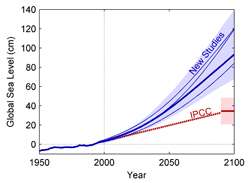
Recent studies agree that sea level will rise by roughly one meter over this century for a mid-range emission scenario. This is 3 times higher than predicted by the IPCC.
New research from several international research groups, including the Niels Bohr Institute at the University of Copenhagen provides independent consensus that IPCC predictions of less than a half a meter rise in sea levels is around 3 times too low. The new estimates show that the sea will rise approximately 1 meter in the next 100 years in agreement with other recent studies. The results have been published in the scientific journal, Geophysical Research Letters.
Since IPCC published the predictions in 2007, that the sea would rise less than half a metre in the next 100 years, it became clear that there was a problem with the prediction models as they did not take into account the dynamic effects of the melting ice sheets. The estimates were therefore too low.
Better prediction models
However, the new model estimates, from international research groups from England, China and Denmark, give independent support for the much higher predictions from other recent studies.
”Instead of using temperature to calculate the rise in sea levels, we have used the radiation balance on Earth - taking into account both the warming effect of greenhouse gasses and the cooling effect from the sulfur clouds of large volcanic eruptions, which block radiation”, explains Aslak Grinsted, PhD in geophysics at the Centre for Ice and Climate, the Niels Bohr Institute at the University of Copenhagen.
The research is based on observations of sea levels from the 1700s to the present and estimates of the radiation balance through approximately 1000 years.
The sun’s heat varies periodically and currently there is a solar minimum, but even if solar radiation were to reach its lowest level in the past 9300 years, it will have only a minimal impact on sea levels. Some have suggested that you could inject sulfur into the atmosphere and get a kind of artificial volcanic eruption cooling effect, but the calculations show that it would only slow down the rise in sea levels for 12-20 years. What are important are greenhouse gasses like CO2, the research shows.
Reduced emissions
The results are that the sea level will rise between 0.7 and 1.2 meters during the next 100 years. The difference depends on what mankind does to stop the emission of greenhouse gases into the atmosphere. If we seriously reduce the emissions of CO2 globally, the sea will only rise 0.7 meters, while there will be a dramatic rise of 1.2 meter if we continue indifferent with the current use of energy based on fossil fuels.
In the calculations the researchers assume that we continue to emit CO2, but that we move more towards other energy supplies and reduce our use of fossil fuels and with that reduce the emission of greenhouse gases. This scenario would give a rise in sea levels of around 1 meter.
Other energy sources important now
Even a one meter rise in sea levels would have a big impact in some places in the world with low lying areas, which will become much more susceptible to extreme storm surges, where water could easily sweep over the coasts.
”The research results show that it is therefore important to do something now to curb the emission of CO2 - there is about a half meter difference in sea level depending on whether nations of the world continue to pump greenhouse gases from fossil fuels into the atmosphere or whether we slam on the brakes and use other energy sources”, explains Aslak Grinsted.
More information: Paper: http://dx.doi.org/ … 2010GL042947
Provided by Niels Bohr Institute
-
Sea level rise of 1 meter within 100 years
Jan 08, 2009 |
not rated yet |
0
-
Impact of sea-level rise on atmospheric CO2 concentrations
Jan 13, 2009 |
not rated yet |
0
-
Report warns of rise in Mediterranean
Jan 20, 2008 |
not rated yet |
0
-
Rising sea levels set to have major impacts around the world
Mar 10, 2009 |
not rated yet |
0
-
New predictions for sea level rise
Jul 27, 2009 |
not rated yet |
0
-
Engineers build first sub-10-nm carbon nanotube transistor
Feb 01, 2012 |
4.9 / 5 (31) |
30
-
Something old, something new: Evolution and the structural divergence of duplicate genes
Jan 31, 2012 |
4.6 / 5 (7) |
1
-
The hidden nanoworld of ice crystals: Revealing the dynamic behavior of quasi-liquid layers
Jan 30, 2012 |
5 / 5 (3) |
1
-
Stock market network reveals investor clustering
Jan 27, 2012 |
3.9 / 5 (23) |
8
-
Of microchemistry and molecules: Electronic microfluidic device synthesizes biocompatible probes
Jan 26, 2012 |
5 / 5 (1) |
0
-
Discrepancy between oxygen and carbon-dioxide levels
21 hours ago
-
where gems are found in the world
Feb 09, 2012
-
Wind Waves in Reservoir ~ Wind run-up and Wind set-up
Feb 08, 2012
-
Balance of oxygen in the atmosphere
Feb 01, 2012
-
The case for a methanol-based economy
Jan 30, 2012
-
Weather in a rotating cylinder
Jan 25, 2012
- More from Physics Forums - Earth
More news stories
NASA sees wide-eyed cyclone Jasmine
Cyclone Jasmine's eye has opened wider on NASA satellite imagery, as it moves through the Southern Pacific Ocean.
Space & Earth / Earth Sciences
2 hours ago |
not rated yet |
1
NASA sees Giovanna reach cyclone strength, threaten Madagascar
Tropical Storm 12S built up steam and became a cyclone on February 10, 2012 as NASA's Terra satellite passed overhead. Residents of east-central Madagascar should prepare for this cyclone to make landfall ...
Space & Earth / Earth Sciences
2 hours ago |
not rated yet |
0
Humans may have helped the decline of African rainforests 3000 years ago
(PhysOrg.com) -- Large areas of rainforests in Central Africa mysteriously disappeared over three thousand years ago, to be replaced by savannas. The prevailing theory has been that the cause was a change ...
Could Venus be shifting gear?
(PhysOrg.com) -- ESAs Venus Express spacecraft has discovered that our cloud-covered neighbour spins a little slower than previously measured. Peering through the dense atmosphere in the infrared, the ...
Space & Earth / Space Exploration
10 hours ago |
5 / 5 (7) |
7
|
Mars Science Laboratory computer issue resolved
(PhysOrg.com) -- Engineers have found the root cause of a computer reset that occurred two months ago on NASA's Mars Science Laboratory and have determined how to correct it.
Space & Earth / Space Exploration
11 hours ago |
4.7 / 5 (6) |
3
|
Google users warned of threat to smartphone wallets
Users of Google smartphone wallets were being warned on Friday that there is a way to crack pass codes intended to thwart thieves from going on illicit shopping sprees.
Anonymous knocks CIA website offline (Update)
The website of the Central Intelligence Agency was inaccessible on Friday after the hacker group Anonymous claimed to have knocked it offline.
Complex wiring of the nervous system may rely on a just a handful of genes and proteins
Researchers at the Salk Institute have discovered a startling feature of early brain development that helps to explain how complex neuron wiring patterns are programmed using just a handful of critical genes. ...
Putting the squeeze on planets outside our solar system
(PhysOrg.com) -- Using high-powered lasers, scientists at Lawrence Livermore National Laboratory and collaborators discovered that molten magnesium silicate undergoes a phase change in the liquid state, abruptly ...
New error-correcting codes guarantee the fastest possible rate of data transmission
Error-correcting codes are one of the triumphs of the digital age. Theyre a way of encoding information so that it can be transmitted across a communication channel such as an optical fiber o ...
The power of estrogen -- male snakes attract other males
A new study has shown that boosting the estrogen levels of male garter snakes causes them to secrete the same pheromones that females use to attract suitors, and turned the males into just about the sexiest ...
Apr 13, 2010
Rank: 1.7 / 5 (12)
Apr 13, 2010
Rank: 2.3 / 5 (9)
Apr 13, 2010
Rank: 4.6 / 5 (8)
Apr 13, 2010
Rank: 2 / 5 (4)
Apr 13, 2010
Rank: 4 / 5 (1)
And 3 years from now?
How about a worst case scenario so that people can make a more informed decision on where to ive in the future.
Apr 14, 2010
Rank: 1 / 5 (3)
no bearing whatsoever... despite what our emotions tell us.
anytime that science pretends to assert such a level of something, then it has somethig else tied to it forcing it to.
The church after causing the invention of science, forced by the philosophers to backtrack to preserve THEIR status as the arbiters of reality (as they are asserting today), sought to use such consensus to unseat Galileo. And ultimately then unseat empirical validation as the ultimate arbiter, putting group consensus over philosophical whit born in a nutshell believing in infinite space and ability
Apr 14, 2010
Rank: 5 / 5 (3)
I can't wait until we have some actual observational evidence as opposed to anecdotal evidence and modeling to accompany the hypothesis. Being able to plan ahead would be very useful regardless of whatever other actions we take to prevent sea level rise, if it's an issue.
Apr 14, 2010
Rank: 3 / 5 (3)
Yes!
Apr 14, 2010
Rank: 1.8 / 5 (5)
Apr 14, 2010
Rank: 3.2 / 5 (5)
You're right, 1 meter over the next century is wrong. We will be lucky if it's only meter. Expect to see a significant rise by mid-century. The only way that won't happen is if something else we don't know about yet offsets it. There are too many luddites like you who haven't got the sense or education to believe scientists unless it suits them.
Apr 14, 2010
Rank: 1 / 5 (4)
Apr 14, 2010
Rank: 5 / 5 (2)
So sad, yet so true.
Apr 14, 2010
Rank: 1 / 5 (4)
Apr 14, 2010
Rank: 3 / 5 (4)
Apr 17, 2010
Rank: 1 / 5 (4)
Apr 18, 2010
Rank: 4 / 5 (2)
The use of unusually cheap fossil fuels for 150 years has upset the balance; for example, something like five to ten calories of fossil fuel are needed to grow and distribute each calorie of food energy. Depending on fossil fuels indefinitely is therefore an extremely bad idea, because their cost of recovery is rising rapidly and this will result in food shortages.
Wealthy nations will buy themselves out of the problem for a time, while they watch the less fortunate starve to death in other places...until those masses start arriving at the border.
We can argue about the cause of global warming all we want, but the ice is clearly melting; fresh water sources are under threat; and the breadbaskets of the world are in decline. Food production per capita peaked in the 1980's. More and more countries are becoming net imports of food (and fossil fuels).
Apr 19, 2010
Rank: 1 / 5 (2)
Thomas Malthus reborn...
eruditism doesnt make stupid things smart, it just makes them SEEM smart, they are still stupid things.
we have technology and we can apply it if is economical. if electricity was 1/1000th the cost it is now, due to 'control' by states attemting to contrl through regression... then things like multistory farmscrappers become possible as solar energy and farm land would be too expensive given the cost or energy...
imagine a space the size of the houston astrodom 30 stories high, running with its own thorium reactor (not uranium). now imagine a 1000 of them...
whats stopping us?
GREENIES.... Luddittes... Malthusians..
who somehow think that we can run out of something we are only moving around... (cant destroy it, can only move it around).
sheesh...
Apr 19, 2010
Rank: 1 / 5 (1)
"...if it is economical." ...NOT
The point I was making was to not get lost in small arguments sustained by TV pundits, who want to distract you from thinking and acting on the big picture and the real issues. Nature can not be fooled.
Apr 19, 2010
Rank: 5 / 5 (1)
That is an interesting view - but a few hundred years out of date. Yes,mass and energy cannot be destroyed by ordinary chemical or mechanical means. However, as you use energy to produce work you increase entropy (second law of thermodynamics says you can never break even). So, you are not correct in saying that a solution is easy and only Luddites would miss the simple approach. The reality is that energy is not easy and not cheap. We can do clever things to extend our use of energy and reduce emissions, but your proposal is not the simple plan you think it is. Please read a good thermodynamics book before your next post along these lines.
Apr 19, 2010
Rank: not rated yet
Apr 19, 2010
Rank: 1 / 5 (1)
I worked with molecular biologists for 15 years, the vast majority of whom sincerely believe that a food crisis can only be averted in this century by the public's wholesale acceptance of genetically engineered food crops--this being seen as the only way to continue to boost yield per acre. That's the next step.
Creation of large structures to grow food is capital and energy intensive. Thorium breeder reactors create U233 and thus nuclear proliferation concerns. Growing food in engineered structures using nuclear energy vs. free sunlight does not produce a food source cheap enough to feed the half of humanity that subsists on a dollar a day. Private enterprise will not see it as good for their shareholders to service this market. (I'm an ex-CEO, not a socialist.)
Apr 20, 2010
Rank: 1 / 5 (2)
now that is a leap!!!
a nonsensical one where someone has learned enough to wow people even more ignorant than they are.
first, the laws of thermodynamics are a SPECIAL CASE, that is they are not applicable to open systems, nor are they applicable to non homogeneous systems (there was a lovely scientific American article on it in the past two years. sorry you missed it).
as for the second part, you prove my point that only a luddite would see that way.
there is a company in nj that puts garbage through a plasma oven. that is they raise the temperature so high, that ALL THE ATOMS DISSOCIATE, and they end up with raw materials.
in a VERY short time, the richest mines will be garbage dumps!!!
Apr 20, 2010
Rank: 5 / 5 (1)
Until you add 0.01% cesium making the materials all but useless in nuclear weaponry.
Apr 20, 2010
Rank: 1.5 / 5 (2)
You’re an idiot pretending to be smart, by being smarmy. How’s that for erudite?
Anyway. I would suggest YOU do the same, as I went through all that stuff in grade school (not high school, not college GRADE SCHOOL). I attended Bronx Science a year early, with my major in theoretical physics. BUT THAT’S NOT WHY YOU SHOULD LISTEN TO ME!!
Thorium is a naturally occurring, slightly radioactive metal. It is estimated to be about three to four times more abundant than uranium in the Earth's crust. It has been considered a waste product in mining rare earths, so its abundance is high and cost low.
Advocates of the use of thorium as the fuel source for nuclear reactors state that they can be built to operate significantly cleaner than uranium based power plants as the wast
Apr 20, 2010
Rank: 1 / 5 (1)
So in essence there IS abundant energy technology, your leaders just won’t let you use it.
The reactors THEY favor make nuclear weapons, of which thorium cant. How’s that for reading a thermodynamics book?
In less than 5 years we could quadruple the nuclear capacity of the United States, drop by HUGE amounts the usage of bad coal, as things shift to cleaner coal. Pre treating coal becomes cheap enough. So why not?
They want to mine the metal hydrates at the ocean beds, which by the way is more dangerous than nuclear reactors.
Apr 20, 2010
Rank: 4 / 5 (1)
Methane Hydrates (clathrates),
But otherwise, spot on.
Apr 20, 2010
Rank: 3 / 5 (1)
from wiki...
And methanol is often sold as “methyl hydrate”, implying an incorrect formula CH3OH2, although the correct formula is CH3–OH.
and
Gas hydrates are clathrate hydrates (a class of solid hydrates of gases): water ice with gas molecules trapped within. When the gas is methane it is called a methane hydrate.
:)
sorry guys! and thanks again skeptic heretic..
Apr 20, 2010
Rank: 2.3 / 5 (3)
however, the worst toxic waste is not a problem if you throw it to the sun. (some greenie will now moan, we are going to pollute the sun. don't worry, it would probably never reach the surface)
the idea of storing nuclear waste for 5000 years, or some crazy number makes no sense on the dawn of free market access to the solar system! (easier to make a vessel that wont break on re-entry accident than to make one to last 5k pluse years in a hole)
so even if we use the nasty stuff, the reduction in energy would allow for such things to be thrown into space at reduced energy, and the planet would be cleaner.
not to mention a solar system of raw materials, and manufacture the worst stuff in space, venting gas to the cosmos.
Apr 20, 2010
Rank: 5 / 5 (1)
Why would you ever want to do that? In only a few hundred years the "waste" can be sorted for usables like gold, platinum, palladium, etc.
Secondly, our "waste" is highly fissible still and can be used in other type reactors.
Apr 20, 2010
Rank: 3 / 5 (2)
I ran some numbers on your idea to build huge nuclear powered structures to grow all the food the world will need in the future.
According to:
http://seedmagazi...or_land/
the world loses 50 million acres of arable land per year to urbanization etc. So just to break even, and assuming construction costs of $100/sq-foot, that's 218 trillion dollars per year--just to break even. That does not begin to account for what actually needed for expected population growth.
Please note that last year, according to CIA World Factbook, the global GDP--the total wealth created by all economic activity on the planet--last year was about 58 trillion dollars.
I asked you what your idea would do to the price of a Big Mac. Now you know. Do you have a Plan B? After all, my construction cost estimate doesn't even count the costs to build, run, and later dismantle the nuclear plants, nor the cost to maintain the structures you have in mind.
May 03, 2010
Rank: 1 / 5 (1)
yeah.. i would suspect that a MORON would bend and pervert what i am saying to ridiculouslness... (and if i did the same thing to his point its even MORE ridiculous!)
let me point out the main point of his stupid.
do you want to know where your hydroponic perfect tomatoes you buy are from? did you know you can get up to 6 crops a year, rather than 3-4 in tropical zones, and 1-2 moving north.
so if you have a building 20 stories high, and only covering one acre...
it would be equal to 120 acres...
now. point out that this building can be built UNDER GROUND in any city. and that it would reduce the transport of goods. gone from your equation is shipping strawberries
May 03, 2010
Rank: 3.7 / 5 (3)
did your calculations include ALL THAT?
of course not, as your not smart, you pretend to be samrt, and you pretend to do an accounting.
but lets see... obamas new increase in budget if put to nuclear reactors at 10 billion each...
would have more than doubled the energy capacity of the US!!!
and COSTS of EVERTHING are connected. so reduced energy for food, means the energy can go someplace else. you will let business figure out what to do. but prices would go DOWN..
a 100 acre regular farm would only put out 115 bushels (bu) per acre..
go here ag.arizona.edu/hydroponictomatoes/overview.htm
and yuou will see that if it was not for our holding energy back we would produce this way! (but no crisis for communists to use)