As honeybee colonies collapse, can native bees handle pollination?
April 13, 2010 by David Tenenbaum
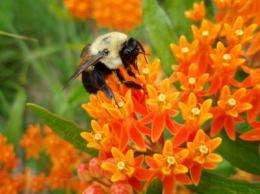
The bumblebee, shown here visiting a flowering native milkweed plant, is one of about 400 native pollinators, mainly solitary bees, which are active in Wisconsin. Entomologists at UW-Madison say preserving habitat in prairies and savannas can sustain native bee populations and help pollination, even if colony collapse disorder continues to damage honeybee hives. Photo: courtesy Hannah Gaines
(PhysOrg.com) -- With colony collapse disorder continuing to plague commercial beekeepers in many parts of the country, University of Wisconsin-Madison experts are studying whether native pollinators can supply the insect pollination needed to form many fruits.
While honeybees are social insects that live in large colonies, or hives, most native pollinators are solitary bees that nest in the ground or inside vegetation. Although the natives cannot be trucked into fields like honeybees, they do not suffer colony collapse. Studies elsewhere show that native pollinators can play a major role in sustaining such pollination-dependent crops as watermelon and cranberry.
Entomologists say that although the collapse seems less dire in Wisconsin, honeybees are still declining.
"If you look at some of the comments about colony collapse, you'd think the end of world was coming, and that this was a new problem," says Phillip Pellitteri, a distinguished faculty associate in the insect diagnostic lab, "but honeybees have been on a decline for three decades for a litany of reasons."
As the bee business has consolidated, and started to emphasize pollination rather than honey production, new insect pests and diseases have made beekeeping more work than it used to be, and pushed some marginal producers out of business, Pellitteri says.
Still, Pellitteri says most of the collapse seems associated with migratory beekeeping.
"I've heard reports of up to 90 percent losses in the almond groves in California," where semi-trailer loads of hives are trucked in from around the country just before the trees flower, he says. The stress of long journeys may be impairing the bees' immune system, making them vulnerable to exotic viruses.
In Wisconsin, where migratory beekeeping is less common, crops like cucumber, cranberry and apples require bees, as do many popular prairie and garden plants.
Colony collapse is less clear-cut in Wisconsin, Pellitteri says. When a hive dies out, "There is no diagnostic test to confirm whether it is collapse or something else. There's always a question, is it one of the mites or another familiar problem?"
The threat or reality of colony collapse has certainly focused attention on native pollinators. About 4,000 species of bees, most of them solitary, are known to pollinate plants in the United States, Pellitteri says.
"Under the right circumstances, natives pollinators can do a lot of benefit, but you can't manipulate them like honeybees. You can't throw them on a truck and move them across country to get pollination services," he says.
Pellitteri says native pollinators are a "much bigger pool than most people think, with about 400 species in Wisconsin," including bumblebees and the more obscure squash bees and leaf cutter bees.
Hannah Gaines, a Ph.D. student in the entomology department at UW-Madison, is studying native pollinators in Wisconsin's cranberry crop, the nation's largest. Although cranberry growers routinely rent honeybees to do the pollinating, relying on native pollinators could cut costs.
Studies of pollination in New Jersey showed that native bees are actually more efficient than honeybees at pollinating cranberries. Gaines says other studies have found that native pollinators can handle watermelon pollination in California, in fields where sufficient natural habitat exists within 1 kilometer.
Gaines is studying how the nature of the surrounding landscape affects pollination in the Wisconsin cranberry bogs, located between Tomah and Wisconsin Rapids. During 2008, she collected 108 species of native bees, and found that both abundance and diversity increased along with the amount of nearby natural habitat.
"Cranberry growers in Wisconsin are very open to the idea of using native pollination," she says, "but none of the big growers are ready to get rid of honeybees yet, and use natives exclusively."
Native pollinators should get a boost from the federal Environmental Quality Incentives Program, which supports landscape conservation, says Gaines. "We're hoping to find growers to participate, to put in strips and plots of native perennial, flowering plants, as habitat for bee nests, and to provide floral resources when the crops are not in bloom."
"Native bee conservation is habitat conservation," she says.
"You can't have native pollinators with a bunch of parking lots," adds Pellitteri. "You have to promote patches of native ground, flowers, prairie or oak savanna, so the bees have a food source and habitat to nest in the ground."
-
Bee research shows benefits of native plants, wild bees
Jan 14, 2010 |
not rated yet |
0
-
Bumblebees dive in to fill a void
Sep 02, 2009 |
not rated yet |
0
-
Honeybees are on the rise but demand grows faster
May 07, 2009 |
not rated yet |
0
-
Bee species outnumber mammals and birds combined
Jun 11, 2008 |
not rated yet |
0
-
Penn State researchers promote pollinator-friendly native gardens
Oct 19, 2009 |
not rated yet |
0
-
Engineers build first sub-10-nm carbon nanotube transistor
Feb 01, 2012 |
4.9 / 5 (30) |
30
-
Something old, something new: Evolution and the structural divergence of duplicate genes
Jan 31, 2012 |
4.6 / 5 (7) |
1
-
The hidden nanoworld of ice crystals: Revealing the dynamic behavior of quasi-liquid layers
Jan 30, 2012 |
5 / 5 (3) |
1
-
Stock market network reveals investor clustering
Jan 27, 2012 |
3.9 / 5 (23) |
8
-
Of microchemistry and molecules: Electronic microfluidic device synthesizes biocompatible probes
Jan 26, 2012 |
5 / 5 (1) |
0
-
Pertubance in a model
4 hours ago
-
Cancer drugs and Alzheimer's, Oh my!
12 hours ago
-
Squishing cells
12 hours ago
-
Any books/articles for evolutionary stable strategy models in humans?
Feb 09, 2012
-
Science behind the bore feeling?
Feb 09, 2012
-
Homo Sapien vs. Chimpanzee - Divergence Timeline
Feb 09, 2012
- More from Physics Forums - Biology
More news stories
The power of estrogen -- male snakes attract other males
A new study has shown that boosting the estrogen levels of male garter snakes causes them to secrete the same pheromones that females use to attract suitors, and turned the males into just about the sexiest ...
2 hours ago |
not rated yet |
0
|
Experts reveal how plants don't get sunburn
(PhysOrg.com) -- Experts at the University of Glasgow have discovered how plants survive the harmful rays of the sun.
2 hours ago |
5 / 5 (2) |
0
|
Protein libraries in a snap
(PhysOrg.com) -- A Rice University undergraduate will depart with not only a degree but also a possible patent for his invention of an efficient way to create protein libraries, an important component of biomolecular ...
5 hours ago |
5 / 5 (1) |
0
|
New drugs schedule makes horse racing a sure thing
What do Gai Waterhouse and Anthony Cummings have in common with Queen Elizabeth II?
2 hours ago |
not rated yet |
0
Miami battling invasion of giant African snails
No one knows how they got there. But an invasion of African giant snails has southern Florida in a panic over potential crop damage, disease and general yuckiness surrounding the slimy gastropods.
6 hours ago |
not rated yet |
2
New understanding of DNA repair could eventually lead to cancer therapy
A research group in the Faculty of Medicine & Dentistry at the University of Alberta is hoping its latest discovery could one day be used to develop new therapies that target certain types of cancers.
Zuckerberg's focus drives Facebook's ascent
When Mark Zuckerberg showed up to rent Judy Fusco's Los Altos, Calif., house in the fall of 2004, soon after he'd arrived in Silicon Valley, the landlord was immediately struck by his confidence.
Antidepressants and pregnancy: Women must consider the impact of drugs on baby, and of depression on baby, themselves
Upon learning they are pregnant, most women dutifully nix the alcohol, sushi and caffeine. But what about antidepressants?
Both maternal and paternal age linked to autism
Older maternal and paternal age are jointly associated with having a child with autism, according to a recently published study led by researchers at The University of Texas Health Science Center at Houston (UTHealth).
Night, weekend delivery OK for babies with birth defects
Weekday delivery is no better than night or weekend delivery for infants with birth defects, according to a new study presented today at The Pregnancy Meeting, the Society for Maternal-Fetal Medicine's annual conference. ...
From virginity to Viagra
Americans will spend more than $17 billion on Valentine's Day, but far less on programs like sex education for adolescents. The editors of the new book, Sex for Life, From Virginity to Viagra, How Sexuality Changes Throughout ...
Apr 14, 2010
Rank: not rated yet
http://www.foxnew...,00.html
http://en.wikiped...syndrome
All these animals are feeding by pollens of GMO plants, which contain toxins of Bacillus thuringiensis, which is very close to anthrax pathogens (Bacillus anthracis) both morphologically, both genetically, so especially high risk of coincidence in immune reactions (i.e. allergies) exists here. These allergies are making bees, bumblebees and bats more vulnerable to another parasites and fungi.