Printed origami offers new technique for complex structues
April 14, 2010
Printed origami offers new technique for complex structues

Enlarge

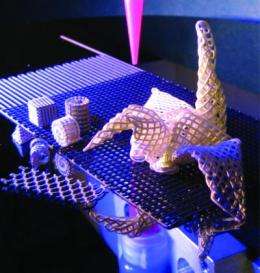
These structures were folded from flat sheets of direct-printed titanium hydride ink, a new technique pioneered by University of Illinois researchers. Credit: Bok Yoep Ahn

Although it looks small and unassuming, the tiny origami crane sitting in a sample dish in University of Illinois professor Jennifer Lewis' lab heralds a new method for creating complex three-dimensional structures for biocompatible devices, microscaffolding and other microsystems. The penny-sized titanium bird began as a printed sheet of titanium hydride ink.

The team will publish their novel technique in the April 14 online edition of the journal .

Small, intricate shapes made of metals, ceramics or polymers have a variety of applications, from biomedical devices to electronics to rapid prototyping. One method of fabricating such structures is by direct-write assembly, which the Lewis group helped pioneer. In this approach, a large printer deposits inks containing metallic, ceramic or plastic particles to assemble a structure layer by layer. Then, the structure is annealed at a high temperature to evaporate the liquid in the ink and bond the particles, leaving a solid object.

However, as more layers are added, the lower layers tend to sag or collapse under their own weight - a problem postdoctoral researcher Bok Yeop Ahn encountered while trying to manufacture titanium scaffolds for . He decided to try a different approach: Print a flat sheet, then roll it up into a spiral - or even fold it into an assortment of shapes.

Folding the printed sheets is not as easy as it would first seem.

"Most of our inks are based on aqueous formulations, so they dry quickly. They become very stiff and can crack when folded," said Lewis, the Thurnauer Professor of Materials Science and Engineering and the director of the university's Frederick Seitz Materials Research Laboratory. The challenge, then, was to find a solution that would render the printed sheets pliable enough to manipulate yet firm enough to retain their shape after folding and during annealing.

Lewis, Ahn and their research team solved the problem by mimicking
wet-folding origami, in which paper is partially wetted to enhance its foldability. By using a mixture of fast-drying and slow-drying solvents in the ink, the sheet dries partway but stays flexible enough to fold through multiple steps - 15, in the case of the crane.

The U. of I. researchers worked with professor David Dunand, the James and Margie Krebs Professor of Materials Science at Northwestern University, who initially approached Lewis with the possibility of titanium hydride inks. "I knew how to transform hydride into metallic titanium without contamination from the ink, based on prior research in my lab," said Dunand, who focused on annealing the soft, titanium hydride origami structures into strong, metallic titanium objects.

The marriage of printing and origami techniques allows for greater structural complexity - such as the crane's overhanging wings, a feature not producible by direct printing methods alone. In addition, Lewis' team can print sheets with a variety of patterns, adding yet another level of architectural detail.

"By combining these methods, you can rapidly assemble very complex structures that simply cannot be made by conventional fabrication methods," Lewis said.

Next, the team hopes to expand its origami repertoire to include much larger and much smaller structures, with an expanding array of inks. For example, the method can be extended to a variety of other ceramics and metals ranging from steels to nickel- and cobalt-based alloys to refractory and noble metals, according to Dunand.

The researchers also plan to explore possible applications including lightweight structures, biomedical devices, sensors and more.

"We've really just begun to unleash the power of this approach," Lewis said.

Provided by University of Illinois at Urbana-Champaign (news : web)

4.7 /5 (13 votes)  

Filter


Move the slider to adjust rank threshold, so that you can hide some of the comments.


Display comments: newest first

ralph_wiggum
Apr 14, 2010

Rank: not rated yet
Who or what is doing the folding and assembly of the printed sheets? If it's a bunch of graduate students, then this isn't much of a breakthrough. If it's computerized, then that's a more interesting technology in itself than the printing.
AdrianMiller
Apr 20, 2010

Rank: not rated yet
If anyone is interested in more information on the science behind this discovery, I'm an editor with Advanced Materials, and we've set the original scientific paper free to access for a limited time; you can see it here: http://www.materi...ami.html

Also, feel free to ask me any questions! ralph_wiggum, to answer yours, nobody has to fold the patterns; their size is such that after fabrication they will deform into shape based on how you let them dry.
Rank 4.7 /5 (13 votes)
Relevant PhysicsForums posts
  • Stoichiometry
    createdFeb 10, 2012
  • Boiling and melting point of impure substances
    createdFeb 10, 2012
  • Safe nitrogen compound to decompose a 500 deg C in a furnace?
    createdFeb 09, 2012
  • [ask]electron inside drinking water
    createdFeb 08, 2012
  • How to avoid formation of Lithium Chromate ???
    createdFeb 08, 2012
  • how to choose a reduced or oxidated form in a redox
    createdFeb 08, 2012
  • More from Physics Forums - Chemistry

More news stories

Fool's gold may prove an unlikely alternative to overexploited catalytic materials

Catalytic materials, which lower the energy barriers for chemical reactions, are used in everything from the commercial production of chemicals to catalytic converters in car engines. However, with current catalytic materials ...

Chemistry / Materials Science

created 15 hours ago | popularity 4.4 / 5 (8) | comments 5 | with audio podcast

Unpicking HIV’s invisibility cloak

Drug researchers hunting for alternative ways to treat human immunodeficiency virus (HIV) infections may soon have a novel target—its camouflage coat. HIV hides inside a cloak unusually rich in a sugar ...

Chemistry / Biochemistry

created 15 hours ago | popularity 5 / 5 (5) | comments 0

Hydrogen from acidic water: Researchers develop potential low cost alternative to platinum for splitting water

A technique for creating a new molecule that structurally and chemically replicates the active part of the widely used industrial catalyst molybdenite has been developed by researchers with the Lawrence Berkeley ...

Chemistry / Materials Science

created Feb 09, 2012 | popularity 4.8 / 5 (14) | comments 15 | with audio podcast

No entry without protein recycling: Researchers discover new coherence in enzyme transport

The group of Prof. Dr. Ralf Erdmann at the Ruhr-Universität Bochum, Germany, discovered a connection of peroxisomal protein import and receptor export. In the Journal of Biological Chemistry, they disclo ...

Chemistry / Biochemistry

created 15 hours ago | popularity not rated yet | comments 0

Under the microscope #7

In this video Dr Ingrid Graz shows us a thin layer of gold on top of rubber. Cracks in the gold allow it to stretch and we can use this for stretchable electronics.

Chemistry / Other

created 17 hours ago | popularity not rated yet | comments 0


Anonymous knocks CIA website offline (Update)

The website of the Central Intelligence Agency was inaccessible on Friday after the hacker group Anonymous claimed to have knocked it offline.

Google users warned of threat to smartphone wallets

Users of Google smartphone wallets were being warned on Friday that there is a way to crack pass codes intended to thwart thieves from going on illicit shopping sprees.

New error-correcting codes guarantee the fastest possible rate of data transmission

Error-correcting codes are one of the triumphs of the digital age. They’re a way of encoding information so that it can be transmitted across a communication channel — such as an optical fiber o ...

Humans may have helped the decline of African rainforests 3000 years ago

(PhysOrg.com) -- Large areas of rainforests in Central Africa mysteriously disappeared over three thousand years ago, to be replaced by savannas. The prevailing theory has been that the cause was a change ...

New power source discovered

(PhysOrg.com) -- Researchers at the Massachusetts Institute of Technology (MIT) and RMIT University have made a breakthrough in energy storage and power generation.

Small modular reactor design could be a 'SUPERSTAR'

(PhysOrg.com) -- Though most of today's nuclear reactors are cooled by water, we've long known that there are alternatives; in fact, the world's first nuclear-powered electricity in 1951 came from a reactor ...