Beetles stand out using Avatar tech
April 14, 2010
Beetles stand out using Avatar tech

Enlarge

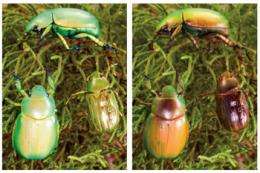
North American jewel scarabs viewed with (right) and without (left) a circularly polarized filter (photographs by John C. Abbott/Abbott Nature Photography ©)

(PhysOrg.com) -- A new study suggests that jewel scarab beetles find each other -- and hide from their enemies -- using the same technology that creates the 3D effects for the blockbuster movie Avatar.

According to researchers from the University of Texas, the jewel scarab species Chrysina gloriosa can distinguish between circularly polarized and unpolarized . That ability could provide the with a tremendous advantage, the researchers say, because most of the light reflected off these beetles’ colorful bodies happens to be circularly polarized.

“The trait would allow the beetles to easily see each other while simultaneously hiding from predators that cannot see circular polarized light,” said physicist Parrish Brady, who conducted the research with Molly Cummings. Their research is published in the May issue of The .

(CP for short) is a way of filtering light that causes the light’s electric field to travel in a circular pattern, as opposed to oscillating in all directions as is does in unpolarized light. CP filters are now used to create 3D effects in movies, such as James Cameron’s Avatar. Human eyes don’t have the ability to perceive CP light, which is why we need special glasses to view films that use CP.

Scientists have known that jewel scarabs reflect CP light since the renowned physicist Albert Michelson discovered it in 1911. But to find out if they can also detect CP light (without the snazzy glasses), Parrish and Cummings took advantage of beetles’ propensity to fly toward light. Through a series of experiments, they tested to see if jewel scarabs alter their flight patterns in the presence of CP light.

“We found significant differences in the beetles’ flights toward circularly polarized and unpolarized light sources, suggesting that their eyes are outfitted to be sensitive to circularly ,” Brady said.

The finding makes Chrysina gloriosa only the second species on Earth known to be sensitive to CP light—the other being a species of shrimp.

Because ability to see CP light is very rare in nature, it’s not likely that any of the beetles’ predators can see it. So the ability to both see and reflect CP light probably evolved to allow jewel scarabs to communicate with each other while staying hidden from predators, but Brady and Cummings are planning more research to see exactly how these beetles use this very rare way of seeing and being seen.

More information: Parrish Brady and Molly Cummings, “Differential Response to Circularly Polarized Light by the Jewel Scarab Beetle Chrysina gloriosa.” The American Naturalist 175:5 (May 2010). http://www.journal … .1086/651593

Provided by University of Chicago (news : web)

4.7 /5 (11 votes)  

Filter


Move the slider to adjust rank threshold, so that you can hide some of the comments.


Display comments: newest first

Megadeth312
Apr 14, 2010

Rank: not rated yet
I could be wrong, but the last time I checked, when I take off 3D glasses, I still see whats on the screen... though I see both images overlapped, because they are being projected on the same surface and are no longer separated by a polarized filter (the glasses), but that doesn't mean it can't be seen...

Doesn't that mean we can see polarized light?
ScientistAmauterEnthusiast
Apr 14, 2010

Rank: not rated yet
You are correct in that we can see polarized light, we just cannot put it into focus ( hence the 3D glasses ).

Maybe we are better at making assumptions from out of focus visual stimuli, to a predator it would just be a blur i am guessing. =]
0o0
Apr 15, 2010

Rank: not rated yet
You are wrong about the focus part. The glasses actually filter out the polarized light which is rotated differently so the right eye only sees the "right" image and the left eye only sees the "left" image. In the case of a 3d movie using polarization 2 different images are both being projected (or interlaced) at on the screen each with the polarized light being rotated differently.
quixoticvixen
Apr 15, 2010

Rank: not rated yet
Minor correction: the other animals to see circularly polarized light aren't shrimp, they're stomatopods (order Stomatopoda).
Rank 4.7 /5 (11 votes)
Related Stories
Relevant PhysicsForums posts
  • Mitosis
    created3 hours ago
  • Stem cell question.
    created4 hours ago
  • Protease cleavage
    created11 hours ago
  • Pertubance in a model
    created17 hours ago
  • Cancer drugs and Alzheimer's, Oh my!
    createdFeb 09, 2012
  • Squishing cells
    createdFeb 09, 2012
  • More from Physics Forums - Biology

More news stories

The power of estrogen -- male snakes attract other males

A new study has shown that boosting the estrogen levels of male garter snakes causes them to secrete the same pheromones that females use to attract suitors, and turned the males into just about the sexiest ...

Biology / Plants & Animals

created 15 hours ago | popularity 4.8 / 5 (6) | comments 1 | with audio podcast

Grass to gas: Researchers' genome map speeds biofuel development

Researchers at the University of Georgia have taken a major step in the ongoing effort to find sources of cleaner, renewable energy by mapping the genomes of two originator cells of Miscanthus x giganteus, a large perenn ...

Biology / Biotechnology

created 12 hours ago | popularity 3.8 / 5 (5) | comments 0 | with audio podcast

Miami battling invasion of giant African snails

No one knows how they got there. But an invasion of African giant snails has southern Florida in a panic over potential crop damage, disease and general yuckiness surrounding the slimy gastropods.

Biology / Ecology

created 19 hours ago | popularity 4 / 5 (1) | comments 4

Experts reveal how plants don't get sunburn

(PhysOrg.com) -- Experts at the University of Glasgow have discovered how plants survive the harmful rays of the sun.

Biology / Cell & Microbiology

created 15 hours ago | popularity 4.8 / 5 (5) | comments 0 | with audio podcast

Protein libraries in a snap

(PhysOrg.com) -- A Rice University undergraduate will depart with not only a degree but also a possible patent for his invention of an efficient way to create protein libraries, an important component of biomolecular ...

Biology / Cell & Microbiology

created 19 hours ago | popularity 4.8 / 5 (4) | comments 1 | with audio podcast


Anonymous knocks CIA website offline (Update)

The website of the Central Intelligence Agency was inaccessible on Friday after the hacker group Anonymous claimed to have knocked it offline.

Google users warned of threat to smartphone wallets

Users of Google smartphone wallets were being warned on Friday that there is a way to crack pass codes intended to thwart thieves from going on illicit shopping sprees.

New error-correcting codes guarantee the fastest possible rate of data transmission

Error-correcting codes are one of the triumphs of the digital age. They’re a way of encoding information so that it can be transmitted across a communication channel — such as an optical fiber o ...

Humans may have helped the decline of African rainforests 3000 years ago

(PhysOrg.com) -- Large areas of rainforests in Central Africa mysteriously disappeared over three thousand years ago, to be replaced by savannas. The prevailing theory has been that the cause was a change ...

New power source discovered

(PhysOrg.com) -- Researchers at the Massachusetts Institute of Technology (MIT) and RMIT University have made a breakthrough in energy storage and power generation.

Small modular reactor design could be a 'SUPERSTAR'

(PhysOrg.com) -- Though most of today's nuclear reactors are cooled by water, we've long known that there are alternatives; in fact, the world's first nuclear-powered electricity in 1951 came from a reactor ...