Giant natural particle accelerator discovered above thunderclouds
April 14, 2010
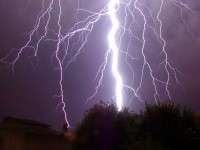
Dr Füllekrug and colleagues have discovered that natural particle accelerators can be formed by lightning storms (Photo by Axel Rouvin)
(PhysOrg.com) -- A lightning researcher at the University of Bath has discovered that during thunderstorms, giant natural particle accelerators can form 40 km above the surface of the Earth.
Dr Martin Füllekrug from the University’s Department of Electronic & Electrical Engineering presented his new work on Wednesday 14 April at the Royal Astronomical Society National Astronomy Meeting (RAS NAM 2010) in Glasgow.
His findings show that when particularly intense lightning discharges in thunderstorms coincide with high-energy particles coming in from space (cosmic rays), nature provides the right conditions to form a giant particle accelerator above the thunderclouds.
The cosmic rays strip off electrons from air molecules and these electrons are accelerated upwards by the electric field of the lightning discharge. The free electrons and the lightning electric field then make up a natural particle accelerator.
The accelerated electrons then develop into a narrow particle beam which can propagate from the lowest level of the atmosphere (the troposphere), through the middle atmosphere and into near-Earth space, where the energetic electrons are trapped in the Earth’s radiation belt and can eventually cause problems for orbiting satellites.
These are energetic events and for the blink of an eye, the power of the electron beam can be as large as the power of a small nuclear power plant.
Dr Füllekrug explained: “The trick to determining the height of one of the natural particle accelerators is to use the radio waves emitted by the particle beam.”
These radio waves were predicted by his co-worker Dr Robert Roussel-Dupré using computer simulations at the Los Alamos National Laboratory supercomputer facility.
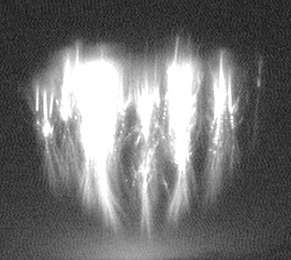
A sprite formed by an intense thunderstorm (Credit: Oscar van der Velde, Universitat de Catalunya, Spain and Serge Soula, Laboratoire d'Aerologie, France)
A team of European scientists, from Denmark, France, Spain and the UK helped to detect the intense lightning discharges in southern France which set up the particle accelerator.They monitored the area above thunderstorms with video cameras and reported lightning discharges which were strong enough to produce transient airglows above thunderstorms known as sprites. A small fraction of these sprites were found to coincide with the particle beams.
The zone above thunderstorms has been a suspected natural particle accelerator since the Scottish physicist and Nobel Prize winner Charles Thomson Rees Wilson speculated about lightning discharges above these storms in 1925.
In the next few years five different planned space missions (the TARANIS, ASIM, CHIBIS, IBUKI and FIREFLY satellites) will be able to measure the energetic particle beams directly.
Dr Füllekrug commented: “It’s intriguing to see that nature creates particle accelerators just a few miles above our heads. Once these new missions study them in more detail from space we should get a far better idea of how they actually work.
“They provide a fascinating example of the interaction between the Earth and the wider Universe.”
-
New satellite observations of terrestrial gamma-ray flashes reveal surprising features of mysterious blasts from Earth
Feb 21, 2005 |
not rated yet |
0
-
Scientists Use High-energy Particles from Space to Probe Thunderstorms
Jun 01, 2009 |
not rated yet |
0
-
Firefly Mission to Study Terrestrial Gamma-ray Flashes
Feb 02, 2010 |
not rated yet |
0
-
Scientists tame electron beams, bringing 'table top' particle accelerators a step closer
Sep 29, 2004 |
not rated yet |
0
-
ALICE particle accelerator achieves energy recovery
Dec 15, 2008 |
not rated yet |
0
-
Engineers build first sub-10-nm carbon nanotube transistor
Feb 01, 2012 |
4.9 / 5 (31) |
30
-
Something old, something new: Evolution and the structural divergence of duplicate genes
Jan 31, 2012 |
4.6 / 5 (7) |
1
-
The hidden nanoworld of ice crystals: Revealing the dynamic behavior of quasi-liquid layers
Jan 30, 2012 |
5 / 5 (3) |
1
-
Stock market network reveals investor clustering
Jan 27, 2012 |
3.9 / 5 (23) |
8
-
Of microchemistry and molecules: Electronic microfluidic device synthesizes biocompatible probes
Jan 26, 2012 |
5 / 5 (1) |
0
-
Discrepancy between oxygen and carbon-dioxide levels
20 hours ago
-
where gems are found in the world
Feb 09, 2012
-
Wind Waves in Reservoir ~ Wind run-up and Wind set-up
Feb 08, 2012
-
Balance of oxygen in the atmosphere
Feb 01, 2012
-
The case for a methanol-based economy
Jan 30, 2012
-
Weather in a rotating cylinder
Jan 25, 2012
- More from Physics Forums - Earth
More news stories
NASA sees wide-eyed cyclone Jasmine
Cyclone Jasmine's eye has opened wider on NASA satellite imagery, as it moves through the Southern Pacific Ocean.
Space & Earth / Earth Sciences
1 hour ago |
not rated yet |
0
NASA sees Giovanna reach cyclone strength, threaten Madagascar
Tropical Storm 12S built up steam and became a cyclone on February 10, 2012 as NASA's Terra satellite passed overhead. Residents of east-central Madagascar should prepare for this cyclone to make landfall ...
Space & Earth / Earth Sciences
1 hour ago |
not rated yet |
0
Humans may have helped the decline of African rainforests 3000 years ago
(PhysOrg.com) -- Large areas of rainforests in Central Africa mysteriously disappeared over three thousand years ago, to be replaced by savannas. The prevailing theory has been that the cause was a change ...
Could Venus be shifting gear?
(PhysOrg.com) -- ESAs Venus Express spacecraft has discovered that our cloud-covered neighbour spins a little slower than previously measured. Peering through the dense atmosphere in the infrared, the ...
Space & Earth / Space Exploration
9 hours ago |
5 / 5 (7) |
7
|
Mars Science Laboratory computer issue resolved
(PhysOrg.com) -- Engineers have found the root cause of a computer reset that occurred two months ago on NASA's Mars Science Laboratory and have determined how to correct it.
Space & Earth / Space Exploration
10 hours ago |
4.7 / 5 (6) |
3
|
Google users warned of threat to smartphone wallets
Users of Google smartphone wallets were being warned on Friday that there is a way to crack pass codes intended to thwart thieves from going on illicit shopping sprees.
CIA website offline, Anonymous takes credit
The website of the Central Intelligence Agency was unresponsive on Friday after the hacker group Anonymous claimed to have knocked it offline.
Complex wiring of the nervous system may rely on a just a handful of genes and proteins
Researchers at the Salk Institute have discovered a startling feature of early brain development that helps to explain how complex neuron wiring patterns are programmed using just a handful of critical genes. ...
Putting the squeeze on planets outside our solar system
(PhysOrg.com) -- Using high-powered lasers, scientists at Lawrence Livermore National Laboratory and collaborators discovered that molten magnesium silicate undergoes a phase change in the liquid state, abruptly ...
The power of estrogen -- male snakes attract other males
A new study has shown that boosting the estrogen levels of male garter snakes causes them to secrete the same pheromones that females use to attract suitors, and turned the males into just about the sexiest ...
New error-correcting codes guarantee the fastest possible rate of data transmission
Error-correcting codes are one of the triumphs of the digital age. Theyre a way of encoding information so that it can be transmitted across a communication channel such as an optical fiber o ...
Apr 14, 2010
Rank: 1 / 5 (4)
Apr 14, 2010
Rank: 5 / 5 (2)
Apr 14, 2010
Rank: not rated yet
Lightning is known to produce gamma and x-rays. Is it possible that some of the discharges are strong enough to produce cosmic ray energy particles?
"Shock-wave and plasma-pinch mechanisms of galactic cosmic-ray production "
http://www.spring...2h82412/