Link between solar activity and the UK's cold winters
April 15, 2010
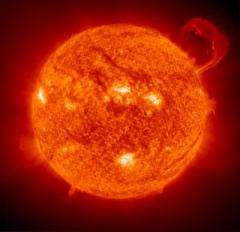
The Sun. Image: SOHO
A link between low solar activity and jet streams over the Atlantic could explain why, despite global warming trends, people in regions North East of the Atlantic Ocean might need to brace themselves for more frequent cold winters in years to come.
A new report published today, Thursday 15 April, in IOP Publishing's Environmental Research Letters describes how we are moving into an era of lower solar activity which is likely to result in UK winter temperatures more like those seen at the end of the seventeenth century.
Lead author Mike Lockwood of the University of Reading said: "This year's winter in the UK has been the 14th coldest in the last 160 years and yet the global average temperature for the same period has been the 5th highest. We have discovered that this kind of anomaly is significantly more common when solar activity is low."
The new paper, 'Are cold winters in Europe associated with low solar activity?', differs from previous efforts to explain the UK's recent cold winters by comparing the most comprehensive, but regionally specific, temperature dataset available (the Central England Temperature dataset) to the long-term behaviour of the Sun's magnetic field, and to trends across the entire Northern Hemisphere.
The paper is being published now as the researchers have just had the opportunity to put this year's data to the test and found that this year's results fit well with the trends they have discovered.
The researchers suggest that the anomaly in Northern Europe's winter temperatures could be to do with a phenomenon called 'blocking'.
'Blocking' is related to the jet stream which brings winds from the west, over the Atlantic, and into Northern Europe but, over the past couple of winters, could have lost its way, for weeks at a time, in an 'anticyclone' before it reaches Europe.
The researchers have found strong correlations between weak solar activity and the occurrences of 'blocking'. As the temperature is affected by a weak Sun so the wind's patterns also change and, as the warmer westerly winds fail to arrive, the UK is hit by north-easterlies from the Arctic.
The researchers, from the Department of Meteorology at the University of Reading, the Science and Technology Facilities Council Space Science and Technology Department, and the Max-Planck Institute for Solar System Research in Katlenburg-Lindau, Germany, are keen to stress the regional and seasonal (European and winter) nature of their research.
Professor Mike Lockwood has explained that the trends do not guarantee colder winters but they do suggest that colder winters will become more frequent. He said: "If we look at the last period of very low solar activity at the end of the seventeenth century, we find the coldest winter on record in 1684 but, for example, the very next year, when solar activity was still low, saw the third warmest winter in the entire 350-year record.
"The results do show however that there are a greater number of cold UK winters when solar activity is low."
More information: The paper can be found in IOP Publishing's open-access journal Environmental Research Letters at http://stacks.iop. … 326/5/024001 .
-
La Niña Anomaly Could Affect Winter Weather in Colorado
Nov 19, 2008 |
not rated yet |
0
-
Rapid changes in the winter climate
Aug 14, 2009 |
not rated yet |
0
-
Past regional cold and warm periods linked to natural climate drivers
Nov 26, 2009 |
not rated yet |
0
-
Impact Of Global Warming On Weather Patterns Underestimated
Sep 22, 2005 |
not rated yet |
0
-
Climate change effects seen in sugar maple
Apr 24, 2006 |
not rated yet |
0
-
Engineers build first sub-10-nm carbon nanotube transistor
Feb 01, 2012 |
4.9 / 5 (30) |
30
-
Something old, something new: Evolution and the structural divergence of duplicate genes
Jan 31, 2012 |
4.6 / 5 (7) |
1
-
The hidden nanoworld of ice crystals: Revealing the dynamic behavior of quasi-liquid layers
Jan 30, 2012 |
5 / 5 (3) |
1
-
Stock market network reveals investor clustering
Jan 27, 2012 |
3.9 / 5 (23) |
8
-
Of microchemistry and molecules: Electronic microfluidic device synthesizes biocompatible probes
Jan 26, 2012 |
5 / 5 (1) |
0
-
Discrepancy between oxygen and carbon-dioxide levels
16 hours ago
-
where gems are found in the world
19 hours ago
-
Wind Waves in Reservoir ~ Wind run-up and Wind set-up
Feb 08, 2012
-
Balance of oxygen in the atmosphere
Feb 01, 2012
-
The case for a methanol-based economy
Jan 30, 2012
-
Weather in a rotating cylinder
Jan 25, 2012
- More from Physics Forums - Earth
More news stories
Could Venus be shifting gear?
(PhysOrg.com) -- ESAs Venus Express spacecraft has discovered that our cloud-covered neighbour spins a little slower than previously measured. Peering through the dense atmosphere in the infrared, the ...
Space & Earth / Space Exploration
4 hours ago |
5 / 5 (5) |
7
|
Humans may have helped the decline of African rainforests 3000 years ago
(PhysOrg.com) -- Large areas of rainforests in Central Africa mysteriously disappeared over three thousand years ago, to be replaced by savannas. The prevailing theory has been that the cause was a change ...
Mars Science Laboratory computer issue resolved
(PhysOrg.com) -- Engineers have found the root cause of a computer reset that occurred two months ago on NASA's Mars Science Laboratory and have determined how to correct it.
Space & Earth / Space Exploration
5 hours ago |
5 / 5 (5) |
3
|
Clam fields found at deep, low-temperature Mariana vents
(PhysOrg.com) -- Scientists have marveled at the unusual life forms thriving at high temperature hydrothermal vents of the deep ocean.
Space & Earth / Earth Sciences
5 hours ago |
not rated yet |
0
|
Two new moons for Jupiter
Advances in technology have lead to the discovery of new planets outside of our Solar System, and now even new moons in our own backyard.
Space & Earth / Space Exploration
4 hours ago |
not rated yet |
2
Putting the squeeze on planets outside our solar system
(PhysOrg.com) -- Using high-powered lasers, scientists at Lawrence Livermore National Laboratory and collaborators discovered that molten magnesium silicate undergoes a phase change in the liquid state, abruptly ...
India probes Google over 'forex transactions'
Indian authorities are probing whether online giant Google broke domestic foreign-exchange transactions rules while shifting funds abroad, the Press Trust of India reported on Friday.
Germany freezes signing of disputed Internet pact
Germany on Friday halted the signing of a controversial international accord billed as a way to beat online piracy that has sparked angry protests, saying it needed more time to consider it.
Health experts, scientists to discuss bird flu studies
The World Health Organization said Friday it will meet next week to determine whether scientists can publish research on a bird flu virus that may be easily passed among humans.
Employers feel no love for unscrupulous practice of 'service sweethearting'
A new study led by two Florida State University marketing professors finds that some frontline service employees who are rewarded for hikes in customer loyalty and satisfaction also may engage in "service ...
Obama forges compromise birth control plan
US President Barack Obama Friday announced a compromise to defuse a row over access to birth control which prompted election-year Republican critics to claim he was waging a war on religion.
Apr 15, 2010
Rank: 2.2 / 5 (10)
What a revolutionary idea!
These heretics should be burned at the stake for spreading such preposterous and outrageous doctrines!
Apr 15, 2010
Rank: 2.9 / 5 (9)
Apr 15, 2010
Rank: 3.1 / 5 (11)
Apr 15, 2010
Rank: 3 / 5 (8)
And cold winters obviously mean Global Warming , innit?
Apr 15, 2010
Rank: 2.2 / 5 (10)
Apr 15, 2010
Rank: 2.8 / 5 (9)
http://www.washin...eadlines
So you were saying?
Apr 15, 2010
Rank: 2.6 / 5 (10)
Tried and found innocent by crooks as well.
Apr 16, 2010
Rank: 2.8 / 5 (4)
the truth always lies somewhere in the middle.
Apr 16, 2010
Rank: 2.3 / 5 (3)
Apr 26, 2010
Rank: 1 / 5 (2)
Well, I for one am not all that surprised. I especially found interesting the following from your link:
The person in charge was funded by the institution to which CRU belongs and also has vested interests in wind energy and Carbon sequestration, both of which become less relevant or at least less pressing if the CRU is found to have committed fraud. I am not surprised at all by their 'clearing' by them.
As to the article, it is pretty much a no-brainer that when solar activity is lower things will cool.
Apr 26, 2010
Rank: 2.3 / 5 (3)
Do you know how I can tell you don't understand the "global" part of AGW?
Apr 27, 2010
Rank: 1 / 5 (2)
Because you are lame and cannot understand my actual stance on the matter no matter how many times I have posted it elsewhere? :)
The signal of the LIA and MWP is found in proxies in both the northern and southern hemisphere. That makes them global in spite of your overeaching desire to elevate Mann to godhood in an Herculean effort to eliminate the MWP and LIA.
But as to the LIA, it is also a no-brainer that glaciation occurs primarily on the northern hemisphere. The signal may appear in other proxies around the globe but it is strongest in the north.
In addition, as you should already know I do not subscribe to AGW but to GW. Climate scientists have yet to convince me to add the A to GW. Climate always is changing and always has. So long as there is water on earth it always will.
Apr 27, 2010
Rank: 3.7 / 5 (3)
Really? So why is it that solar activity has been falling since the '80's and temperatures have been rising....and why is it that whilst the sun has been at its lowest activity temperatures are higher than previously recorded?
This is a rhetorical question by the way, no responses about mangoes and chillies please...has SR lost the plot?
Apr 27, 2010
Rank: 1 / 5 (2)
No, sockpuppets have once again infested this website. Check the _ at the end of the above sockpuppet's username and compare it to my own username.
By the way, temperatures have not been rising globally. In other regions the temps have been falling again. Your 'rhetorical' question does not make much sense in light of the above article regarding cooling in the UK. In addition, it makes even less sense since there is a lag time between lowering solar activity and cooling.
Please try to remember that this last year was the fifth warmest year. If it were the warmest year, you might have had more of a point. :)
Apr 27, 2010
Rank: 2.3 / 5 (3)
Want to know how I know you don't understand statistics?
Apr 27, 2010
Rank: 1 / 5 (2)
Because you are lame and do not understand the subject matter, thinking that someone else misunderstands when the fault lies with you? :)
You never did answer the question in another thread regarding the so-called statistics which alternatively claim second warmest and fifth warmest globally, and which statistical method of which organization is right. Care to try to do so now rather than sockpuppeteering?
Apr 27, 2010
Rank: 2.3 / 5 (3)
Want to know how I know you're an idiot?
Apr 27, 2010
Rank: 1 / 5 (2)
I have only two, the one I used to use (before you misused and abused it via your sockpuppets) and the one I use now. By the way, you are a sockpuppeteer not because you misuse peoples' usernames when irritated with them but because you also have these alternate personas post to each other.
Because you project your own actions and capacities onto others out of habit? :)
Apr 27, 2010
Rank: 2.3 / 5 (3)
Apr 27, 2010
Rank: 1 / 5 (2)
Don't need to. You do it yourself adequately enough. :)
Apr 27, 2010
Rank: 2.3 / 5 (3)
Apr 27, 2010
Rank: 1 / 5 (2)
Already done. I already let them know to check IP addresses, hostnames and usernames when they investigate you. If they find no evidence that you are behind the sockpuppeteering, I will recant and apologize. Not until then, however.
Apr 27, 2010
Rank: 1 / 5 (2)
Apr 27, 2010
Rank: 1 / 5 (2)
Which institution is right? The one that claims 'second warmest' or the ones that claim 'fifth warmest'? Which is the one we should choose and why is it right?
Still waiting... :)
Apr 28, 2010
Rank: 1 / 5 (2)
Apr 30, 2010
Rank: 1 / 5 (2)
Apr 30, 2010
Rank: 1 / 5 (1)