
The Eerie Silence
April 15, 2010 by Leslie Mullen
The open cluster NGC 290 contains hundreds of stars and spans 65 light years across. The vastness of the universe, filled with such a multitude of stars, has led many to conclude that life must be elsewhere. Paul Davies’s new book challenges this view. Image credit: ESA/NASA/University of Arizona/E. Olszewski
Why have we not made contact with aliens after so many years searching the depths of space? The Eerie Silence, a new book by SETI researcher Paul Davies, provides a fresh and thoughtful look at this question.
If aliens exist, where are they?
The physicist Enrico Fermi asked this question 60 years ago, and it has since come to be known as the “Fermi Paradox”. Given how vast the universe is, and the billions of years that life has had to spread across the cosmos, why have we not found any evidence of alien life?
Paul Davies takes a fresh look at this question in his engaging and thoughtful new book, The Eerie Silence.
Davies runs Arizona State University’s Beyond Center for Fundamental Concepts in Science, and he’s involved in the search for extraterrestrial intelligence (SETI). In fact, he is the Chair of the SETI Post-Detection Taskgroup, which has developed a plan for the day we do find life elsewhere.
In his new book, he provides an overview of various efforts to contact aliens, and he also notes how recent discoveries have led to the widespread belief that life must be common in the universe. Hundreds of planets have been detected orbiting distant stars, and while these planets are more like Jupiter than Earth, that’s mostly due to our detection methods. Less massive planets will likely be found by newer telescopes, and the fact that we have already found so many worlds bodes well for the potential number of habitable planets in the galaxy. In addition, life has been discovered in some of the most extreme environments on Earth, including the deep subsurface where sunlight cannot penetrate. This suggests that life is possible in all sorts of unusual places, including planets we once would have considered inhospitable to life.
Davies asks us to step back from the popular view that life must be common in the universe. Instead, he says we should consider the possibility that life on Earth is a fluke, a completely improbable event - a winning ticket in a lottery with a trillion-trillion-to-one odds:
To a physicist like me, life looks to be a little short of magic: all those dumb molecules conspiring to achieve such clever things! How do they do it? There is no orchestrator, no choreographer directing the performance, no esprit de corps, no collective will, no life force - just mindless atoms pushing and pulling on each other, kicked about by random thermal fluctuations. Yet the end product is an exquisite and highly distinctive form of order. Even chemists, who are familiar with the amazing transformative powers of molecules, find it breathtaking. George Whitesides, Professor of Chemistry at Harvard University, writes, “How remarkable is life? The answer is: very. Those of us who deal in networks of chemical reactions know of nothing like it.”

Most of the extrasolar planets found so far are gas giant planets like Jupiter, and are not likely to have life as we know it. Image Credit: NASA/JPL/Space Science Institute
Davies says there is nothing in the laws of chemistry or physics to indicate life is inevitable, or even a cosmic imperative. He notes there is no mathematical regularity to life, revealing some underlying basic law of nature. Instead, “the chemical sequences seem totally haphazard.” And yet, life has its own sense of order, since re-arranging those chemical sequences can upend the whole system.“So the arrangement is at once both random and highly specific - a peculiar, indeed unique, combination of qualities hard to explain by deterministic physical forces,” he writes.
Biology’s law of evolution may have played a role in life’s origin, since all that’s theoretically needed to get the system going is the replication of information. For life today, that replication occurs with DNA, but for the first life, patterns in a physical structure or even particular arrays of atoms may have been enough. While life’s origin from non-living materials is still a mystery, Davies says that life may be one possible outcome of complex self-organizing systems. Just like ant colonies, the stock market and the internet, life may result from a law of increasing complexity that occurs under certain circumstances.
To find out whether life was a bizarre accident unique to Earth, we need to search for life elsewhere. Davies points out that there has only been one successful mission by any space agency to search for life on another planet: NASA’s Viking mission.
“The media tend to present all Mars exploration as part of the search for life, but this is a sly piece of disinformation,” he writes. “It is true that some Mars exploration - looking for water, for example - bears indirectly on the question of life, but explicitly biological experiments have for thirty years been systematically eliminated by NASA missions.”
Most scientists think the Viking life experiments found no proof of life, although some, including Gilbert Levin, who designed Viking’s Labeled Release experiment, contest this conclusion. Even if we were to unquestionably find life on Mars, Davies notes, this wouldn’t tell us if there was life farther afield, since Earth and Mars swapped material back and forth over the history of the solar system. Meteorites striking Earth sent some of our rocks hurtling into space and on to Mars, and vice versa - and some of those rocks could have contained microbial life. .
To really answer the question, we need to find evidence for life on a far-distant planet. However, Davies says another way to prove that life is more than a freak accident is to find a completely different kind of life on Earth.
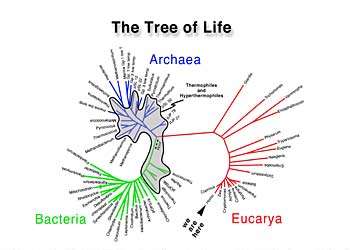
The Tree of Life shows the interconnectedness of all life on Earth. The Tree is divided between major cell types: those with a nucleus (eukaryotes) and without a nucleus (prokaryotes: the bacteria and archaea.)
“If life started more than once on Earth, we could be virtually certain that the universe is teeming with it,” Davies writes. “Unless there is something very peculiar about our planet, it is inconceivable that life would have begun twice on one Earth-like planet but hardly ever on the rest.”All life on Earth can be placed on a diagram called the Tree of Life, which indicates how the various organisms can be traced back to a common ancestor. But a shadow biosphere would be composed of life that would not have a place on the Tree. Davies writes:
If you examine the innards of a microbe, chances are you will find the same stuff - DNA, proteins, ribosomes - as is found in you and me. At least, that has been the experience so far. But microbiologists have only just scratched the surface of the microbial realm. Our world is literally seething with these tiny organisms. Just one cubic centimeter (0.061 cubic inches) of soil might contain millions of different species adding up to billions of microbes in all, and the vast majority haven’t even been classified, let alone analyzed. Nobody knows for sure what they are; for all we know, some of them could be life as we do not know it.
Because scientists must culture microbes in a lab in order to study them, an entirely different form of life would go unnoticed because the tests are custom-made to handle known life forms. Davies says new tests need to be developed to see what might be hidden right in front of our eyes.
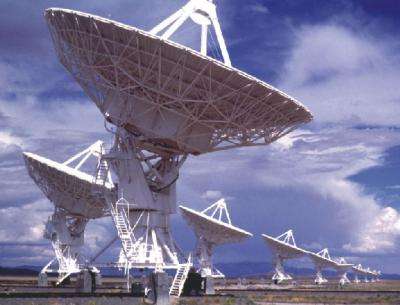
Aliens living more than 100 light years away wouldn’t see evidence for radio technology on Earth, such as the Very Large Array in New Mexico. Image credit: VLA, NRAO
Astrobiologists often say that complex life may be rare in the universe, but microbial life is probably abundant. They base this assumption on Earth’s history, because simple life started relatively quickly here, perhaps within 500 million years after Earth’s origin, but multi-cellular life didn’t appear until much later. The first evidence in the fossil record of multi-cellular life dates back to about 2 billion years ago, some 2.5 billion years after the Earth formed. The story of life on Earth is mostly a saga of single cells.Even if complex life can be found elsewhere, does that mean it will be intelligent? By “intelligent,” we often mean a species that will use science to investigate the universe. Davies again throws cold water on our assumptions, saying the scientific method is a specific outcome of Greek philosophy and medieval European monotheism. Despite this, Davies gamely uses the Drake Equation to estimate there could be 10,000 civilizations in the galaxy capable at this time of communicating by radio waves.
“At this time” is an important element of his estimate, since a barrier to interstellar communications is not only distance but time. Consider aliens living one thousand light years away. Davies points out that if they were able to see Earth in their telescopes, they would not see us as we are today, but as we were in the year 1010 A.D. - long before we invented radio dishes. And because human radio technology is only about 100 years old, it will take another 900 years for our first signals to reach them.
Communication signals on Earth are now mostly sent by optical fibers rather than by radio wavelengths, so Davies says there’s no reason to think advanced aliens would bother with that technology. Instead, he suggests they may use neutrino beams, various wavelength beacons, or a galaxy-wide internet system to communicate. We might even find clues to alien technology closer to home in the form of reproducing nanomachines, or microprobes that latch onto DNA. Davies thinks the SETI search should be expanded to include these, and it also should look for alien ‘footprints’ in space that indicate advanced mining or engineering projects, or waste dump sites.
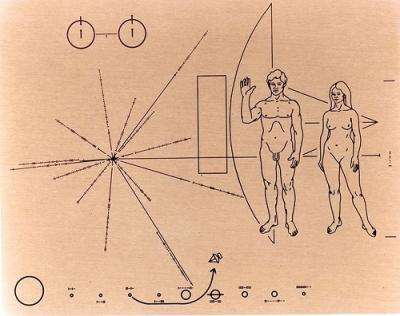
The Pioneer plaques are onboard the Pioneer 10 and 11 spacecraft, which launched in 1972 and 1973. The pictorial message was designed to provide information for aliens about the origin of the spacecraft, and include a human male figure waving “hello.” Image credit: NASA Ames Research Center
One problem with our past searches, says Davies, is we tend to imbue aliens with human motivations and behavior. He is especially critical of previous attempts to craft messages for aliens. The phonographs on the two Voyager spacecraft, which had greetings in 55 languages, as well as music, bird song, and other sounds from Earth, he calls “a pointless gimmick.”Davies is equally dismissive of the plaques on the Pioneer 10 and 11 spacecraft, which depicted male and female human figures (with the male’s hand raised in greeting), and our solar system and its location in the galaxy:
This image may be worthless as far as signaling aliens is concerned, but it speaks volumes about humans. A brief message to an unknown alien community should presumably reflect the things that we consider most significant about ourselves. The picture is dominated by human shapes, yet our physical form is probably the least significant thing we can say. It is almost completely irrelevant both scientifically and culturally. To put it bluntly, who gives a damn what we look like? The raised hand part is the height of absurdity; such a culturally specific mannerism would be utterly incomprehensible to another species, especially one that might not have limbs.
Instead, Davies says our messages should be based on mathematics, preferably containing equations that describe our knowledge of the laws of the universe. By talking about what we may have in common with life elsewhere, true communication can take place. Only later should we share more Earth-centric information.
Davies says if we ever do make contact, human society would be changed forever. He thinks religion would be especially hard-hit. But he also acknowledges that SETI itself has been described as a religion, since it is driven by faith rather than proof. Even if the hunt for aliens comes up empty after a million years of searching, he says that would not be absolute proof that they don’t exist.
As a scientist, Davies says he wouldn't be surprised if life on Earth turns out to be entirely unique. This lonely outlook makes him uneasy, but he also notes this would be a golden silence, because life on Earth would be even more precious if we really are alone.
Still, the fact that we don’t know and may never have the answer about alien life is reason enough to keep searching, says Davies. By stretching our minds to try to envision all the possibilities in our search for aliens, not only may we one day find what we seek, but in the process we also will learn about many other deep and enduring mysteries of the cosmos.
Source: Astrobio.net, by Leslie Mullen
-
Widening the search for extraterrestrial intelligence
Mar 01, 2010 |
not rated yet |
0
-
Cosmologist Paul Davies explores notion of 'alien' life on Earth
Feb 15, 2009 |
not rated yet |
0
-
Channeling your inner alien? Maybe, scientists say (Update)
Jan 26, 2010 |
not rated yet |
0
-
Search for life in space getting closer
Jun 07, 2007 |
not rated yet |
0
-
Life in the universe? Almost certainly. Intelligence? Maybe not
May 12, 2009 |
not rated yet |
0
-
Engineers build first sub-10-nm carbon nanotube transistor
Feb 01, 2012 |
4.9 / 5 (30) |
30
-
Something old, something new: Evolution and the structural divergence of duplicate genes
Jan 31, 2012 |
4.6 / 5 (7) |
1
-
The hidden nanoworld of ice crystals: Revealing the dynamic behavior of quasi-liquid layers
Jan 30, 2012 |
5 / 5 (3) |
1
-
Stock market network reveals investor clustering
Jan 27, 2012 |
3.9 / 5 (23) |
8
-
Of microchemistry and molecules: Electronic microfluidic device synthesizes biocompatible probes
Jan 26, 2012 |
5 / 5 (1) |
0
-
Titan's lack of impact craters
21 hours ago
-
Real pictures of black hole eating a star?
Feb 08, 2012
-
Hypothetical way to travel faster than light, but not technically exceed lightspeed
Feb 06, 2012
-
How do scientists monitor the Sun's activity?
Feb 05, 2012
-
Search patterns in observational studies
Feb 05, 2012
-
Derivation of Pogson's law
Feb 03, 2012
- More from Physics Forums - General Astronomy
More news stories
Mars Science Laboratory computer issue resolved
(PhysOrg.com) -- Engineers have found the root cause of a computer reset that occurred two months ago on NASA's Mars Science Laboratory and have determined how to correct it.
Space & Earth / Space Exploration
43 minutes ago |
5 / 5 (1) |
1
|
Clam fields found at deep, low-temperature Mariana vents
(PhysOrg.com) -- Scientists have marveled at the unusual life forms thriving at high temperature hydrothermal vents of the deep ocean.
Space & Earth / Earth Sciences
18 minutes ago |
not rated yet |
0
|
Streams need trees to withstand climate change
(PhysOrg.com) -- More than twenty years of biological monitoring have confirmed the importance of vegetation for protecting Australia's freshwater streams and rivers against the ravages of drought and climate ...
27 minutes ago |
not rated yet |
0
The turbulent birth of super star clusters in galaxy mergers
By combining two of the most advanced telescopes in the world -- the new Atacama Large Millimeter Array (ALMA) and the Very Large Telescope (VLT) of ESO -- a team of French astronomers from the Institut d'astrophysique ...
9 minutes ago |
not rated yet |
0
Putin receives 'prehistoric' water from Antarctic lake
Prime Minister Vladimir Putin was given a water sample Friday taken from a pristine lake hidden under Antarctic ice for over a million years, after Russian scientists drilled down to its surface.
Space & Earth / Earth Sciences
49 minutes ago |
5 / 5 (1) |
0
A frank discussion of the power law and linking correlation to causation
(PhysOrg.com) -- Michael Stumpf a mathematics professor at Imperial College in London, and Mason Porter a lecturer at Oxford have teamed together to write and publish a perspective piece in Science regarding the in ...
Advanced power-grid model finds low-cost, low-carbon future in West
(PhysOrg.com) -- The least expensive way for the Western U.S. to reduce greenhouse gas emissions enough to help prevent the worst consequences of global warming is to replace coal with renewable and other ...
Small modular reactor design could be a 'SUPERSTAR'
(PhysOrg.com) -- Though most of today's nuclear reactors are cooled by water, we've long known that there are alternatives; in fact, the world's first nuclear-powered electricity in 1951 came from a reactor ...
Seeing colors in music, tasting flavors in shapes may happen in life's early months
Famed violinist Itzhak Perlman sees a deep forest green whenever he plays a B-flat on his Stradivarius' G string. The A on the E string is red.
The question of life in the ancient world
Theres a general feeling that we dont get the Greeks ancient or modern. Many, including heads of state like Angela Merkel, visibly shake their head in exasperation, rightly or wrongly, at ...
Study suggests girls can 'rewire' brains to ward off depression
(Medical Xpress) -- What if you could teach your brain to respond differently to things that make you feel sad, down or stressed out? What if doing that helped ward off depression?


Apr 15, 2010
Rank: 1.7 / 5 (3)
There *is* intelligent life in space, and we are it!
Apr 15, 2010
Rank: 2.7 / 5 (7)
We would expect such civilizations to generally venerate life producing processes and would probably have cataloged life sustaining worlds throughout our galaxy. From this awareness a species would develop gardening and husbandry behaviors and if enduring enough would be evident in their work in encouraging ever higher forms of intelligent life to develop.
A multi-million year old galactic species would probably not communicate by material transmission, but by telepathy or other non-temporal architecture. We will only encounter the constructs of galactic organization when our awareness becomes sufficiently mature to "see" it.
Apr 15, 2010
Rank: 3.8 / 5 (4)
Apr 15, 2010
Rank: 3 / 5 (4)
The key to unlocking the denying minds of men is to rejoice in the simple math of a 1 G expansion into the galaxy. Within a single human lifespan, a 1 G capable vehicle will allow humans to reach any point within our galaxy. The geometric expansion of human colonization at 1 G is humbling and startling.
Apr 15, 2010
Rank: 4.5 / 5 (2)
1 G expansion??? vehicle??
I agree with you to to the telepahy thing. why?? After being around for so long they communicate with telepathy??? I just doubt it... In my humble opinion they probably communicate locally, in the same room, either using a material means or have augmented themselves with technology to communicate in a way that is outside of our understanding that we might call it telepathy but it is just technology. kinda like a guy from 1010 AD would look around and call technology of today magic. Even this seems unlikely if they developed and art of cutural significance around communication -- such as our singing and oration.
And interstellar communication is either by some unknown faster than light method or it doesn;t exist at all because the distances are too great and interference to great to even bother with using the electromagnetic spectrum.
@ winthrom
-- the drake equation has nothing to do with an earthlike planets - just life
Apr 15, 2010
Rank: 5 / 5 (7)
"By "intelligent," we often mean a species that will use science to investigate the universe. Davies again throws cold water on our assumptions, saying the scientific method is a specific outcome of Greek philosophy and medieval European monotheism."
-The scientific method is only a reiteration of how all organisms explore and adapt; they move (postulate), they respond (experiment), they adapt (record). The use of the scientific method marks a structured return to instinctive behavior that Euro monotheism INTERRUPTED for 100s of years for ruinous albeit essential sociopolitical ends.
Necessary or not, religions job is done and its residue only impedes further progress.
The possibility that we have not made contact (if we have it does not follow that us little people would know about it) would tell us how important it is to keep this strain alive. This means spreading it far and wide as quickly as possible.
Apr 15, 2010
Rank: 1 / 5 (3)
Their Task is almost complete. We stand on the verge of a new Great Exodus, a Diaspora which will lift us to the stars.
Thanks Guys.
Apr 15, 2010
Rank: 2 / 5 (6)
I did read, years ago, that SETI did detect purposeful communication from somewhere nearby in space but these signals were quickly jammed from somewhere on earth. Probably just another internet hearsay, BS story.
Remember, this hypothesis is based on a big IF.
Apr 15, 2010
Rank: 3 / 5 (3)
Apr 15, 2010
Rank: 3.7 / 5 (3)
Apr 15, 2010
Rank: 4.3 / 5 (7)
Apr 15, 2010
Rank: 3.9 / 5 (11)
If you break all indisputably "living" organisms down to their ultimate basic interactions, we're simply a self continuing chemical reaction with incredible amounts of complexity. The fundamental difference between something "alive" and something "dead" is nothing more than how resistant to change it is over human timescales.
Well remove the last subjective piece of the puzzle (human timeframes) and what do you get? A entire system of interaction based on energy trading through chemistry.
Life, is not so special when you peel the layers of subjective reasoning away. In some respects the only requirement for life is free energy. Perhaps that's the truth of it. The Universe is alive, and we're simply an organelle comparitively.
Apr 15, 2010
Rank: 2 / 5 (4)
Apr 15, 2010
Rank: 1 / 5 (1)
Apr 15, 2010
Rank: 4 / 5 (1)
Apr 15, 2010
Rank: 4 / 5 (4)
Apr 15, 2010
Rank: 3.3 / 5 (6)
WHY?
If you transmit in ANALOG then you must have an ANALOG receiver to receive the signal.
Same for UHF and VHF and MicroWave etc etc
If people from other planets are smart enough to travel here through the vastness of space in relatively short periods of time, they would CERTAINLY NOT be using our dynosaaur like communication frequencies.
The FACT that NO one actually gets this simple concept astounds me.
At least he got his name in print.
Think about this
The universe is approx 14 billion years old
Our sun approx is 4.5 billion years old
It took us approx 400 million years to get to where we are today biologically
When we send space craft to other planets, we "seed" these planets with bacteria
So
IF just 1 planet evolved just 1 billion years ahead of us, think of the advancements they would have achieved by this stage.
Perhaps our planet was seeded? (joking)
David Venturi
Apr 15, 2010
Rank: 1 / 5 (2)
Apr 16, 2010
Rank: 4.5 / 5 (4)
But, we happen to be here because of those circumstances and so are able to enquire as to why.
Timescale - Universe 13-5 + billion years old - life 3 billion at best. How far might we progress in 20000 yrs let alone a million ? Other life may have progressed way beyond human life and have dissappeared (Local sun expires etc). Also, our radio waves travelling 100 light years would take 200 yrs to receive a response. And .. if any alien life studies us (hence very advanced) I'm surely they would catagorise us a 'dangerous hooligans' (or alien equivalent) and stay well clear
Apr 16, 2010
Rank: 3 / 5 (1)
It is likely that more advanced life can be identified by their energy exploitation level, the most advanced having reached the stage of exploiting all the energy available from the infall onto a supermassive black hole. What we should be searching for is unusually dark (eg. non-energy-emitting) stars, black holes, or perhaps even entire galaxies.
Is our noticing the existence of as-yet unexplainable "dark matter" a clue?
Apr 16, 2010
Rank: not rated yet
http://www.simula...ent.com/
Apr 16, 2010
Rank: 3 / 5 (1)
If it isn't emitting energy we'll never see it.
The hierarchy describes how to class a civilization by it's energy use, it also postulates that a type 1 (which even humans cannot be classed as) will only be able to detect type 1 and below, type 2 will detect type 2 and below, etc..
Apr 16, 2010
Rank: 5 / 5 (2)
Apr 16, 2010
Rank: 4.2 / 5 (6)
Apr 16, 2010
Rank: 5 / 5 (1)
The Eerie Silence, by Paul Davies, Mar 2, 2010
http://physicswor...th/41816
Apr 16, 2010
Rank: 5 / 5 (3)
Apr 16, 2010
Rank: 4 / 5 (2)
Apr 17, 2010
Rank: not rated yet
Life is quite possibly a by-product of self organisation and "inteligence" a further by product.
Cellular structure may also be a by product of this same self organising process. So that all life wherever we may find it may have more in common at a cellular level than it has differences. The outer form of life may vary greatly being governed by its originating conditions.
The idea that life may be seeded might prove to be the only way to spread life throughout the universe.
Whilst we do not have to embrace the idea that we are the product of such seeding we are not in a position to prove we are not.
We need to be less absolute about all things.
I do feel however that in our present state of social and intellectual evolution we are not fit to move beyond our present sphere.
Apr 17, 2010
Rank: not rated yet
Apr 18, 2010
Rank: not rated yet
The evolution of "intelligent" communications technology will quickly lead any alien species to using technologies esentially indistinguishable from noise... we cannot recognize it as communications.
So SETI is only able to recognize as a "signal" EM radiation encoded with techniques that only existed well less than 100 years in societies like our own. A distant star would appear to go "dark" in SETI's eyes after a brief flicker of recognizeable "crude" broadcasts.
SETI's search is futile.
Apr 18, 2010
Rank: not rated yet
from Paul Hellyer, the former Canadian Defense Minister:
http://www.scient...ure.html
Apr 18, 2010
Rank: not rated yet
Then again there is a probability that the implications of this statement might be true.
That's not only eerie but is downright creepy...
Apr 18, 2010
Rank: not rated yet
Apr 18, 2010
Rank: not rated yet
Apr 18, 2010
Rank: not rated yet
Apr 18, 2010
Rank: 1 / 5 (2)
Apr 18, 2010
Rank: 5 / 5 (1)
Apr 18, 2010
Rank: not rated yet
Seriously, would our Leaders really need aliens to teach them the obvious? Study history with this in mind and you will see the Process which prepares us to take our place among the stars. There are never 'sides' in any conflict anymore; there is always only One Side...
Apr 18, 2010
Rank: not rated yet
Apr 18, 2010
Rank: not rated yet
The bottom line is that if advanced civilizations are out there,they know we are here,and have placed earth on a quarantine list,if only to prevent a collapse of our culture if they were to acknowledge their existence.For proof,look what happened to the indigenous cultures when Europeans arrived in North America.
Apr 18, 2010
Rank: 2 / 5 (2)
So what makes you think you and I would know if we had been contacted? There are lots of major things going on on this planet which have been kept very effectively secret for decades if not centuries. A discrete, intelligent probe that knew better than to land on the white house lawn, is all that would be needed to announce their presence. Heck, a transmission at the proper time to the proper people would do it. They would be far better at analyzing our cultures and properly contacting us than we would be with them. I believe that if they're out there, then contact has already been made and the proper Agencies are benefiting from it. Much like precolumbian meso-American cultures were contacted by Phoenicians and Egyptians who were wise enough to keep their mutual existance secret, and so protect each other from disease and incursion. And to restrict trade of destabilizing drugs and precious metals to priests and rulers.
Apr 18, 2010
Rank: not rated yet
Apr 18, 2010
Rank: 5 / 5 (1)
Apr 19, 2010
Rank: 5 / 5 (4)
If I found them on Mars, hell yes I would.
Apr 19, 2010
Rank: 1 / 5 (2)
What I am suggesting is that our violence as it exists today is constructive, and wholly intended to raise us from a primitive state to a state of technological and sociological competence. Violence is absolutely inevitable on an overcrowded world and our biology, coupled with our life-saving technologies, has made it so. A detailed study of the violence in the modern world with this in mind leads one to believe that it is designed, engineered, managed, to improve the human condition. The rewards of planned wars and revolutions are almost unimaginable; one must only imagine that Leaders on both sides of a conflict are actually serving one Authority in order to realize this.
Apr 19, 2010
Rank: not rated yet
The difference is that this conflict is controlled and all that is truly vital is preserved. Populations are managed and their quality is improved which has always been the natural result of competition. Resources are exploited and essential new technologies are developed out of dire necessity. The human store of knowledge, the most precious and irreplaceable thing we posess, is preserved and added to, while in the ancient past it had been destroyed time and again.
We always emerge from these conflicts stronger and more capable of protecting ourselves in a dangerous universe. This alone is compelling evidence that this Process exists.
Apr 19, 2010
Rank: 1 / 5 (1)
Only an alien system of ethics that puts no value on individual life would ever consider violence to be "constructive." Sounds like you've been taking civics from old fashioned human carnivores rather than stellar progenitors.
The emerging system of human oligarchy is NOT the result of progenitor ethics or star-culture wisdom. It's a animal system of carnage designed by animals to harvest local life for their own material purposes. Luciferian ethics like the one you espouse are from such animals.
Galactic progenitor ethics would promote evolution and proliferation, not enslavement and consumption. Their ways are peace, not violence. Liberty and intelligence is the fruit of peace and wisdom. The product of violence is slavery and terror, and it sounds like you've never really tasted it, Otto1923.
Apr 19, 2010
Rank: 1 / 5 (1)
First we should prove to ourselves that the relatively weak radio signals transmitted from extra stellar probes can even be detected by Earth bound receiving stations by dedicating a mission to send one out into the Oort cloud for just that purpose. The little specks of light that we see as stars originate from extremely energetic sources. What makes anyone think that we could detect a four watt radio signal from even the nearest neighbor star? Egads, we are naive.
Apr 19, 2010
Rank: 5 / 5 (1)
Apr 19, 2010
Rank: not rated yet
Quite idealistic and entirely inaccurate.
Simply look at what we do. We don't saddle life for it to thrive, we saddle it so that we may attach tools for exploitation and utilization to our own self beneficial ends. A "Galatic Progentitor" may have seeded this planet so that it could mine the carbon from the Earth. Our electrical generation does that quite well, and it is literally programmed into us to exploit whatever resources we can for self benefit.
Perhaps our God is another being, and perhaps he made us in his image to perform his bidding. If such intelligence exists, stating that intelligence must be benevolent and loving is idiocy of the highest order.
Apr 19, 2010
Rank: not rated yet
Every advance in technology threatens civilization by allowing populations to grow faster and surge farther above that threshold of instability. Technological advance is essential. Consumption drives it. But humanity is inextricably locked in cycles of growth, decay, collapse, and rebirth; and the only way to ensure that there is net GAIN in this equation, and that entropy is overcome, is to Plan it, Direct it, Manage it, and see that it turns out the way you want it to. There is simply no other way, and no other convincing way of explaining the world as it exists today.
You are the one who claims humans are nothing but animals. I believe there are a Few who have managed to rise above this.
Apr 19, 2010
Rank: not rated yet
Apr 19, 2010
Rank: not rated yet
Apr 19, 2010
Rank: not rated yet
"What I am suggesting is that our violence as it exists today is constructive, and wholly intended to raise us from a primitive state to a state of technological and sociological competence".
Up until WWII,that way of thinking had a great deal of validity.After WWII,wars between nuclear armed states will result in wiping out most of the technological progress to date. Think I am exaggerating? In a full scale nuke exchange,most of the world's tech expertise would be lost,along with most records.
Part of the loss would be due to the lack of medical care,with hospitals and doctors largely obliterated,leaving millions of badly injured seeking help from overwhelmed surviving health care workers.Modern civilization as we know it would collapse,leaving only isolated pockets of people struggling with basic survival.
Apr 19, 2010
Rank: 5 / 5 (1)
This phoney mutual threat also put us in space and gave us a computer-based infrastructure, among many many other vital advancements. Controlled competition. Communism/capitalism. Two sides/one coin. Future gens will be thanking us for our foresight.
Apr 19, 2010
Rank: not rated yet
Apr 19, 2010
Rank: not rated yet
Apr 19, 2010
Rank: not rated yet
"The cold war was a sham. There never was a threat of nuclear war".
No threat of nuclear war? Have you been living under some rock? Have you ever heard of the Cuban Missile Crisis? See:http://en.wikiped...e_Crisis
There are other examples you can easily find with a Google search.
The competition you think is required to keep humanity striving can come from the fight against global warming,which promises to be a destabilizing force on a global scale.
Apr 20, 2010
Rank: not rated yet
So you admit it! It is petrified wood! :)
http://www.physor...913.html
Apr 20, 2010
Rank: not rated yet
The Cuban missile crisis was staged to remind the west of just who the 'enemy' was and what they were capable of. We hadn't tangled with the soviets in any meaningful way since Korea, and the Vietnam war was about to begin in earnest. The US public needed a demonstration of why it needed to support another war on the other side of the planet.
Like I say wars are Planned. This includes preparation, to the extent that both Korea and Vietnam were politically divided (as in the Union and Confederacy) north and south to create adversaries. "Divide the people and set them against one another"- it's in the Book of Enoch. They've had lots of practice with this sort of thing.
Apr 20, 2010
Rank: 5 / 5 (1)
No, technology always has progressed. It may not follow the same track each time but our technological sophistication follows Moore's Law perfectly. When you don't need more sophisticated image techniques for weaponry, you'll need them for art and entertainment. When you can grow enough food to feed your family, you now want bigger and better leisure items.
Technology always advances, because there is always a reason to advance technology.
Apr 20, 2010
Rank: not rated yet
Tech devt has been far from steady. In places like china where the use of gunpowder was halted, and Europe in the middle ages, and in the ottoman empire just to name a few, it didnt progress. I believe it was intentionally suppressed because the world was being conquered by Design, and true Leaders were in agreement as to how, and when, and why one culture or another needed to be given the upper hand.
Apr 20, 2010
Rank: not rated yet
@newbeak
McCarthyism served the same purpose as the CMC for the Korean war. There were absolutely communists in govt, universities, and Hollywood, placed there (or unwitting dupes enticed for the purpose). McCarthys secondary message, now lost in the pall of efforts to discredit him, was the need to support the Korean war. After the first year of that war it faded from the media, and the slaughter began. 2-3 million Asians died, and not one public building was left standing in the north. Dams were bombed and a million more starved. Victory. We didn't hear from them for another 50 years.
http://www.google...;q=stage
Apr 20, 2010
Rank: 5 / 5 (1)
Apr 20, 2010
Rank: not rated yet
Apr 20, 2010
Rank: not rated yet
Apr 20, 2010
Rank: not rated yet
Apr 20, 2010
Rank: not rated yet
Apr 28, 2010
Rank: not rated yet
No individuals or groups have that kind of control. There are those who are trying to do so have fooled a large number of people that they can. Their attempt to form a hidden system of collusion away from public awareness was not fully successful. They tried to sneak their way into a centralized global authority structure, but clearly their founding members lack any real genius and their successors are even more degenerate.
Their reign promises to be very short, since their authority derives from the temporary illusion of competence. Natural processes and the consequences of the real will destroy their illusions of control because they rely upon deception and force.
Look at the other attempts to build a global empire. All of them failed and caused destruction. The latest iteration of "total control" is just the same philosophy trying to hide from the public. It will fail the same as the others before it.
May 14, 2010
Rank: 1 / 5 (1)
May 14, 2010
Rank: not rated yet
No, it relies on mathematics and probability.
If life arose here, and there are so many trillions of planets and environments in which life could potentially arise elsewhere, by the law of large numbers the probability that we are alone is less than the probability that we are not alone. Therefore, there is a greater degree of certainty that life exists elsewhere in the Universe than that we're alone.
If you can't follow that, go back to your Bible study.