Stalagmite reveals carbon footprint of early Native Americans
April 15, 2010
Stalagmite reveals carbon footprint of early Native Americans

Enlarge

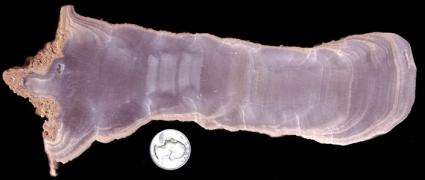
This stalagmite, found in a West Virginia cave, showed a major change in the carbon record at about 100 B.C. (Courtesy Gregory Springer, Ohio University.)

A new study led by Ohio University scientists suggests that early Native Americans left a bigger carbon footprint than previously thought, providing more evidence that humans impacted global climate long before the modern industrial era.

Chemical analysis of a stalagmite found in the mountainous Buckeye Creek basin of West Virginia suggests that native people contributed a significant level of greenhouse gases to the atmosphere through land use practices. The early Native Americans burned trees to actively manage the forests to yield the nuts and fruit that were a large part of their diets.

"They had achieved a pretty sophisticated level of living that I don't think people have fully appreciated," said Gregory Springer, an associate professor of geological sciences at Ohio University and lead author of the study, which was published a recent issue of the journal The Holocene. "They were very advanced, and they knew how to get the most out of the forests and landscapes they lived in. This was all across North America, not just a few locations."

Initially, Springer and research collaborators from University of Texas at Arlington and University of Minnesota were studying historic drought cycles in North America using carbon isotopes in stalagmites. To their surprise, the carbon record contained evidence of a major change in the local ecosystem beginning at 100 B.C. This intrigued the team because an archeological excavation in a nearby cave had yielded evidence of a Native American community there 2,000 years ago.

Springer recruited two Ohio University graduate students to examine stream sediments, and with the help of Harold Rowe of University of Texas at Arlington, the team found very high levels of charcoal beginning 2,000 years ago, as well as a history similar to the stalagmite.

This evidence suggests that Native Americans significantly altered the local ecosystem by clearing and burning forests, probably to make fields and enhance the growth of nut trees, Springer said. This picture conflicts with the popular notion that early Native Americans had little impact on North American landscapes. They were better land stewards than the European colonialists who followed, he said, but they apparently cleared more land and burned more forest than previously thought.

"Long before we were burning fossil fuels, we were already pumping greenhouse gasses into the atmosphere. It wasn't at the same level as today, but it sets the stage," Springer said.

This long-ago land clearing would have impacted global climate, Springer added. Ongoing clearing and burning of the Amazon rainforest, for example, is one of the world's largest sources of emissions. Prehistoric burning by Native Americans was less intense, but a non-trivial source of greenhouse gases to the atmosphere, he said.

Provided by Ohio University (news : web)

3.9 /5 (16 votes)  

Filter


Move the slider to adjust rank threshold, so that you can hide some of the comments.


Display comments: newest first

Bob_Kob
Apr 16, 2010

Rank: 5 / 5 (1)
I don't believe there is any substantial connection between the two. More self bashing..
iknow
Apr 16, 2010

Rank: 1 / 5 (1)
Burning of forests a non-trivial source? ok ...

.. what about millennia of using wood as heating and coal and natural forest fires and volcanoes ... ad infinitum?
muddy
Apr 16, 2010

Rank: 5 / 5 (1)
Am I missing something here? Couldn't higher carbon content in the stalagmites just be caused by the Native Americans burning fires in the cave? If the researchers made the assumption that the air in the cave had the same carbon content as the outside atmosphere then they need to rethink this thing.
archaedude
Apr 22, 2010

Rank: 1 / 5 (1)
I wonder if this will eventually found to be a contributing factor to the Younger Dryas.
XQZME
May 01, 2010

Rank: 3 / 5 (2)
If they are receiving a global warming grant or are seeking one, then their conclusions are not credible.
Rank 3.9 /5 (16 votes)
Relevant PhysicsForums posts
  • Discrepancy between oxygen and carbon-dioxide levels
    created22 hours ago
  • where gems are found in the world
    createdFeb 09, 2012
  • Wind Waves in Reservoir ~ Wind run-up and Wind set-up
    createdFeb 08, 2012
  • Balance of oxygen in the atmosphere
    createdFeb 01, 2012
  • The case for a methanol-based economy
    createdJan 30, 2012
  • Weather in a rotating cylinder
    createdJan 25, 2012
  • More from Physics Forums - Earth

More news stories

NASA sees wide-eyed cyclone Jasmine

Cyclone Jasmine's eye has opened wider on NASA satellite imagery, as it moves through the Southern Pacific Ocean.

Space & Earth / Earth Sciences

created 2 hours ago | popularity not rated yet | comments 1

NASA sees Giovanna reach cyclone strength, threaten Madagascar

Tropical Storm 12S built up steam and became a cyclone on February 10, 2012 as NASA's Terra satellite passed overhead. Residents of east-central Madagascar should prepare for this cyclone to make landfall ...

Space & Earth / Earth Sciences

created 2 hours ago | popularity not rated yet | comments 0

Humans may have helped the decline of African rainforests 3000 years ago

(PhysOrg.com) -- Large areas of rainforests in Central Africa mysteriously disappeared over three thousand years ago, to be replaced by savannas. The prevailing theory has been that the cause was a change ...

Space & Earth / Environment

created 14 hours ago | popularity 4.2 / 5 (9) | comments 10 | with audio podcast report

Could Venus be shifting gear?

(PhysOrg.com) -- ESA’s Venus Express spacecraft has discovered that our cloud-covered neighbour spins a little slower than previously measured. Peering through the dense atmosphere in the infrared, the ...

Space & Earth / Space Exploration

created 10 hours ago | popularity 5 / 5 (7) | comments 7 | with audio podcast

Mars Science Laboratory computer issue resolved

(PhysOrg.com) -- Engineers have found the root cause of a computer reset that occurred two months ago on NASA's Mars Science Laboratory and have determined how to correct it.

Space & Earth / Space Exploration

created 11 hours ago | popularity 4.7 / 5 (6) | comments 3 | with audio podcast


Google users warned of threat to smartphone wallets

Users of Google smartphone wallets were being warned on Friday that there is a way to crack pass codes intended to thwart thieves from going on illicit shopping sprees.

Anonymous knocks CIA website offline (Update)

The website of the Central Intelligence Agency was inaccessible on Friday after the hacker group Anonymous claimed to have knocked it offline.

Complex wiring of the nervous system may rely on a just a handful of genes and proteins

Researchers at the Salk Institute have discovered a startling feature of early brain development that helps to explain how complex neuron wiring patterns are programmed using just a handful of critical genes. ...

Putting the squeeze on planets outside our solar system

(PhysOrg.com) -- Using high-powered lasers, scientists at Lawrence Livermore National Laboratory and collaborators discovered that molten magnesium silicate undergoes a phase change in the liquid state, abruptly ...

New error-correcting codes guarantee the fastest possible rate of data transmission

Error-correcting codes are one of the triumphs of the digital age. They’re a way of encoding information so that it can be transmitted across a communication channel — such as an optical fiber o ...

The power of estrogen -- male snakes attract other males

A new study has shown that boosting the estrogen levels of male garter snakes causes them to secrete the same pheromones that females use to attract suitors, and turned the males into just about the sexiest ...