NASA'S Terra Satellite Captures Ash Plume of Icelandic Volcano
April 15, 2010 by Rob Gutro
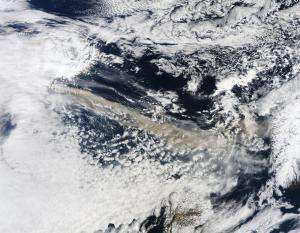
The MODIS instrument on NASA's Terra satellite captured an Ash plume from Eyjafjallajokull Volcano over the North Atlantic at 11:35 UTC (7:35 a.m. EDT) on April 15, 2010. Credit: NASA/MODIS Rapid Response Team
(PhysOrg.com) -- The Eyjafjallajokull volcano in Iceland erupted Wednesday, April 14, for the second time this month. The volcano is still spewing ash into the air and the ash clouds are impacting air travel in Northern Europe.
NASA's Terra satellite flew over the volcano the following day at 11:35 UTC (7:35 a.m. EDT) on April 15, 2010, and the Moderate Resolution Imaging Spectroradiometer, or MODIS instrument onboard Terra captured a visible image of the ash plume from Eyjafjallajokull Volcano.
The MODIS Rapid Response System was developed to provide daily satellite images of the Earth's landmasses in near real time. True-color, photo-like imagery and false-color imagery are available within a few hours of being collected, making the system a valuable resource. The MODIS Rapid Response Team that generates the images is located at NASA's Goddard Space Flight Center in Greenbelt, Md.
NASA works with other agencies on using satellite observations to aid in the detection and monitoring of aviation hazards caused by volcanic ash. For more on this NASA program, visit: http://science.larc.nasa.gov/asap/research-ash.html
-
New satellite image of volcanic ash cloud
Apr 15, 2010 |
not rated yet |
0
-
Scientists to evaluate Icelandic volcano eruption
Mar 22, 2010 |
not rated yet |
0
-
Alaska volcano spews 25,000 feet-high ash plume
Apr 01, 2009 |
not rated yet |
0
-
Alaskan volcano sends ash plume high
Jan 17, 2006 |
not rated yet |
0
-
Ash falls on Anchorage as volcano keeps spewing
Mar 29, 2009 |
not rated yet |
0
-
Engineers build first sub-10-nm carbon nanotube transistor
Feb 01, 2012 |
4.9 / 5 (30) |
30
-
Something old, something new: Evolution and the structural divergence of duplicate genes
Jan 31, 2012 |
4.6 / 5 (7) |
1
-
The hidden nanoworld of ice crystals: Revealing the dynamic behavior of quasi-liquid layers
Jan 30, 2012 |
5 / 5 (3) |
1
-
Stock market network reveals investor clustering
Jan 27, 2012 |
3.9 / 5 (23) |
8
-
Of microchemistry and molecules: Electronic microfluidic device synthesizes biocompatible probes
Jan 26, 2012 |
5 / 5 (1) |
0
-
Discrepancy between oxygen and carbon-dioxide levels
15 hours ago
-
where gems are found in the world
19 hours ago
-
Wind Waves in Reservoir ~ Wind run-up and Wind set-up
Feb 08, 2012
-
Balance of oxygen in the atmosphere
Feb 01, 2012
-
The case for a methanol-based economy
Jan 30, 2012
-
Weather in a rotating cylinder
Jan 25, 2012
- More from Physics Forums - Earth
More news stories
Could Venus be shifting gear?
(PhysOrg.com) -- ESAs Venus Express spacecraft has discovered that our cloud-covered neighbour spins a little slower than previously measured. Peering through the dense atmosphere in the infrared, the ...
Space & Earth / Space Exploration
4 hours ago |
5 / 5 (4) |
6
|
Humans may have helped the decline of African rainforests 3000 years ago
(PhysOrg.com) -- Large areas of rainforests in Central Africa mysteriously disappeared over three thousand years ago, to be replaced by savannas. The prevailing theory has been that the cause was a change ...
Mars Science Laboratory computer issue resolved
(PhysOrg.com) -- Engineers have found the root cause of a computer reset that occurred two months ago on NASA's Mars Science Laboratory and have determined how to correct it.
Space & Earth / Space Exploration
5 hours ago |
5 / 5 (5) |
3
|
Clam fields found at deep, low-temperature Mariana vents
(PhysOrg.com) -- Scientists have marveled at the unusual life forms thriving at high temperature hydrothermal vents of the deep ocean.
Space & Earth / Earth Sciences
4 hours ago |
not rated yet |
0
|
Two new moons for Jupiter
Advances in technology have lead to the discovery of new planets outside of our Solar System, and now even new moons in our own backyard.
Space & Earth / Space Exploration
4 hours ago |
not rated yet |
2
Hovering not hard if you're top-heavy, researchers find
Top-heavy structures are more likely to maintain their balance while hovering in the air than are those that bear a lower center of gravity, researchers at New York University's Courant Institute of Mathematical Sciences ...
Grass to gas: Researchers' genome map speeds biofuel development
Researchers at the University of Georgia have taken a major step in the ongoing effort to find sources of cleaner, renewable energy by mapping the genomes of two originator cells of Miscanthus x giganteus, a large perenn ...
Drug halts organ damage in inflammatory genetic disorder
A new study shows that Kineret (anakinra), a medication approved for the treatment of rheumatoid arthritis, is effective in stopping the progression of organ damage in people with neonatal-onset multisystem inflammatory disease ...
Cochlear implants may be safe, effective for organ transplant patients
Cochlear implants may be a safe, effective option for some organ transplant patients who've lost their hearing as an unfortunate consequence of their transplant-related drug regime, researchers report.
Researchers develop new method for creating tissue engineering scaffolds
Researchers at Northwestern University have developed a new method for creating scaffolds for tissue engineering applications, providing an alternative that is more flexible and less time-intensive than current technology.
Molecular profiling reveals differences between primary and recurrent ovarian cancers
There is a need to analyze tumor specimens at the time of ovarian cancer recurrence, according to a new study published in Molecular Cancer Therapeutics. Researchers used a diagnostic technology called molecular profiling to examine ...